
The Official 2026 UK Highway Code – Free PDF, Audiobook & Podcast
Valid for the 2026. Updated 10/04/2025 >>
The Highway Code
1. General guidance (1 to 6)
1
Pavements and footways (including any path along the side of a road) should be used if provided. Where possible, avoid being next to the kerb with your back to the traffic. If you have to step into the road, look both ways first. Always remain aware of your environment and avoid unnecessary distractions. Always show due care and consideration for others.
2
If there is no pavement, keep to the right-hand side of the road so that you can see oncoming traffic. You should take extra care and
- be prepared to walk in single file, especially on narrow roads or in poor light
- keep close to the side of the road.
It may be safer to cross the road well before a sharp right-hand bend so that oncoming traffic has a better chance of seeing you. Cross back after the bend.
3
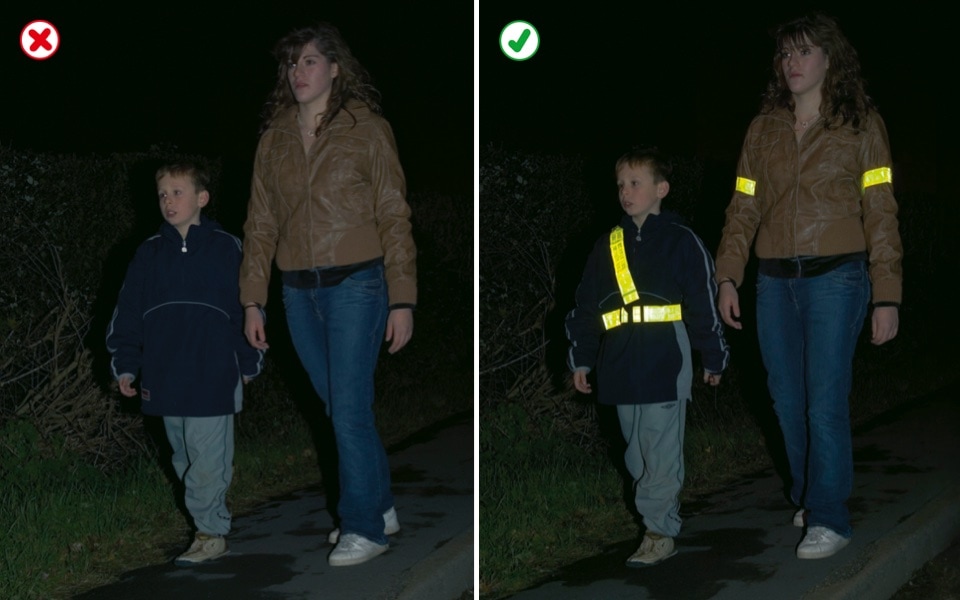
Help other road users to see you. Wear or carry something light-coloured, bright or fluorescent in poor daylight conditions. When it is dark, use reflective materials (e.g. armbands, sashes, waistcoats, jackets, footwear), which can be seen by drivers using headlights up to three times as far away as non-reflective materials.
4
Young children should not be out alone on the pavement or road (see Rule 7). When taking children out, keep between them and the traffic and hold their hands firmly. Strap very young children into push-chairs or use reins. When pushing a young child in a buggy, do not push the buggy into the road when checking to see if it is clear to cross, particularly from between parked vehicles.
5
Organised walks or parades involving large groups of people walking along a road should use a pavement if available; if one is not, they should keep to the left. Look-outs should be positioned at the front and back of the group, and they should wear fluorescent clothes in daylight and reflective clothes in the dark. At night, the look-out in front should show a white light and the one at the back a red light. People on the outside of large groups should also carry lights and wear reflective clothing.
6
Motorways. Pedestrians MUST NOT be on motorways or slip roads except in an emergency (see Rule 271 and Rule 275).
Laws RTRA sect 17, MT(E&W)R 1982 as amended, reg 15(1)(b) & MT(S)R reg 13
2. Crossing the road (7 to 17)
7
The Green Cross Code. The advice given below on crossing the road is for all pedestrians. Children should be taught the Code and should not be allowed out alone until they can understand and use it properly. The age when they can do this is different for each child. Many children cannot judge how fast vehicles are going or how far away they are. Children learn by example, so parents and carers should always use the Code in full when out with their children. They are responsible for deciding at what age children can use it safely by themselves.
A. First find a safe place to cross and where there is space to reach the pavement on the other side. Where there is a crossing nearby, use it. It is safer to cross using a subway, a footbridge, an island, a zebra, pelican, toucan or puffin crossing, or where there is a crossing point controlled by a police officer, a school crossing patrol or a traffic warden. Otherwise choose a place where you can see clearly in all directions. Try to avoid crossing between parked cars (see Rule 14), on a blind bend, or close to the brow of a hill. Move to a space where drivers and riders can see you clearly. Do not cross the road diagonally.
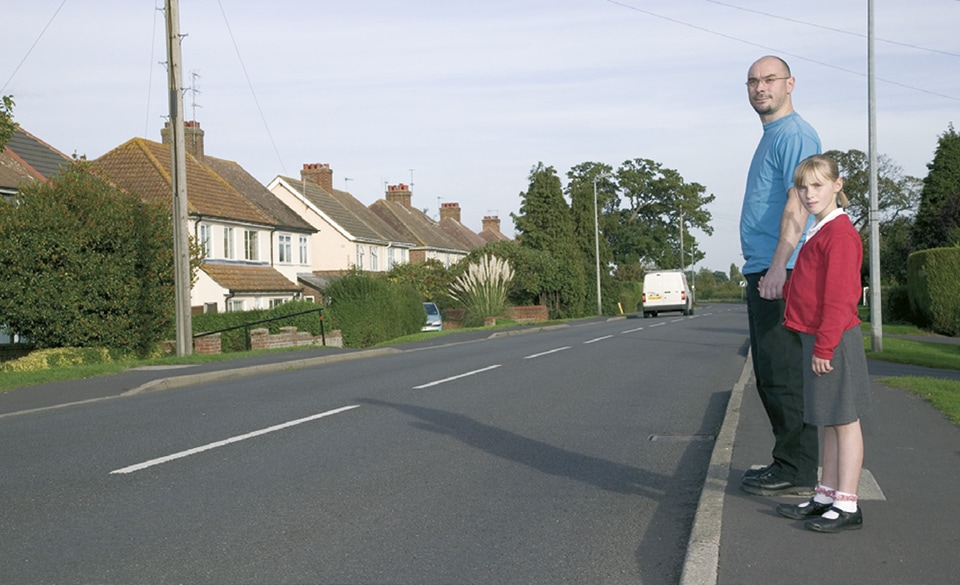
B. Stop just before you get to the kerb, where you can see if anything is coming. Do not get too close to the traffic. If there’s no pavement, keep back from the edge of the road but make sure you can still see approaching traffic.
C. Look all around for traffic and listen. Traffic could come from any direction. Listen as well, because you can sometimes hear traffic before you see it.
D. If traffic is coming, let it pass. Look all around again and listen. Do not cross until there is a safe gap in the traffic and you are certain that there is plenty of time. Remember, even if traffic is a long way off, it may be approaching very quickly.
E. When it is safe, go straight across the road – do not run. Keep looking and listening for traffic while you cross, in case there is any traffic you did not see, or in case other traffic appears suddenly. Look out for cyclists and motorcyclists travelling between lanes of traffic. Do not walk diagonally across the road.
8
At a junction. When you are crossing or waiting to cross the road, other traffic should give way. Look out for traffic turning into the road, especially from behind you, and cross at a place where drivers can see you. If you have started crossing and traffic wants to turn into the road, you have priority and they should give way (see Rules H2 and 170).
9
Pedestrian Safety Barriers. Where there are barriers, cross the road only at the gaps provided for pedestrians. Do not climb over the barriers or walk between them and the road.
10
Tactile paving. Raised surfaces that can be felt underfoot provide warning and guidance to blind or partially sighted people. The most common surfaces are a series of raised studs, which are used at crossing points with a dropped kerb, or a series of rounded raised bars which are used at level crossings, at the top and bottom of steps and at some other hazards.
11
One-way streets. Check which way the traffic is moving. Do not cross until it is safe to do so without stopping. Bus and cycle lanes may operate in the opposite direction to the rest of the traffic.
12
Bus and cycle lanes. Take care when crossing these lanes as traffic may be moving faster than in the other lanes, or against the flow of traffic.
13Routes shared with cyclists. Cycle tracks may run alongside footpaths or pavements and be separated from them by a feature such as a change of material, a verge, a kerb or a white line. Such routes may also incorporate short lengths of tactile paving to help visually impaired people stay on the correct side. On the pedestrian side this may comprise a series of flat-topped bars running across the direction of travel (ladder pattern). On the cyclist side the same bars are orientated in the direction of travel (tramline pattern).
Some routes shared with cyclists will not be separated by such a feature allowing cyclists and pedestrians to share the same space. Cyclists should respect your safety (see Rule 62) but you should also take care not to obstruct or endanger them. Always remain aware of your environment and avoid unnecessary distractions.
Where signs indicate, some routes are shared between pedestrians, cyclists, horse riders and horse drawn vehicles. Cyclists, horse riders and drivers of horse drawn vehicles should respect your safety, but you should take care not to obstruct or endanger them. Always remain aware of your environment and avoid unnecessary distractions.
14
Parked vehicles. If you have to cross between parked vehicles, use the outside edges of the vehicles as if they were the kerb. Stop there and make sure you can see all around and that the traffic can see you. Make sure there is a gap between any parked vehicles on the other side, so you can reach the pavement. Never cross the road in front of, or behind, any vehicle with its engine running, especially a large vehicle, as the driver may not be able to see you.
15
Reversing vehicles. Never cross behind a vehicle which is reversing, showing white reversing lights or sounding a warning.
16
Moving vehicles. You MUST NOT get onto or hold onto a moving vehicle.
Law RTA 1988 sect 26
17
At night. Wear something reflective to make it easier for others to see you (see Rule 3). If there is no pedestrian crossing nearby, cross the road near a street light so that traffic can see you more easily.
3. Crossings (18 to 30)
18
At all crossings. When using any type of crossing you should
- always check that the traffic has stopped before you start to cross or push a pram onto a crossing
- always cross between the studs or over the zebra markings. Do not cross at the side of the crossing or on the zig-zag lines, as it can be dangerous.
You MUST NOT loiter on any type of crossing.
Laws ZPPPCRGD reg 19 & RTRA sect 25(5)
19
Zebra crossings. Give traffic plenty of time to see you and to stop before you start to cross. Vehicles will need more time when the road is slippery. Wait until traffic has stopped from both directions or the road is clear before crossing. Remember that traffic does not have to stop until someone has moved onto the crossing. Drivers and riders should give way to pedestrians waiting to cross and MUST give way to pedestrians on a zebra crossing (see Rule H2). Keep looking both ways, and listening, in case a driver or rider has not seen you and attempts to overtake a vehicle that has stopped.
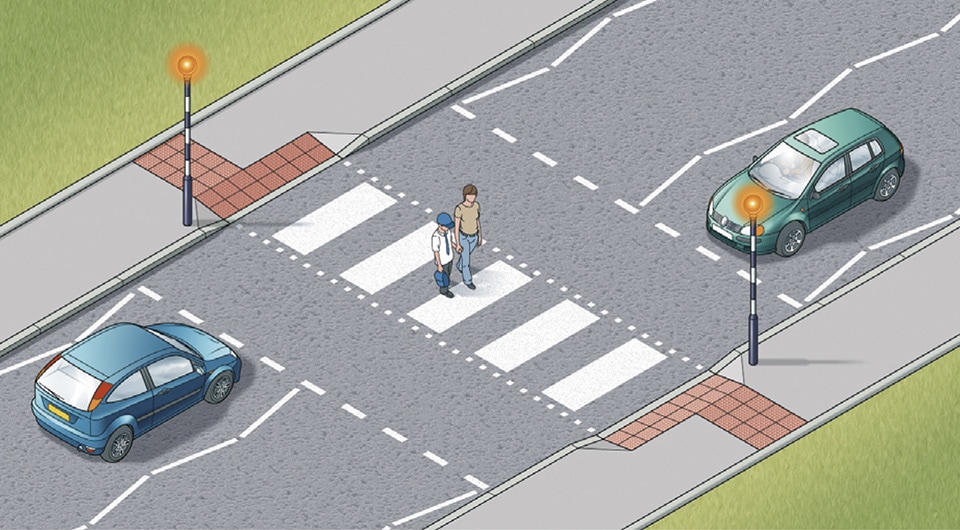
Where there is an island in the middle of a zebra crossing, wait on the island and follow Rule 19 before you cross the second half of the road – it is a separate crossing.
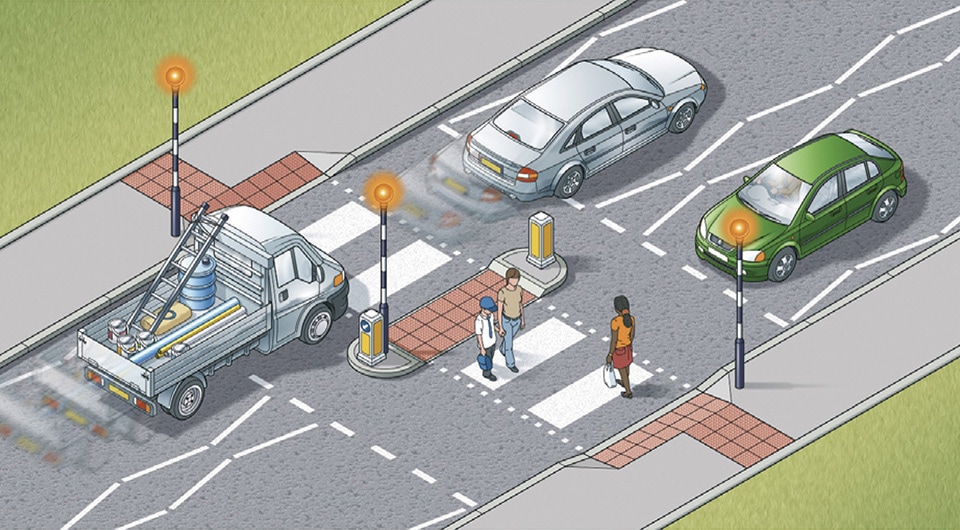
At traffic lights. There may be special signals for pedestrians. You should only start to cross the road when the green figure shows. If you have started to cross the road and the green figure goes out, you should still have time to reach the other side, but do not delay. If no pedestrian signals have been provided, watch carefully and do not cross until the traffic lights are red and the traffic has stopped. Keep looking and check for traffic that may be turning the corner. Remember that traffic lights may let traffic move in some lanes while traffic in other lanes has stopped.
22
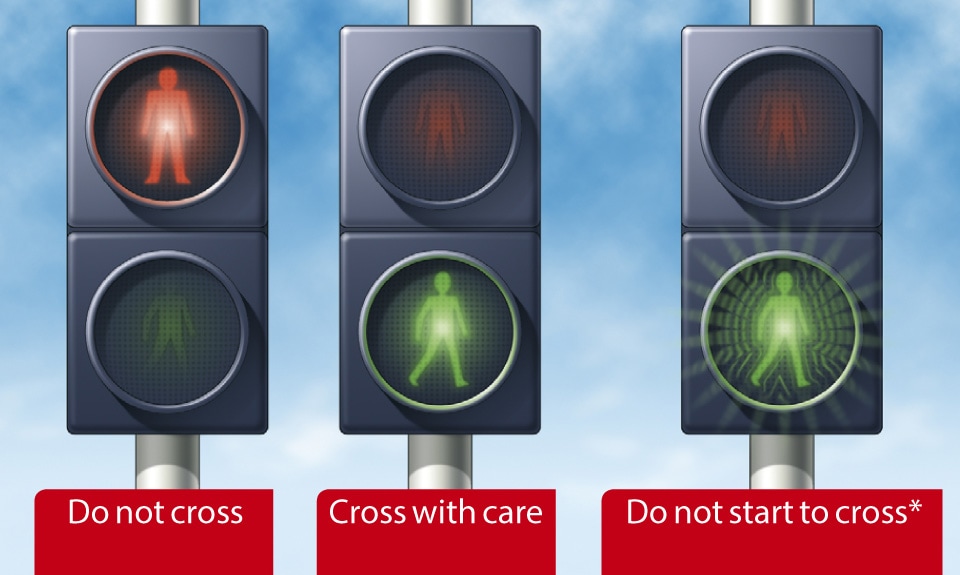
Pelican crossings. These are signal-controlled crossings operated by pedestrians. Push the control button to activate the traffic signals. When the red figure shows, do not cross. When a steady green figure shows, check the traffic has stopped then cross with care. When the green figure begins to flash you should not start to cross. If you have already started you should have time to finish crossing safely.
23
Puffin crossings differ from pelican crossings as the red and green figures are above the control box on your side of the road and there is no flashing green figure phase. Press the button and wait for the green figure to show.
24
When the road is congested, traffic on your side of the road may be forced to stop even though their lights are green. Traffic may still be moving on the other side of the road, so press the button and wait for the signal to cross.
25
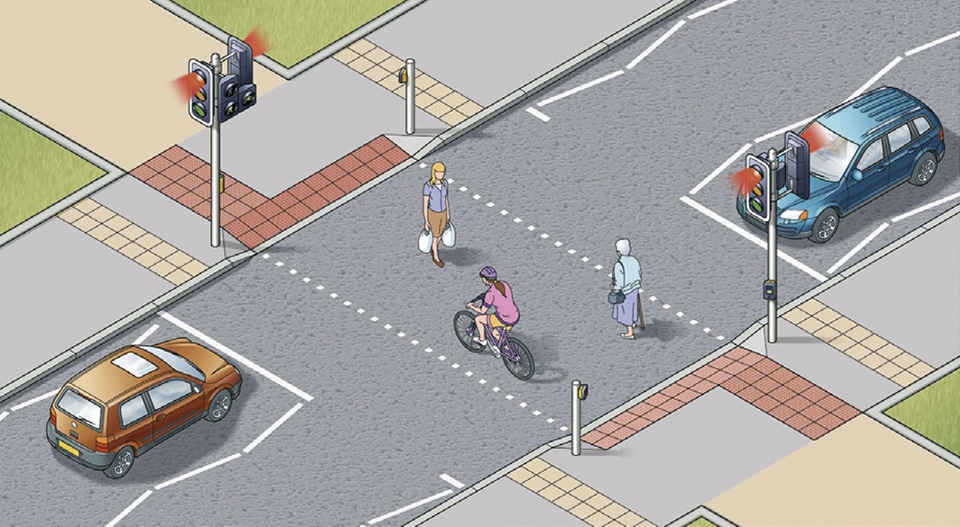
Toucan crossings are light-controlled crossings which allow cyclists and pedestrians to share crossing space and cross at the same time. They are push-button operated. Pedestrians and cyclists will see the green signal together. Cyclists are permitted to ride across.
26
At some crossings there is a bleeping sound or voice signal to indicate to blind or partially sighted people when the steady green figure is showing, and there may be a tactile signal to help deafblind people.
27
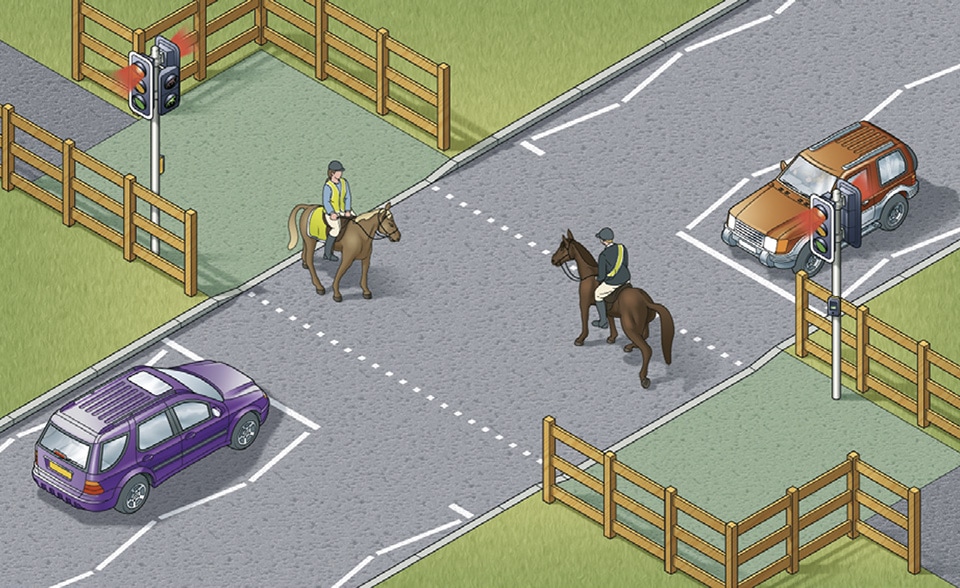
Equestrian crossings are for horse riders. They have pavement barriers, wider crossing spaces, horse and rider figures in the light panels and either two sets of controls (one higher), or just one higher control panel.
28
‘Staggered’ pelican or puffin crossings. When the crossings on each side of the central refuge are not in line they are two separate crossings. On reaching the central island, press the button again and wait for a steady green figure.
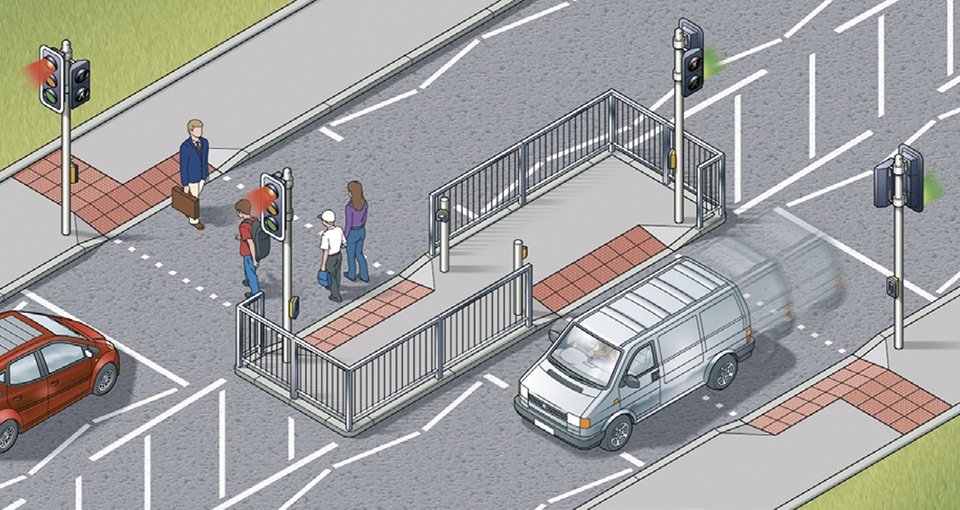
29
Crossings controlled by an authorised person. Do not cross the road unless you are signalled to do so by a police officer, traffic warden or school crossing patrol. Always cross in front of them.
30
Where there are no controlled crossing points available it is advisable to cross where there is an island in the middle of the road. Use the Green Cross Code (see Rule 7) to cross to the island and then stop and use it again to cross the second half of the road.
4. Situations needing extra care (31 to 35)
31
Emergency vehicles. If an ambulance, fire engine, police or other emergency vehicle approaches using flashing blue lights, headlights and/or sirens, keep off the road.
32
Buses. Get on or off a bus only when it has stopped to allow you to do so. Watch out for cyclists when you are getting off. Never cross the road directly behind or in front of a bus. Wait until it has moved off and you can see clearly in both directions.
33
Tramways. These may run through pedestrian areas. Their path will be marked out by shallow kerbs, changes in the paving or other road surface, white lines or yellow dots. Cross at designated crossings where provided. Elsewhere treat trams as you would other road vehicles and look both ways along the track before crossing. Do not walk along the track as trams may come up behind you. Trams move quietly and cannot steer to avoid you.
34
Railway level crossings. You MUST NOT cross or pass a stop line when the red lights show, (including a red pedestrian figure). Also do not cross if an alarm is sounding or the barriers are being lowered. The tone of the alarm may change if another train is approaching. If there are no lights, alarms or barriers, stop, look both ways and listen before crossing. A tactile surface comprising rounded bars running across the direction of pedestrian travel may be installed on the footpath approaching a level crossing to warn visually impaired people of its presence. The tactile surface should extend across the full width of the footway and should be located at an appropriate distance from the barrier or projected line of the barrier.
Law TSRGD, reg 52
35
Street and pavement repairs. A pavement may be closed temporarily because it is not safe to use. Take extra care if you are directed to walk in or to cross the road.
1. Powered wheelchairs and mobility scooters (36 to 37)
36
There is one class of manual wheelchair (called a Class 1 invalid carriage) and two classes of powered wheelchairs and powered mobility scooters. Manual wheelchairs and Class 2 vehicles are those with an upper speed limit of 4 mph (6 km/h) and are designed to be used on pavements. Class 3 vehicles are those with an upper speed limit of 8 mph (12 km/h) and are equipped to be used on the road as well as the pavement.
37
When you are on the road you should obey the guidance and rules for other vehicles; when on the pavement you should follow the guidance and rules for pedestrians.
2. On pavements (38 to 40)
38
Pavements are safer than roads and should be used when available. You should give pedestrians priority and show consideration for other pavement users, particularly those with a hearing or visual impairment who may not be aware that you are there.
39
Powered wheelchairs and scooters MUST NOT travel faster than 4 mph (6 km/h) on pavements or in pedestrian areas. You may need to reduce your speed to adjust to other pavement users who may not be able to move out of your way quickly enough or where the pavement is too narrow.
Law UICHR 1988 reg 4
40
When moving off the pavement onto the road, you should take special care. Before moving off, always look round and make sure it’s safe to join the traffic. Always try to use dropped kerbs when moving off the pavement, even if this means travelling further to locate one. If you have to climb or descend a kerb, always approach it at right angles and don’t try to negotiate a kerb higher than the vehicle manufacturer’s recommendations.
3. On the road (41 to 46)
41
You should take care when travelling on the road as you may be travelling more slowly than other traffic (your machine is restricted to 8 mph (12 km/h) and may be less visible).
42
When on the road, Class 3 vehicles should travel in the direction of the traffic. Class 2 users should always use the pavement when it is available. When there is no pavement, you should use caution when on the road. Class 2 users should, where possible, travel in the direction of the traffic. If you are travelling at night when lights MUST be used, you should travel in the direction of the traffic to avoid confusing other road users.
Law UICHR 1988 reg 9
43
You MUST follow the same rules about using lights, indicators and horns as for other road vehicles, if your vehicle is fitted with them. At night, lights MUST be used. Be aware that other road users may not see you and you should make yourself more visible - even in the daytime and also at dusk - by, for instance, wearing a reflective jacket or reflective strips on the back of the vehicle.
Law UICHR 1988 reg 9
44
Take extra care at road junctions. When going straight ahead, check to make sure there are no vehicles about to cross your path from the left, the right, or overtaking you and turning left. There are several options for dealing with right turns, especially turning from a major road. If moving into the middle of the road is difficult or dangerous, you can - stop on the left-hand side of the road and wait for a safe gap in the traffic - negotiate the turn as a pedestrian, i.e. travel along the pavement and cross the road between pavements where it is safe to do so. Class 3 users should switch the vehicle to the lower speed limit when on pavements.
If the junction is too hazardous, it may be worth considering an alternative route. Similarly, when negotiating major roundabouts (i.e. with two or more lanes) it may be safer for you to use the pavement or find a route which avoids the roundabout altogether.
45
All normal parking restrictions should be observed. Your vehicle should not be left unattended if it causes an obstruction to other pedestrians - especially those in wheelchairs. Parking concessions provided under the Blue Badge scheme (see Further reading) will apply to those vehicles displaying a valid badge.
46
These vehicles MUST NOT be used on motorways (see Rule 253). They should not be used on unrestricted dual carriageways where the speed limit exceeds 50 mph (80 km/h) but if they are used on these dual carriageways, they MUST have a flashing amber beacon. A flashing amber beacon should be used on all other dual carriageways (see Rule 220).
Laws RTRA sect 17(2) & (3), & RVLR reg 17(1) & 26
1. Horse-drawn vehicles (47 to 48)
47
Horse-drawn vehicles used on the highway should be operated and maintained in accordance with standards set out in the Department for Transport’s Code of Practice for Horse-Drawn Vehicles. This Code lays down the requirements for a road driving assessment and includes a comprehensive list of safety checks to ensure that a carriage and its fittings are safe and in good working order. The standards set out in the Road Driving Assessment may be required to be met by a Local Authority if an operator wishes to obtain a local authority licence to operate a passenger-carrying service.
48
Safety equipment and clothing. All horse-drawn vehicles should have two red rear reflectors. It is safer not to drive at night but if you do, a light showing white to the front and red to the rear MUST be fitted.
Law RVLR 1989 reg 4
2. Horse riders (49 to 55)
Safety equipment. Children under the age of 14 MUST wear a helmet which complies with the Regulations. It MUST be fastened securely.
Other riders should also follow these requirements. These requirements do not apply to a child who is a follower of the Sikh religion while wearing a turban.
Laws H(PHYR) Act 1990, sect 1 & H(PHYR) Regulations 1992, reg 3
50
Other clothing. You should wear
- boots or shoes with hard soles and heels
- light-coloured or fluorescent clothing in daylight
- reflective clothing if you have to ride at night or in poor visibility.
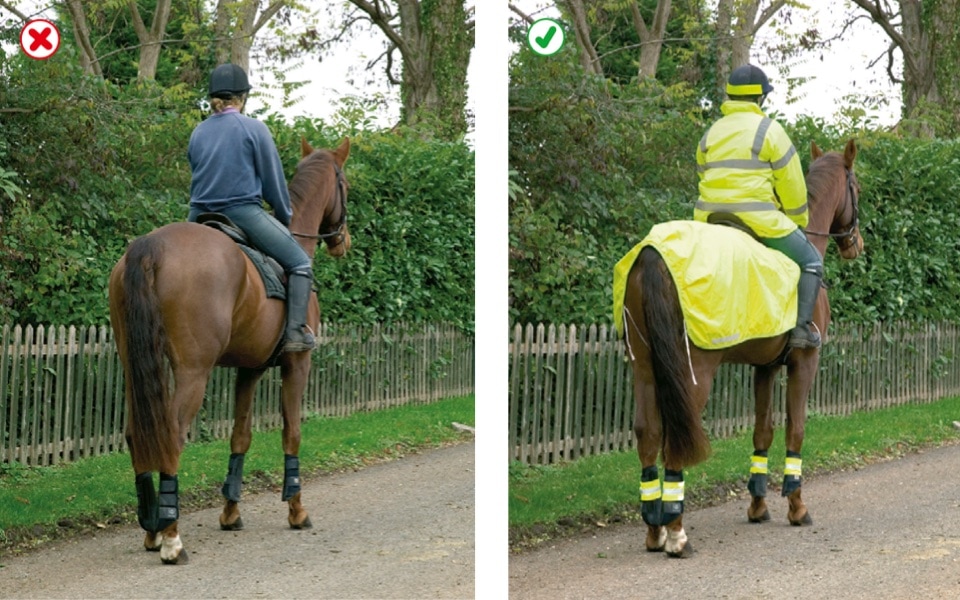
At night. It is safer not to ride on the road at night or in poor visibility, but if you do, make sure you wear reflective clothing and your horse has reflective bands above the fetlock joints. A light which shows white to the front and red to the rear should be fitted, with a band, to the rider’s right arm and/or leg/riding boot. If you are leading a horse at night, carry a light in your right hand, showing white to the front and red to the rear, and wear reflective clothing on both you and your horse. It is strongly recommended that a fluorescent/reflective tail guard is also worn by your horse.
Riding
52Before you take a horse or horse drawn vehicle on to the road, you should
- ensure all tack fits well and is in good condition
- make sure you can control the horse.
If you are an inexperienced horse rider or have not ridden for a while, consider taking the Ride Safe Award from the British Horse Society. The Ride Safe Award provides a foundation for any horse rider to be safe and knowledgeable when riding in all environments but particularly on the road. For more information, see www.bhs.org.uk
Always ride with other, less nervous horses if you think that your horse will be nervous of traffic. Never ride a horse without both a saddle and bridle.
53
Before riding off or turning, look behind you to make sure it is safe, then give a clear arm signal.
When riding on the road you should
- keep to the left
- keep both hands on the reins unless you are signalling
- keep both feet in the stirrups
- not carry another person
- not carry anything which might affect your balance or get tangled up with the reins
- keep a horse you are leading to your left
- move in the direction of the traffic flow in a one-way street
- never ride more than two abreast, and ride in single file on narrow or busy roads and when riding round bends.
You MUST NOT take a horse onto a footpath or pavement, and you should not take a horse onto a cycle track. Use a bridleway where possible. Equestrian crossings may be provided for horse riders to cross the road and you should use these where available (see Crossings). You should dismount at level crossings where a ‘horse rider dismount’ sign is displayed.
Laws HA 1835 sect 72, R(S)A 1984, sect 129(5)
Avoid roundabouts wherever possible. If you use them you should - keep to the left and watch out for vehicles crossing your path to leave or join the roundabout - signal right when riding across exits to show you are not leaving - signal left just before you leave the roundabout.
3. Other animals (56 to 58)
56
Dogs. Do not let a dog out on the road on its own. Keep it on a short lead when walking on the pavement, road or path shared with cyclists or horse riders.
57
When in a vehicle make sure dogs or other animals are suitably restrained so they cannot distract you while you are driving or injure you, or themselves, if you stop quickly. A seat belt harness, pet carrier, dog cage or dog guard are ways of restraining animals in cars.
58
Animals being herded. These should be kept under control at all times. You should, if possible, send another person along the road in front to warn other road users, especially at a bend or the brow of a hill. It is safer not to move animals after dark, but if you do, then wear reflective clothing and ensure that lights are carried (white at the front and red at the rear of the herd).
1. Overview (59 to 71)
These rules are in addition to those in the following sections, which apply to all vehicles (except the motorway section). See also You and your bicycle.
59
Clothing. You should avoid clothes that may get tangled in the chain, or in a wheel or may obscure your lights when you are cycling.
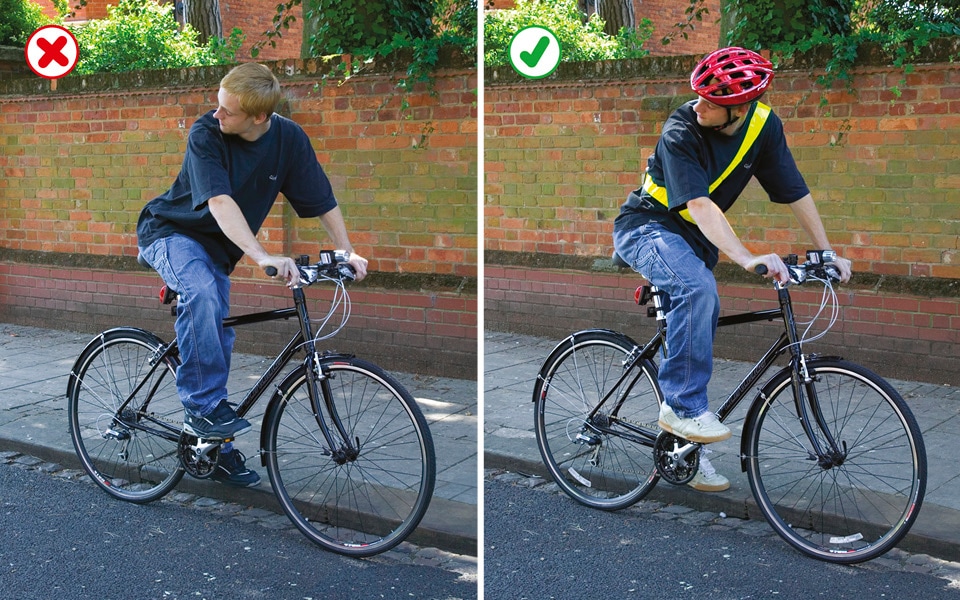
Light-coloured or fluorescent clothing can help other road users to see you in daylight and poor light, while reflective clothing and/or accessories (belt, arm or ankle bands) can increase your visibility in the dark.
You should wear a cycle helmet that conforms to current regulations, is the correct size and securely fastened. Evidence suggests that a correctly fitted helmet will reduce your risk of sustaining a head injury in certain circumstances.
60
At night your cycle MUST have white front and red rear lights lit. It MUST also be fitted with a red rear reflector (and amber pedal reflectors, if manufactured after 1/10/85). White front reflectors and spoke reflectors will also help you to be seen. Flashing lights are permitted but it is recommended that cyclists who are riding in areas without street lighting use a steady front lamp.
Law RVLR regs 13, 18 & 24
61
Cycle Routes and Other Facilities. Cycle lanes are marked by a white line (which may be broken) along the carriageway (see Rule 140). Use facilities such as cycle lanes and tracks, advanced stop lines and toucan crossings (see Rules 62 and 73) where they make your journey safer and easier. This will depend on your experience and skills and the situation at the time. While such facilities are provided for reasons of safety, cyclists may exercise their judgement and are not obliged to use them.
62
Cycle Tracks. These are routes for cyclists that are physically protected or located away from motor traffic, other than where they cross side roads (see Rule 206). Cycle tracks may run alongside footpaths or pavements and be separated by a feature such as a change of material, a verge, a kerb or a white line. You MUST keep to the side intended for cyclists as the pedestrian side remains a pavement or footpath.
Some cycle tracks shared with pedestrians will not be separated by such a feature. On such shared use routes, you should always take care when passing pedestrians, especially children, older or disabled people, and allow them plenty of room. Always be prepared to slow down and stop if necessary (see Rule H2).
63
Sharing space with pedestrians, horse riders and horse drawn vehicles. When riding in places where sharing with pedestrians, horse riders or horse drawn vehicles is permitted, take care when passing pedestrians and horse riders, especially children, older adults or disabled people. Slow down when necessary and let them know you are there; for example, by ringing your bell (it is recommended that a bell is fitted to your bike), or by calling out politely.
Remember that pedestrians may be deaf, blind or partially sighted and that this may not be obvious.
Do not pass pedestrians, horse riders or horse drawn vehicles closely or at high speed, particularly from behind. You should not pass a horse on their left. Remember that horses can be startled if passed without warning. Always be prepared to slow down and stop when necessary.
64
You MUST NOT cycle on a pavement.
Laws HA 1835 sect 72 & R(S)A 1984, sect 129
65
Bus Lanes. Most bus lanes may be used by cyclists as indicated on signs. Watch out for people getting on or off a bus. Be very careful when overtaking a bus or leaving a bus lane as you will be entering a busier traffic flow. Do not pass between the kerb and a bus when it is at a stop.
66You should
- avoid any actions that could reduce your control of your cycle
- be considerate of the needs of other road users when riding in groups. You can ride two abreast and it can be safer to do so, particularly in larger groups or when accompanying children or less experienced riders. Be aware of drivers behind you and allow them to overtake (for example, by moving into single file or stopping) when you feel it is safe to let them do so
- not ride close behind another vehicle in case it stops suddenly
- not carry anything which will affect your balance or may get tangled up with your wheels or chain
- be considerate of other road users, particularly blind and partially sighted pedestrians, and horse riders (see Rule H1). Let them know you are there when necessary, for example, by calling out or ringing your bell if you have one. It is recommended that a bell be fitted.
67You should
- look all around to make sure it is safe before moving away from the kerb, when pulling out to overtake or to pass stationary vehicles, or when turning at junctions or stopping
- watch out for obstructions in the road, such as drains, service covers and potholes, positioning yourself so you can move to the left (as well as to the right) to avoid them safely
- take care when passing parked vehicles, leaving enough room (a door’s width or 1 metre) to avoid being hit if a car door is opened, and watch out for pedestrians stepping into your path
- be aware of traffic coming up behind you, including other cyclists, and give a clear signal to show other road users what you intend to do see ‘Signals to other road users’)
- take extra care near road humps, narrowings and other traffic calming features
- when cycling on the road, only pass to the left of large vehicles when they are stationary or slow moving and you should proceed with caution as the driver may not be able to see you. Be particularly careful on the approach to junctions or where a large vehicle could change lanes to the left.
68
You MUST NOT
- carry a passenger unless your cycle has been built or adapted to carry one
- hold onto a moving vehicle or trailer
- ride in a dangerous, careless or inconsiderate manner
- ride when under the influence of drink or drugs, including medicine.
Law RTA 1988 sects 24, 26, 28, 29 & 30 as amended by RTA 1991
69
You MUST obey all traffic signs and traffic light signals.
Laws RTA 1988 sect 36 & TSRGD Schedule 3 pt 3, sch7 pt4, sch9 pts 4 and 6, sch 13 pt 6, sch 14 pt 2
70
When parking your cycle
- find a conspicuous location where it can be seen by passers-by
- use cycle stands or other cycle parking facilities wherever possible
- do not leave it where it would cause an obstruction or hazard to other road users
- secure it well so that it will not fall over and become an obstruction or hazard.
71At traffic light junctions and at cycle-only crossings with traffic lights, you MUST NOT cross the stop line when the traffic lights are red.
Some junctions have an advanced stop line to enable you to position yourself ahead of other traffic and wait (see Rule 178). When the traffic lights are red, you may cross the first stop line, but you MUST NOT cross the final stop line.
Laws RTA 1988 sect 36 & TSRGD regs 10 & 36(1)
2. Road junctions (72 to 75)
72
Road positioning. When riding on the roads, there are two basic road positions you should adopt, depending on the situation.
1) Ride in the centre of your lane, to make yourself as clearly visible as possible, in the following situations
- on quiet roads or streets – if a faster vehicle comes up behind you, move to the left to enable them to overtake, if you can do so safely
- in slower-moving traffic - when the traffic around you starts to flow more freely, move over to the left if you can do so safely so that faster vehicles behind you can overtake
- at the approach to junctions or road narrowings where it would be unsafe for drivers to overtake you
2) When riding on busy roads, with vehicles moving faster than you, allow them to overtake where it is safe to do so whilst keeping at least 0.5 metres away, and further where it is safer, from the kerb edge. Remember that traffic on most dual carriageways moves quickly. Take extra care crossing slip roads.
73
Junctions. Some junctions, particularly those with traffic lights, have special cycle facilities, including small cycle traffic lights at eye-level height, which may allow you to move or cross separately from or ahead of other traffic. Use these facilities where they make your journey safer and easier.
At junctions with no separate cyclist facilities, it is recommended that you proceed as if you were driving a motor vehicle (see Rules 170 to 190).
Position yourself in the centre of your chosen lane, where you feel able to do this safely, to make yourself as visible as possible and to avoid being overtaken where this would be dangerous. If you do not feel safe to proceed in this way, you may prefer to dismount and wheel your bike across the junction.
74
Turning. When approaching a junction on the left, watch out for vehicles turning in front of you, out of or into the side road. If you intend to turn left, check first for other cyclists or motorcyclists before signalling. Do not ride on the inside of vehicles signalling or slowing down to turn left.
If you are turning right, check the traffic to ensure it is safe, then signal and move to the centre of the road. Wait until there is a safe gap in the oncoming traffic and give a final look before completing the turn. It may be safer to wait on the left until there is a safe gap or to dismount and push your cycle across the road.
When turning into or out of a side road, you should give way to pedestrians crossing or waiting to cross (see Rule H2).
75
Two Stage Turns. At some signal-controlled junctions there may be signs and markings informing cyclists to turn right in two stages:
Stage 1: When the traffic lights turn green, cyclists wishing to make the turn should go straight ahead to the location marked by a cycle symbol and turn arrow on the carriageway; then stop and wait there
Stage 2: When the traffic lights on the far side of the junction, now facing the cyclists, turn green, they should then complete the manoeuvre
3. Roundabouts (76 to 78)
76
Going straight ahead. If you are going straight ahead at a junction, you have priority over traffic waiting to turn into or out of the side road, unless road signs or markings indicate otherwise (see Rule H3). Check that you can proceed safely, particularly when approaching junctions on the left alongside stationary or slow-moving traffic. Watch out for drivers intending to turn across your path. Remember the driver ahead may not be able to see you, so bear in mind your speed and position in the road.
Take great care when deciding whether it is safe to pass stationary or slow-moving lorries and other long vehicles, especially at the approach to junctions, as their drivers may not be able to see you. Remember that they may have to move over to the right before turning left, and that their rear wheels may then come very close to the kerb while turning (see Rule 67).
77
Busy roads. When crossing faster or busy main roads, you may find it safer and easier to
- dismount and push your cycle across
- wait for a safe gap in the traffic before doing so, especially on faster roads and dual carriageways
- make use of traffic islands or central reservations to help you where appropriate.
78
Full details about the correct procedure at roundabouts without cycle facilities are contained in Rules 184 to 190.
Watch out for vehicles crossing your path to leave or join the roundabout, remembering that drivers may not easily see you.
4. Crossing the road (79 to 82)
79
If you are turning right, you can ride in the left or right-hand lanes and move left when approaching your exit. Position yourself in the centre of your lane if it is safe to do so (see Rule 72) and signal right to indicate that you are not leaving the roundabout. Alternatively, you may feel safer walking your cycle round on the pavement or verge.
If you decide to ride round keeping to the left-hand lane you should
- be aware that drivers may not easily see you
- take extra care when cycling across exits. You should signal right to show you are not leaving the roundabout
- watch out for vehicles crossing your path to leave or join the roundabout.
Where a roundabout has separate cycle facilities, you should use these facilities where they make your journey safer and easier although you are not obliged to use them. This will depend on your experience and skills and the situation at the time.
80
Give plenty of room to long vehicles on the roundabout as they need more space to manoeuvre. Do not ride in the space they need to get round the roundabout. It may be safer to wait until they have cleared the roundabout.
81
Do not ride across equestrian crossings, as they are for horse riders only. Do not ride across a pelican, puffin or zebra crossing. Dismount and wheel your cycle across.
Law TSRGD regs 33(2) & 36(1)
82
Crossings. Toucan crossings are light-controlled crossings which allow cyclists and pedestrians to share crossing space and cross at the same time. They are push-button operated. Pedestrians and cyclists will see the green signal together. Cyclists are permitted to ride across.
Cycle tracks on opposite sides of the road may be linked by cycle-only signalled crossings. You may ride across but you MUST NOT cross until the green cycle symbol is showing.
Cycle track crossings can be in spacious pedestrian environments. Cyclists should look out and be prepared to stop for pedestrians crossing the track informally as well as at these designated points.
Take extra care when crossing level crossings and tramways (see Rule 306). You should dismount at level crossings where a ‘cyclist dismount’ sign is displayed.
Annex 1 - You and your bicycle
Make sure that you feel confident of your ability to ride safely on the road. Be sure that
- you choose the right size and type of cycle for comfort and safety
- lights and reflectors are kept clean and in good working order
- tyres are in good condition and inflated to the pressure shown on the tyre
- gears are working correctly
- the chain is properly adjusted and oiled
- the saddle and handlebars are adjusted to the correct height.
It is recommended that you fit a bell to your cycle.
You MUST
- ensure your brakes are efficient
- at night, use lit front and rear lights and have a red rear reflector.
Laws PCUR regs 6 & 10 & RVLR reg 18
Cycle training can help both children and adults, especially those adults returning to cycling to develop the skills needed to cycle safely on today’s roads. A new national cycle training standard has been developed which the Government is promoting and making funding available for delivery in schools.
All cyclists should consider the benefits of undertaking cycle training. For information, contact your local authority.
1. General guidance (83 to 88)
On all journeys, the rider and pillion passenger on a motorcycle, scooter or moped MUST wear a protective helmet. This does not apply to a follower of the Sikh religion while wearing a turban. Helmets MUST comply with the Regulations and they MUST be fastened securely. Riders and passengers of motor tricycles and quadricycles, also called quadbikes, should also wear a protective helmet. Before each journey check that your helmet visor is clean and in good condition.
Laws RTA 1988 sects 16 & 17 & MC(PH)R as amended reg 4
It is also advisable to wear eye protectors, which MUST comply with the Regulations. Scratched or poorly fitting eye protectors can limit your view when riding, particularly in bright sunshine and the hours of darkness. Consider wearing ear protection. Strong boots, gloves and suitable clothing may help to protect you if you are involved in a collision.
Laws RTA sect 18 & MC(EP)R as amended reg 4
You MUST NOT carry more than one pillion passenger who MUST sit astride the machine on a proper seat. They should face forward with both feet on the footrests. You MUST NOT carry a pillion passenger unless your motor cycle is designed to do so. Provisional licence holders MUST NOT carry a pillion passenger.
Laws RTA 1988 sect 23, MV(DL)R 1999 reg 16(6) & CUR 1986 reg 102
Daylight riding. Make yourself as visible as possible from the side as well as the front and rear. You could wear a light or brightly coloured helmet and fluorescent clothing or strips. Dipped headlights, even in good daylight, may also make you more conspicuous. However, be aware that other vehicle drivers may still not have seen you, or judged your distance or speed correctly, especially at junctions.
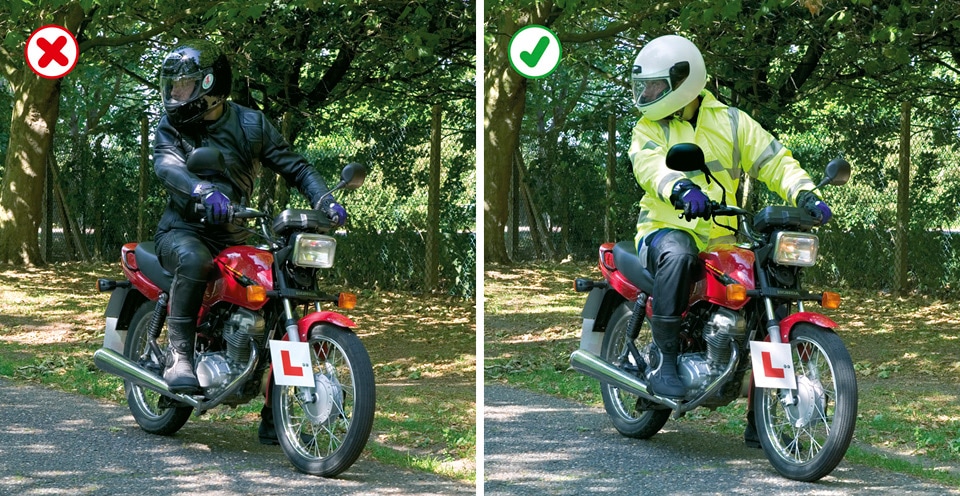
Riding in the dark. Wear reflective clothing or strips to improve your visibility in the dark. These reflect light from the headlamps of other vehicles, making you visible from a longer distance. See Rules 113–116 for lighting requirements.
88
Manoeuvering. You should be aware of what is behind and to the sides before manoeuvring. Look behind you; use mirrors if they are fitted. When in traffic queues look out for pedestrians crossing between vehicles and vehicles emerging from junctions or changing lanes. Position yourself so that drivers in front can see you in their mirrors. Additionally, when filtering in slow-moving traffic, take care and keep your speed low.
Remember: Observation – Signal – Manoeuvre.
2. Motorcycle licence requirements
If you have a provisional motorcycle licence, you MUST satisfactorily complete a Compulsory Basic Training (CBT) course. You can then ride a motorcycle up to 125 cc with a power output not exceeding 11 kW on the public road, with L plates (in Wales either D plates, L plates or both can be used), for up to two years. Under direct access you can practise on a motorcycle that exceeds 125 cc provided that:
- you meet the minimum age for the category concerned
- you’re accompanied at all times by a qualified approved trainer, who is on another motorcycle and in radio contact with you
- fluorescent or reflective safety clothing is worn during supervision
- red L plates (D plates in Wales) are fitted and provisional licence restrictions followed.
To obtain your full motorcycle licence you MUST pass a motorcycle theory test and then a practical test.
Law MV(DL)R regs 16 & 68
A1 motorcycle licence: At age 17 or over, you take a test on a motorcycle without sidecar of between 120 and 125 cc. If you pass you may ride a motorcycle up to 125 cc with power output up to 11 kW, or a motor tricycle with power not exceeding 15 kW.
A2 motorcycle licence: At age 19 or over, you take a test on a motorcycle without sidecar of at least 395 cc with a power output of at least 25 kW but not exceeding 35 kW. If you pass, you may ride any motorcycle not exceeding 35 kW and with a power to weight ratio not exceeding 0.2 kW/kg.
Full A motorcycle licence: Test taken on a motorcycle without sidecar, of at least 595 cc and an engine power of at least 40 kW. This gives you full access to all motorcycles and motor tricycles. You obtain a category A licence by taking progressive access from age 21, or under the direct access scheme from age 24.
Category A under progressive access: You can take a category A practical test at age 21 if you already have an A2 licence that you’ve held for a minimum of two years. You don’t need to take another theory test or hold a CBT certificate.
Category A under direct access: This is for riders aged 24 or over. To obtain a category A licence you must
- successfully complete a CBT course
- pass the motorcycle theory test
- pass the practical motorcycle test.
- Passing the practical test on a motorcycle of at least 40 kW (53.6bhp) gives immediate access to all sizes of motorcycle.
You MUST NOT carry a pillion passenger or pull a trailer until you have passed your test. Also see Rule 253 covering vehicles prohibited from motorways.
Law MV(DL)R reg 16
A moped MUST have an engine capacity not exceeding 50 cc, not weigh more than 250kg and be designed to have a maximum speed not exceeding 28mph (45 km/h). Before June 2003 a licence allowed the riding of mopeds up to 50km/h.
Moped licence requirements
To ride a moped, learners MUST
- be 16 or over
- have a provisional moped licence
- complete CBT training.
You MUST first pass the theory test for motorcycles and then the moped practical test to obtain your full moped licence. If you passed your car driving test before 1 February 2001 you are qualified to ride a moped without L plates (and/or D plates in Wales), although it is recommended that you complete CBT before riding on the road. If you passed your car driving test after this date you MUST complete CBT before riding a moped on the road.
Laws RTA 1988 sects 97(e) & 101 & MV(DL)R regs 38(4) & 43
1. Vehicle condition (89)
89
Vehicle condition. You MUST ensure your vehicle and trailer comply with the full requirements of the Road Vehicles (Construction and Use) Regulations and Road Vehicles Lighting Regulations (see The road user and the law).
2. Fitness to drive (90 to 94)
Make sure that you are fit to drive. You MUST report to the Driver and Vehicle Licensing Agency (DVLA) any health condition likely to affect your driving.
Law RTA 1988 sect 94
91Driving when you are tired greatly increases your risk of collision. To minimise this risk
- make sure you are fit to drive. Do not begin a journey if you are tired. Get sufficient sleep before embarking on a long journey
- avoid undertaking long journeys between midnight and 6 am, when natural alertness is at a minimum
- plan your journey to take sufficient breaks. A minimum break of at least 15 minutes after every two hours of driving is recommended
- if you feel sleepy, stop in a safe place. Do not stop in an emergency area or on a hard shoulder of a motorway (see Rule 262 for guidance on places to take a break when travelling on motorways).
Vision. You MUST be able to read a vehicle number plate, in good daylight, from a distance of 20 metres (or 20.5 metres where the old style number plate is used). If you need to wear glasses (or contact lenses) to do this, you MUST wear them at all times while driving. The police have the power to require a driver to undertake an eyesight test.
Laws RTA 1988 sect 96 & MV(DL)R reg 40 & sch 8
Slow down, and if necessary stop, if you are dazzled by bright sunlight.
At night or in poor visibility, do not use tinted glasses, lenses or visors if they restrict your vision.
3. Alcohol and drugs (95 to 96)
95
Do not drink and drive as it will seriously affect your judgement and abilities.
In England and Wales you MUST NOT drive with a breath alcohol level higher than 35 microgrammes/100 millilitres of breath or a blood alcohol level of more than 80 milligrammes/100 millilitres of blood.
In Scotland the legal limits are lower. You MUST NOT drive with a breath alcohol level higher than 22 microgrammes/100 millilitres of breath or a blood alcohol level of more than 50 milligrammes/100 millilitres of blood.
Alcohol will
- give a false sense of confidence
- reduce co-ordination and slow down reactions
- affect judgement of speed, distance and risk
- reduce your driving ability, even if you’re below the legal limit
- take time to leave your body; you may be unfit to drive in the evening after drinking at lunchtime, or in the morning after drinking the previous evening.
The best solution is not to drink at all when planning to drive because any amount of alcohol affects your ability to drive safely. If you are going to drink, arrange another means of transport.
Laws RTA 1988 sects 4,5 & 11(2), the Road Traffic 1988 PLSR
96
You MUST NOT drive under the influence of drugs or medicine. For medicines, check with your doctor or pharmacist and do not drive if you are advised that you may be impaired.
You MUST NOT drive if you have illegal drugs or certain medicines in your blood above specified limits. It is highly dangerous so never take illegal drugs if you intend to drive; the effects are unpredictable, but can be even more severe than alcohol and result in fatal or serious road crashes. Illegal drugs have been specified at very low levels so even small amounts of use could be above the specified limits. The limits for certain medicines have been specified at higher levels, above the levels generally found in the blood of patients who have taken normal therapeutic doses. If you are found to have a concentration of a drug above its specified limit in your blood because you have been prescribed or legitimately supplied a particularly high dose of medicine, then you can raise a statutory medical defence, provided your driving was not impaired by the medicine you are taking.
Laws RTA 1988 sect 4 & Law RTA 1988 sect 5A
4. Before setting off (97)
97
Before setting off. You MUST ensure that
- you have a valid licence and insurance to drive the vehicle you intend to use (see Annex 3)
- your vehicle is legal and roadworthy (see Annexes 3 and 6 for important vehicle maintenance and safety checks).
You SHOULD ensure that
- you have planned your route and allowed sufficient time for breaks and possible delays
- you have sufficient fuel or charge for your journey, especially if it includes motorway driving
- you know where all the controls are and how to use them
- clothing and footwear do not prevent you using the controls in the correct manner
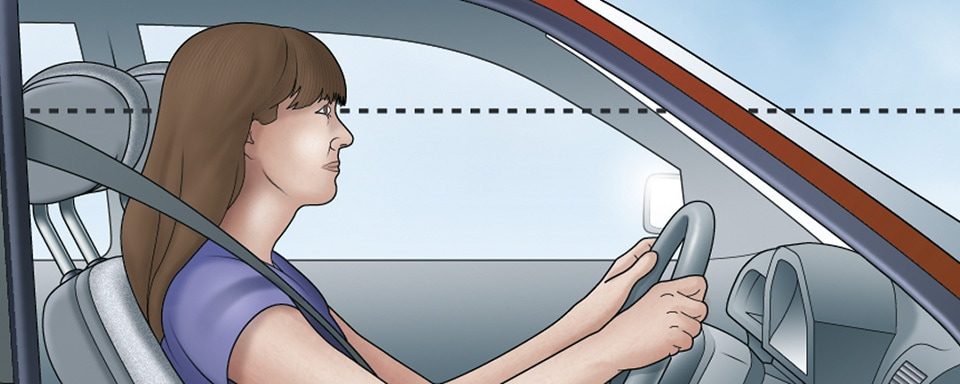
- your mirrors and seat are adjusted correctly to ensure comfort, full control and maximum vision
- head restraints are properly adjusted to reduce the risk of neck and spine injuries in the event of a collision.
It is recommended for emergency use that
- you have a mobile telephone containing emergency contacts (e.g. breakdown assistance)
- you have high-visibility clothing.
5. Vehicle towing and loading (98)
98
Vehicle towing and loading. As a driver
- you MUST NOT tow more than your licence permits. If you passed your car driving test on or after 1 January 1997, you are restricted on the weight of trailer you can tow
- you MUST ensure that both your vehicle and your trailer are in a roadworthy condition. This includes checking that all tyres are legal, the trailer braking system is in full working order and all trailer lights are working correctly
- you MUST NOT overload your vehicle or trailer. You should not tow a weight greater than that recommended by the manufacturer of your vehicle
- you should distribute the weight in your caravan or trailer evenly with heavy items over the axle(s) and ensure a downward load on the tow ball. The manufacturer’s recommended weight and tow ball load should not be exceeded. This should minimise the possibility of swerving or snaking and loss of control
- you MUST secure your load and it MUST NOT stick out dangerously. Make sure any heavy or sharp objects and any animals are secured safely. If there is a collision, they might hit someone inside the vehicle and cause serious injury
- if your vehicle is narrower than your trailer or load, or your trailer or load obstructs your rearward view, then towing mirrors MUST be used
- your trailer MUST be fitted with a secondary coupling device, such as a safety chain
- carrying a load or pulling a trailer may require you to adjust your headlights.
During towing. As a driver
- you should be aware that reduced speed limits apply (see Rule 124)
- you should be aware that your stopping distance may increase significantly when towing (see Rule 126)
- you MUST NOT drive in the right-hand lane on motorways with three or more lanes (see Rule 265)
- if the trailer starts to swerve or snake, or you lose control, ease off the accelerator and reduce speed gently to regain control. Do not brake harshly.
Breakdowns. In the event of a breakdown, be aware
- that towing a vehicle on a tow rope is potentially dangerous. You should consider using a solid tow bar or professional recovery
- it may take longer to build up speed when rejoining a carriageway (see also Rule 278).
6. Seat belts and child restraints (99 to 102)
You MUST wear a seat belt in cars, vans and other goods vehicles if one is fitted (see table below). Adults, and children aged 14 years and over, MUST use a seat belt or child restraint, where fitted, when seated in minibuses, buses and coaches. Exemptions are allowed for the holders of medical exemption certificates and those making deliveries or collections in goods vehicles when travelling less than 50 metres (approx 162 feet).
Laws RTA 1988 sects 14 & 15, MV(WSB)R, MV(WSBCFS)R & MV(WSB)(A)R
Seat Belt Requirements. This table summarises the main legal requirements for wearing seat belts in cars, vans and other goods vehicles.
| Front seat | Rear seat | Who is responsible? | |
|---|---|---|---|
| Driver | Seat belt MUSTbe worn if fitted | - | Driver |
| Child under 3 years of age | Correct child restraint MUSTbe used | Correct child restraint MUST be used. If one is not available in a taxi, may travel unrestrained. | Driver |
| Child from 3rd birthday up to 1.35 metres in height (or 12th birthday, whichever they reach first) | Correct child restraint MUSTbe used | Correct child restraint MUST be used where seat belts fitted. MUST use adult belt if correct child restraint is not available in a licensed taxi or private hire vehicle, or for reasons of unexpected necessity over a short distance, or if two occupied restraints prevent fitment of a third. | Driver |
| Child over 1.35 metres (approx 4ft 5ins) in height or 12 or 13 years | Seat belt MUSTbe worn if available | Seat belt MUST be worn if available | Driver |
| Adult passengers aged 14 and over | Seat belt MUSTbe worn if available | Seat belt MUST be worn if available | Passenger |
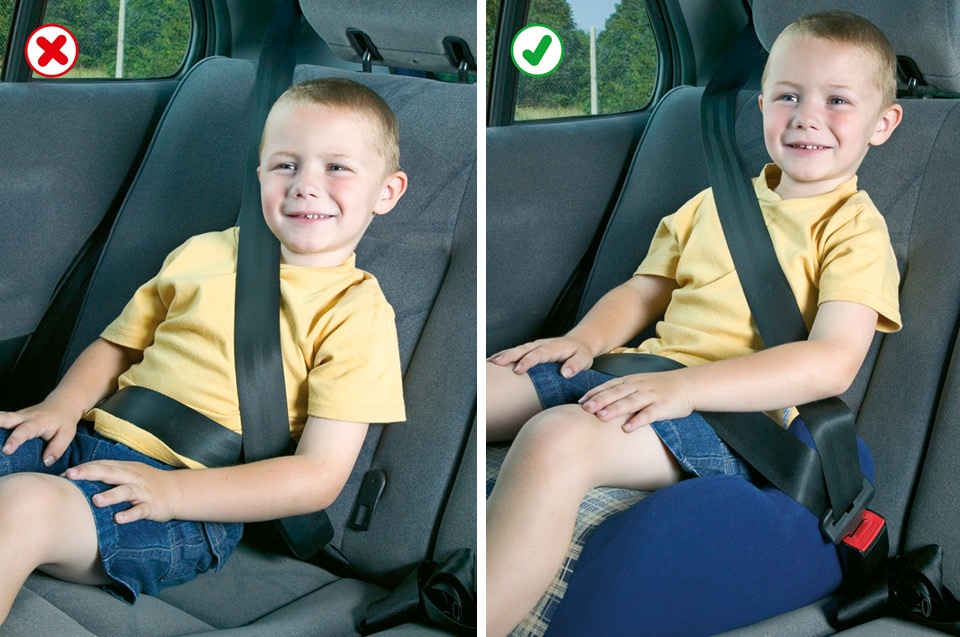
The driver MUST ensure that all children under 14 years of age in cars, vans and other goods vehicles wear seat belts or sit in an approved child restraint where required (see table above). If a child is under 1.35 metres (approx 4 feet 5 inches) tall, a baby seat, child seat, booster seat or booster cushion MUST be used suitable for the child’s weight and fitted to the manufacturer’s instructions.
Laws RTA 1988 sects 14 & 15, MV(WSB)R, MV(WSBCFS)R & MV(WSB)(A)R
A rear-facing baby seat MUST NOT be fitted into a seat protected by an active frontal airbag, as in a crash it can cause serious injury or death to the child.
Laws RTA 1988 sects 14 & 15, MV(WSB)R, MV(WSBCFS)R & MV(WSB)(A)R
102
Children in cars, vans and other goods vehicles. Drivers who are carrying children in cars, vans and other goods vehicles should also ensure that
- children should get into the vehicle through the door nearest the kerb
- child restraints are properly fitted to manufacturer’s instructions
- children do not sit behind the rear seats in an estate car or hatchback, unless a special child seat has been fitted
- the child safety door locks, where fitted, are used when children are in the vehicle
- children are kept under control.
1. Overview
This section should be read by all drivers, motorcyclists, cyclists and horse riders. The rules in The Highway Code do not give you the right of way in any circumstance, but they advise you when you should give way to others. Always give way if it can help to avoid an incident.
2. Signals (103 to 106)
103
Signals warn and inform other road users, including pedestrians (download ‘Signals to other road users’), of your intended actions. You should always
- give clear signals in plenty of time, having checked it is not misleading to signal at that time
- use them to advise other road users before changing course or direction, stopping or moving off
- cancel them after use
- make sure your signals will not confuse others. If, for instance, you want to stop after a side road, do not signal until you are passing the road. If you signal earlier it may give the impression that you intend to turn into the road. Your brake lights will warn traffic behind you that you are slowing down
- use an arm signal to emphasise or reinforce your signal if necessary. Remember that signalling does not give you priority.
104
You should also
- watch out for signals given by other road users and proceed only when you are satisfied that it is safe
- be aware that an indicator on another vehicle may not have been cancelled.
You MUST obey signals given by police officers, traffic officers, traffic wardens (download ‘Signals by authorised persons’) and signs used by school crossing patrols.
Laws RTRA sect 28, RTA 1988 sect 35, TMA 2004 sect 6, & FTWO art 3
106
Police stopping procedures. If the police want to stop your vehicle they will, where possible, attract your attention by
- flashing blue lights, headlights or sounding their siren or horn, usually from behind
- directing you to pull over to the side by pointing and/or using the left indicator.
You MUST then pull over and stop as soon as it is safe to do so. Then switch off your engine.
Law RTA 1988 sect 163
3. Other stopping procedures (107 to 112)
107
Driver and Vehicle Standards Agency Officers have powers to stop vehicles on all roads, including motorways and trunk roads, in England and Wales. They will attract your attention by flashing amber lights
- either from the front requesting you to follow them to a safe place to stop
- or from behind directing you to pull over to the side by pointing and/or using the left indicator.
It is an offence not to comply with their directions. You MUST obey any signals given (download ‘Signals by authorised persons’).
Laws RTA 1988, sect 67, & PRA 2002, sect 41 & sched 5(8)
108
Traffic officers have powers to stop vehicles on most motorways and some ‘A’ class roads, in England and Wales. If traffic officers in uniform want to stop your vehicle on safety grounds (e.g. an insecure load) they will, where possible, attract your attention by
- flashing amber lights, usually from behind
- directing you to pull over to the side by pointing and/or using the left indicator.
You MUST then pull over and stop as soon as it is safe to do so. Then switch off your engine. It is an offence not to comply with their directions (see ‘Signals by authorised persons’).
Traffic light signals and traffic signs. You MUST obey all traffic light signals (download ‘Light signals controlling traffic’) and traffic signs giving orders, including temporary signals & signs (download ‘Traffic signs’). Make sure you know, understand and act on all other traffic and information signs and road markings (download ‘Road markings’ and Vehicle markings’) .
Laws RTA 1988 sect 36 & TSRGD regs 10, 15, 16, 25, 26, 27, 28, 29, 36, 38 & 40
Flashing headlights. Only flash your headlights to let other road users know that you are there. Do not flash your headlights to convey any other message or intimidate other road users.
Never assume that flashing headlights is a signal inviting you to proceed. Use your own judgement and proceed carefully.
112
The horn. Use only while your vehicle is moving and you need to warn other road users of your presence. Never sound your horn aggressively. You MUST NOT use your horn
- while stationary on the road
- when driving in a built-up area between the hours of 11.30 pm and 7.00 am
except when another road user poses a danger.
Law CUR reg 99
4. Lighting requirements (113 to 116)
113
You MUST
- ensure all sidelights and rear registration plate lights are lit between sunset and sunrise
- use headlights at night, except on a road which has lit street lighting. These roads are generally restricted to a speed limit of 30 mph (48 km/h), or 20mph (32km/h) in Wales, unless otherwise specified
- use headlights when visibility is seriously reduced (see Rule 226).
Night (the hours of darkness) is defined as the period between half an hour after sunset and half an hour before sunrise).
Laws RVLR regs 3, 24, & 25, (In Scotland - RTRA 1984 sect 82 (as amended by NRSWA, para 59 of sched 8))
114
You MUST NOT
- use any lights in a way which would dazzle or cause discomfort to other road users, including pedestrians, cyclists and horse riders
- use front or rear fog lights unless visibility is seriously reduced. You MUST switch them off when visibility improves to avoid dazzling other road users (see Rule 226).
In stationary queues of traffic, drivers should apply the parking brake and, once the following traffic has stopped, take their foot off the footbrake to deactivate the vehicle brake lights. This will minimise glare to road users behind until the traffic moves again.
Law RVLR reg 27
115
You should also
- use dipped headlights, or dim-dip if fitted, at night in built-up areas and in dull daytime weather, to ensure that you can be seen
- keep your headlights dipped when overtaking until you are level with the other vehicle and then change to main beam if necessary, unless this would dazzle oncoming road users
- slow down, and if necessary stop, if you are dazzled by oncoming headlights
Hazard warning lights. These may be used when your vehicle is stationary, to warn that it is temporarily obstructing traffic. Never use them as an excuse for dangerous or illegal parking. You MUST NOT use hazard warning lights while driving or being towed unless you are on a motorway or unrestricted dual carriageway and you need to warn drivers behind you of a hazard or obstruction ahead. Only use them for long enough to ensure that your warning has been observed.
Law RVLR reg 27
5. Control of the vehicle (117 to 126)
Braking
In normal circumstances. The safest way to brake is to do so early and lightly. Brake more firmly as you begin to stop. Ease the pressure off just before the vehicle comes to rest to avoid a jerky stop.
In an emergency. Brake immediately. Try to avoid braking so harshly that you lock your wheels. Locked wheels can lead to loss of control.
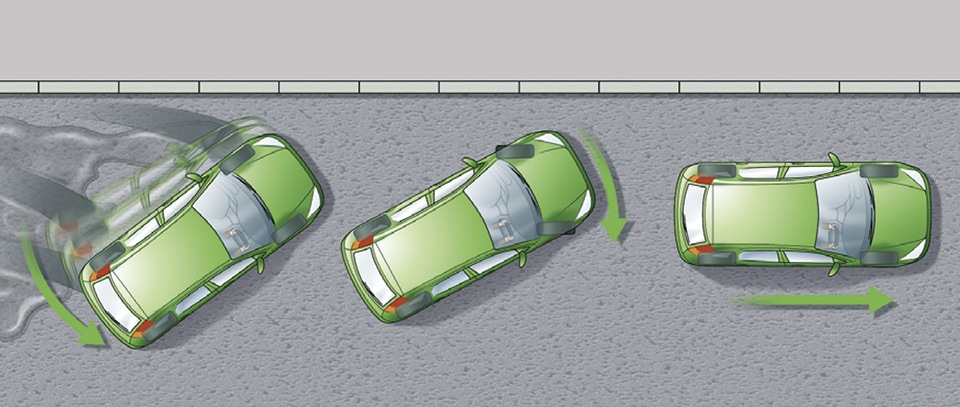
Skids. Skidding is usually caused by the driver braking, accelerating or steering too harshly or driving too fast for the road conditions. If skidding occurs, remove the cause by releasing the brake pedal fully or easing off the accelerator. Turn the steering wheel in the direction of the skid. For example, if the rear of the vehicle skids to the right, steer immediately to the right to recover.
ABS. If your vehicle is fitted with anti-lock brakes, you should follow the advice given in the vehicle handbook. However, in the case of an emergency, apply the footbrake firmly; do not release the pressure until the vehicle has slowed to the desired speed. The ABS should ensure that steering control will be retained, but do not assume that a vehicle with ABS will stop in a shorter distance.
Brakes affected by water. If you have driven through deep water your brakes may be less effective. Test them at the first safe opportunity by pushing gently on the brake pedal to make sure that they work. If they are not fully effective, gently apply light pressure while driving slowly. This will help to dry them out.
122
Coasting. This term describes a vehicle travelling in neutral or with the clutch pressed down. It can reduce driver control because
- engine braking is eliminated
- vehicle speed downhill will increase quickly
- increased use of the footbrake can reduce its effectiveness
- steering response will be affected, particularly on bends and corners
- it may be more difficult to select the appropriate gear when needed.
The Driver and the Environment
You MUST NOT leave a parked vehicle unattended with the engine running or leave a vehicle engine running unnecessarily while that vehicle is stationary on a public road. Generally, if the vehicle is stationary and is likely to remain so for more than a couple of minutes, you should apply the parking brake and switch off the engine to reduce emissions and noise pollution. However it is permissible to leave the engine running if the vehicle is stationary in traffic or for diagnosing faults.
Law CUR regs 98 & 107
Speed limits
You MUST NOT exceed the maximum speed limits for the road and for your vehicle (see the speed limits table). A speed limit of 30 mph (48 km/h), or 20mph (32km/h) in Wales, generally applies to all roads with street lights (excluding motorways) unless signs show otherwise.
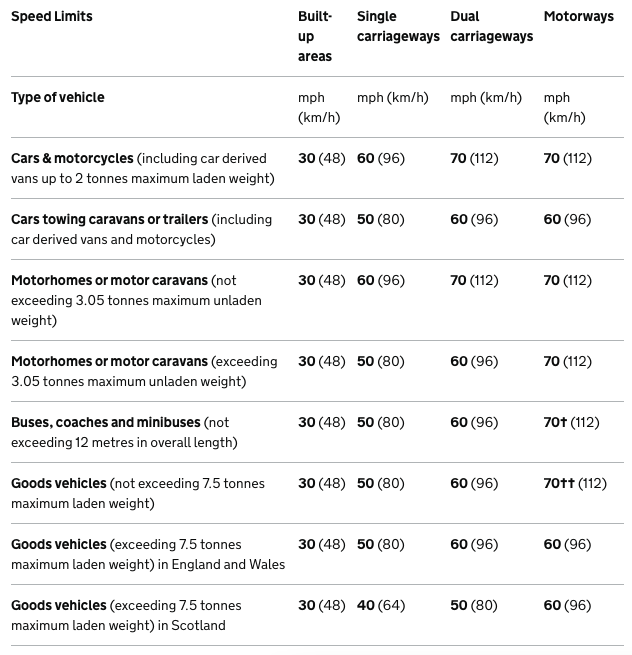
† 60 mph (96 km/h) if exceeding 12 metres in overall length.
†† 60 mph (96 km/h) if articulated or towing a trailer.
For speed limits that apply to special types of vehicles, such as oversized vehicles, see Further reading.
Locally set speed limits may apply, for example
- 20 mph (32 km/h) in some built-up areas
- 50 mph (80 km/h) on single carriageways with known hazards
- variable speed limit signs are used on some motorways and dual carriageways to change the maximum speed limit.
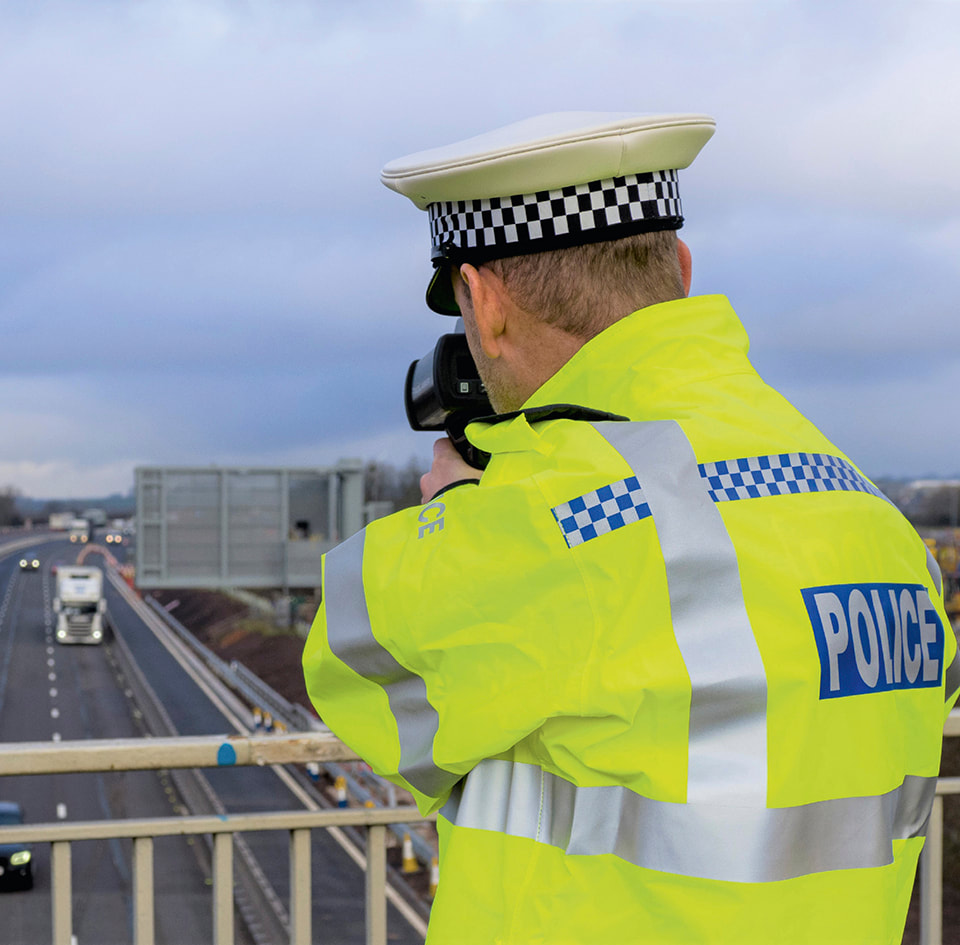
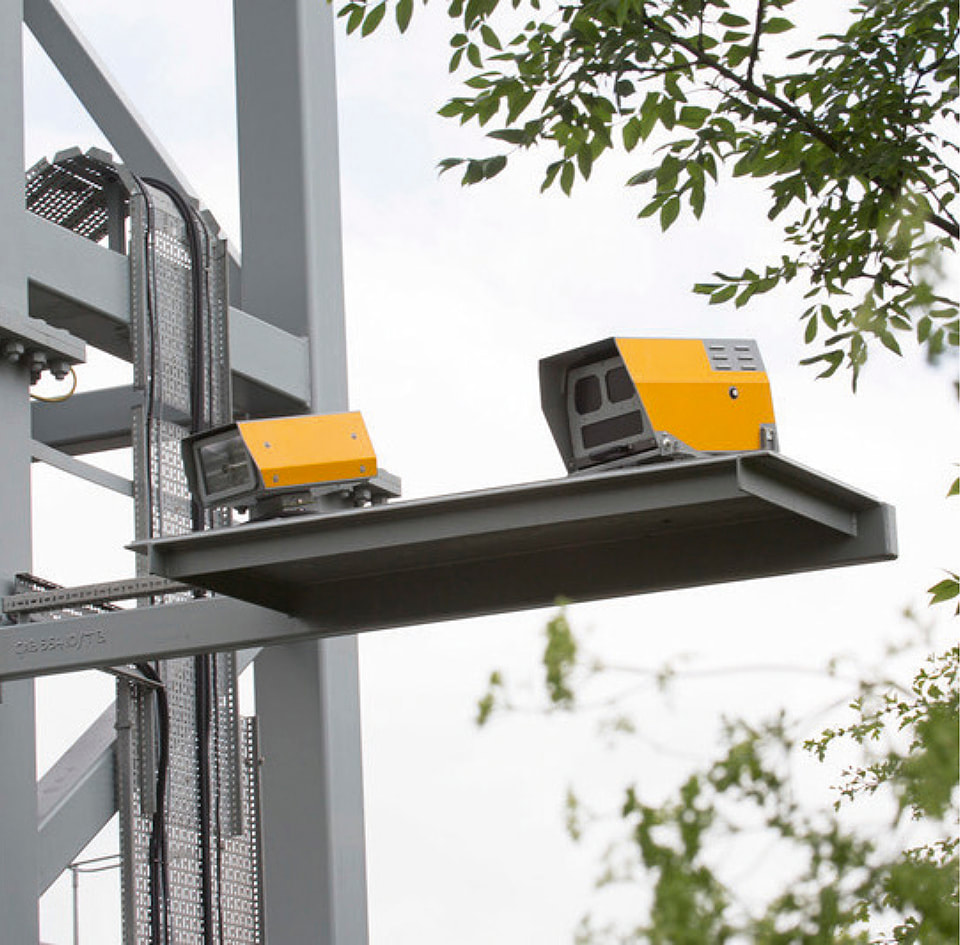
Speed limits are enforced by the police.
125
The speed limit is the absolute maximum and does not mean it is safe to drive at that speed irrespective of conditions. Unsafe speed increases the chances of causing a collision (or being unable to avoid one), as well as its severity. Inappropriate speeds are also intimidating, deterring people from walking, cycling or riding horses. Driving at speeds too fast for the road and traffic conditions is dangerous. You should always reduce your speed when
- the road layout or condition presents hazards, such as bends
- sharing the road with pedestrians, particularly children, older adults or disabled people, cyclists and horse riders, horse drawn vehicles and motorcyclists
- weather conditions make it safer to do so
- driving at night as it is more difficult to see other road users.
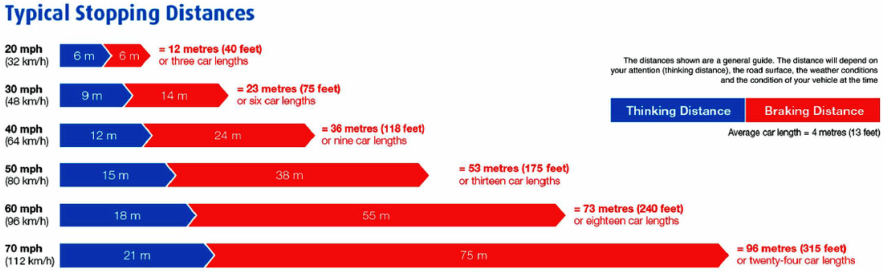
Stopping Distances. Drive at a speed that will allow you to stop well within the distance you can see to be clear. You should
- leave enough space between you and the vehicle in front so that you can pull up safely if it suddenly slows down or stops. The safe rule is never to get closer than the overall stopping distance (see Typical Stopping Distances diagram, shown below)
- allow at least a two-second gap between you and the vehicle in front on roads carrying faster-moving traffic and in tunnels where visibility is reduced. The gap should be at least doubled on wet roads and increased still further on icy roads
- remember, large vehicles and motorcycles need a greater distance to stop. If driving a large vehicle in a tunnel, you should allow a four-second gap between you and the vehicle in front.
If you have to stop in a tunnel, leave at least a 5-metre gap between you and the vehicle in front.
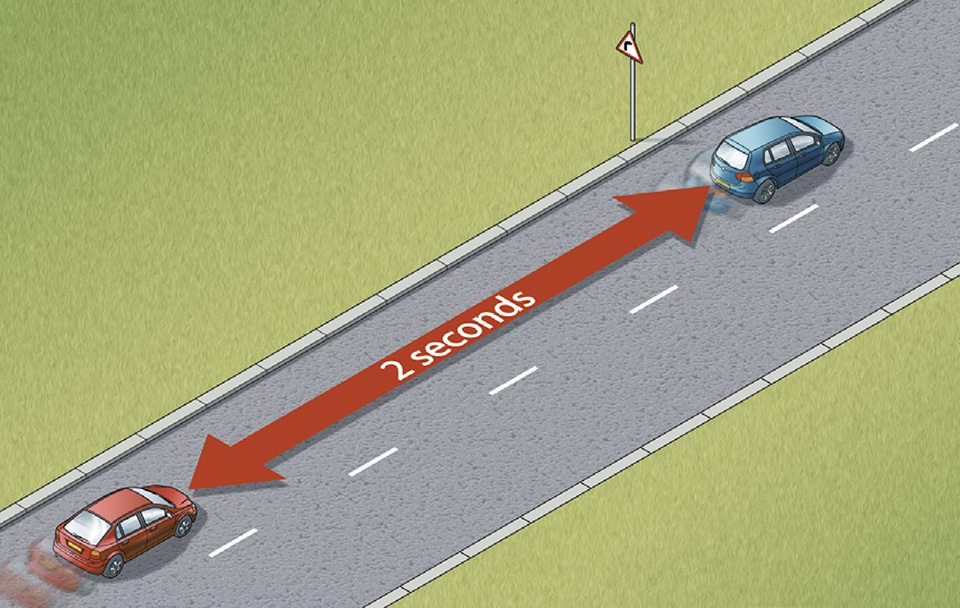
Tailgating is dangerous, intimidating and can cause collisions, especially when driving at speed. Keeping a safe distance from the vehicle in front gives you time to react and stop if necessary. Dangerous and careless driving offences, such as tailgating, are enforced by the police.
6. Lines and lane markings on the road (127 to 132)
to see diagrams of all lines.
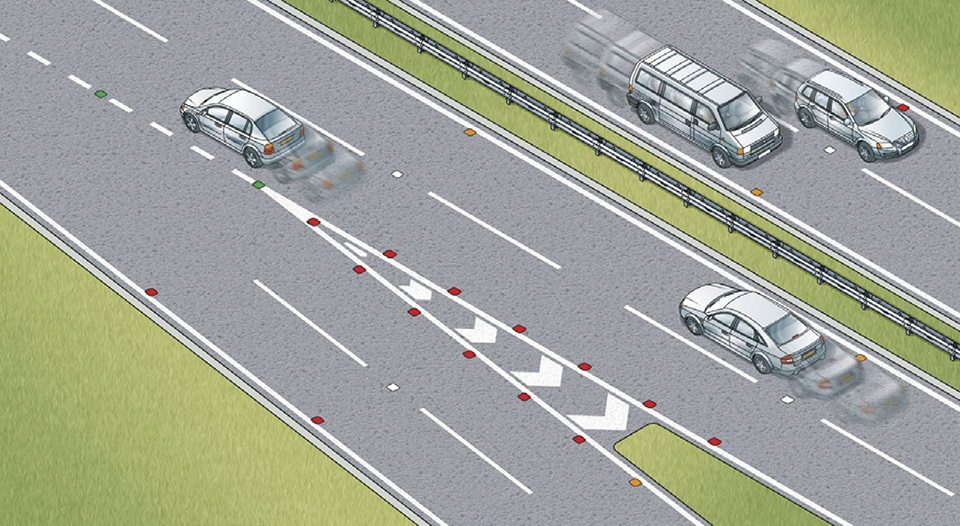
A broken white line. This marks the centre of the road. When this line lengthens and the gaps shorten, it means that there is a hazard ahead. Do not cross it unless you can see the road is clear and wish to overtake or turn off.
Double white lines where the line nearest to you is broken. This means you may cross the lines to overtake if it is safe, provided you can complete the manoeuvre before reaching a solid white line on your side. White direction arrows on the road indicate that you need to get back onto your side of the road.
Double white lines where the line nearest you is solid. This means you MUST NOT cross or straddle it unless it is safe and you need to enter adjoining premises or a side road. You may cross the line if necessary, provided the road is clear, to pass a stationary vehicle, or overtake a pedal cycle, horse or road maintenance vehicle, if they are travelling at 10 mph (16 km/h) or less.
Laws RTA 1988 sect 36 & TSRGD regs 10 & 26
130
Areas of white diagonal stripes or chevrons painted on the road. These are to separate traffic lanes or to protect traffic turning right.
- If the area is bordered by a broken white line, you should not enter the area unless it is necessary and you can see that it is safe to do so.
- If the area is marked with chevrons and bordered by solid white lines you MUST NOT enter it except in an emergency.
Laws MT(E&W)R regs 5, 9, 10 & 16, MT(S)R regs 4, 8, 9 & 14, RTA sect 36 & TSRGD 10(1)
Lane dividers. These are short, broken white lines which are used on wide carriageways to divide them into lanes. You should keep between them.
132
Reflective road studs may be used with white lines.
- White studs mark the lanes or the middle of the road.
- Red studs mark the left edge of the road.
- Amber studs mark the central reservation of a dual carriageway or motorway.
- Green studs mark the edge of the main carriageway at lay-bys and slip roads.
- Green/yellow studs indicate temporary adjustments to lane layouts, e.g. where road works are taking place.
7. Multi-lane carriageways (133 to 143)
Lane discipline
If you need to change lane, first use your mirrors and if necessary take a quick sideways glance to make sure you will not force another road user to change course or speed. When it is safe to do so, signal to indicate your intentions to other road users and when clear, move over.
You should follow the signs and road markings and get into the lane as directed. In congested road conditions do not change lanes unnecessarily. Merging in turn is recommended but only if safe and appropriate when vehicles are travelling at a very low speed, e.g. when approaching road works or a road traffic incident. It is not recommended at high speed.
Single carriageway
135
Where a single carriageway has three lanes and the road markings or signs do not give priority to traffic in either direction
- use the middle lane only for overtaking or turning right. Remember, you have no more right to use the middle lane than a driver coming from the opposite direction
- do not use the right-hand lane.
Where a single carriageway has four or more lanes, use only the lanes that signs or markings indicate.
Dual carriageways
On a two-lane dual carriageway you should stay in the left-hand lane. Use the right-hand lane for overtaking or turning right. After overtaking, move back to the left-hand lane when it is safe to do so.
On a dual carriageway with three or more lanes, you may use the middle lanes or the right-hand lane to overtake but you should return to the middle lanes and then the left-hand lane when it is safe to do so.
Climbing and crawler lanes. These are provided on some hills. Use this lane if you are driving a slow-moving vehicle or if there are vehicles behind you wishing to overtake. Be aware of the signs and road markings which indicate the lane is about to end.
Cycle lanes and cycle tracks. Cycle lanes are shown by road markings and signs. You MUST NOT drive or park in a cycle lane marked by a solid white line during its times of operation. Do not drive or park in a cycle lane marked by a broken white line unless it is unavoidable. You MUST NOT park in any cycle lane whilst waiting restrictions apply.
You should give way to any cyclists in a cycle lane, including when they are approaching from behind you – do not cut across them when you are turning or when you are changing lane (see Rule H3). Be prepared to stop and wait for a safe gap in the flow of cyclists before crossing the cycle lane.
Cycle tracks are routes for cyclists that are physically protected or located away from motor traffic, other than where they cross side roads. Cycle tracks may be shared with pedestrians.
You should give way to cyclists approaching or using the cycle track when you are turning into or out of a junction (see Rule H3). Be prepared to stop and wait for a safe gap in the flow of cyclists before crossing the cycle track, which may be used by cyclists travelling in both directions.
Bear in mind that cyclists are not obliged to use cycle lanes or cycle tracks.
Law RTRA sects 5 & 8
Bus lanes. These are shown by road markings and signs that indicate which (if any) other vehicles are permitted to use the bus lane. Unless otherwise indicated, you should not drive in a bus lane during its period of operation. You may enter a bus lane to stop, to load or unload where this is not prohibited.
142
High-occupancy vehicle lanes and other designated vehicle lanes. Lanes may be restricted for use by particular types of vehicle; these restrictions may apply some or all of the time. The operating times and vehicle types will be indicated on the accompanying traffic signs. You MUST NOT drive in such lanes during their times of operation unless signs indicate that your vehicle is permitted.
Vehicles permitted to use designated lanes may or may not include cycles, buses, taxis, licensed private hire vehicles, motorcycles, heavy goods vehicles (HGVs) and high-occupancy vehicles (HOVs). Where HOV lanes are in operation, they MUST ONLY be used by
- vehicles containing at least the minimum number of people indicated on the traffic signs
- any other vehicles, such as buses and motorcycles, as indicated on signs prior to the start of the lane, irrespective of the number of occupants.
Laws RTRA sects 5 & 8, & RTA 1988, sect 36
143
One-way streets. Traffic MUST travel in the direction indicated by signs. Buses and/or cycles may have a contraflow lane. Choose the correct lane for your exit as soon as you can. Do not change lanes suddenly. Unless road signs or markings indicate otherwise, you should use
- the left-hand lane when going left
- the right-hand lane when going right
- the most appropriate lane when going straight ahead.
Remember – traffic could be passing on both sides.
Laws RTA 1988 sect 36 & RTRA sects 5 & 8
8. General advice (144 to 158)
144
You MUST NOT
- drive dangerously
- drive without due care and attention
- drive without reasonable consideration for other road users.
Driving requires focus and attention at all times. Remember, you may be driving dangerously or travelling too fast even if you don’t mean to.
Law RTA 1988 sects 2 & 3 as amended by RTA 1991
You MUST NOT drive on or over a pavement, footpath or bridleway except to gain lawful access to property, or in the case of an emergency.
Laws HA 1835 sect 72 & RTA 1988 sect 34
146
Adapt your driving to the appropriate type and condition of road you are on. In particular
- do not treat speed limits as a target. It is often not appropriate or safe to drive at the maximum speed limit
- take the road and traffic conditions into account. Be prepared for unexpected or difficult situations, for example, the road being blocked beyond a blind bend. Be prepared to adjust your speed as a precaution
- where there are junctions, be prepared for road users emerging
- in side roads and country lanes look out for unmarked junctions where nobody has priority
- be prepared to stop at traffic control systems, road works, pedestrian crossings or traffic lights as necessary
- try to anticipate what pedestrians and cyclists might do. If pedestrians, particularly children, are looking the other way, they may step out into the road without seeing you.
147
Be considerate. Be careful of and considerate towards all types of road users, especially those requiring extra care (see Rule 204).
- you MUST NOT throw anything out of a vehicle; for example, food or food packaging, cigarette ends, cans, paper or carrier bags. This can endanger other road users, particularly motorcyclists and cyclists.
- try to be understanding if other road users cause problems; they may be inexperienced or not know the area well.
- be patient; remember that anyone can make a mistake.
- do not allow yourself to become agitated or involved if someone is behaving badly on the road. This will only make the situation worse. Pull over, calm down and, when you feel relaxed, continue your journey.
- slow down and hold back if a road user pulls out into your path at a junction. Allow them to get clear. Do not over-react by driving too close behind to intimidate them.
148
Safe driving and riding needs concentration. Avoid distractions when driving or riding such as
- loud music (this may mask other sounds)
- trying to read maps
- inserting a cassette or CD or tuning a radio
- arguing with your passengers or other road users
- eating and drinking
- smoking
You MUST NOT smoke in public transport vehicles or in vehicles used for work purposes in certain prescribed circumstances. Separate regulations apply to England, Wales and Scotland. In England and Wales, the driver MUST NOTsmoke or allow anyone to smoke in an enclosed private vehicle carrying someone under 18, including motor caravans. In Scotland it is an offence for anyone aged 18 or over to smoke in a private motor vehicle (unless it is parked and being used as living accommodation) when there is someone under 18 in the vehicle and the vehicle is in a public place.
Mobile phones and in-vehicle technology
149
You MUST exercise proper control of your vehicle at all times. You MUST NOTuse a hand-held mobile phone, or similar device, capable of interactive communication (such as a tablet) for any purpose when driving or when supervising a learner driver. This ban covers all use of a hand-held interactive communication device and it applies even when the interactive communication capability is turned off or unavailable. You MUST NOT pick up the phone or similar device while driving to dial a number and then put it in the cradle for the duration of the conversation. You MUST NOT pick up and use your hand-held phone or similar device while stationary in traffic.
There is an exception to call 999 or 112 in a genuine emergency when it is unsafe or impractical to stop. There is also an exception if you are using a hand-held mobile phone or similar device to make a contactless payment at a contactless payment terminal. Your vehicle MUST be stationary, and the goods or services MUST be received at the same time as, or after, the contactless payment.
Never use a hand-held microphone when driving. Using hands-free equipment is also likely to distract your attention from the road. It is far safer not to use any telephone or similar device while you are driving or riding - find a safe place to stop first or use the voicemail facility and listen to messages later.
You may park your vehicle using a handheld remote control app or device. The app or device MUST be legal, and you should not put other people in danger when you use it.
150
There is a danger of driver distraction being caused by in-vehicle systems such as satellite navigation systems, congestion warning systems, PCs, multi-media, etc. You MUST exercise proper control of your vehicle at all times. Do not rely on driver assistance systems such as cruise control or lane departure warnings. They are available to assist but you should not reduce your concentration levels. Do not be distracted by maps or screen-based information (such as navigation or vehicle management systems) while driving or riding. If necessary find a safe place to stop.
As the driver, you are still responsible for the vehicle if you use a driver assistance system (like motorway assist). This is also the case if you use a hand-held remote control parking app or device. You MUST have full control over these systems at all times.
151
In slow-moving traffic. You should
- reduce the distance between you and the vehicle ahead to maintain traffic flow
- never get so close to the vehicle in front that you cannot stop safely
- leave enough space to be able to manoeuvre if the vehicle in front breaks down or an emergency vehicle needs to get past
- not change lanes to the left to overtake
- allow access into and from side roads, as blocking these will add to congestion
- allow pedestrians and cyclists to cross in front of you
- be aware of cyclists and motorcyclists who may be passing on either side.
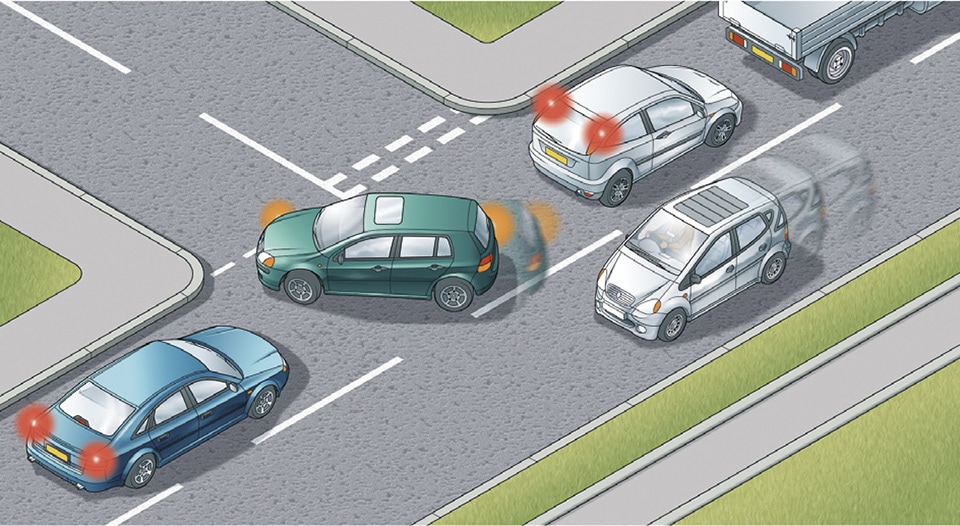
Driving in built-up areas
152
Residential streets. You should drive slowly and carefully on streets where there are likely to be pedestrians, cyclists and parked cars. In some areas a 20 mph (32 km/h) maximum speed limit may be in force. Look out for
- vehicles emerging from junctions or driveways
- vehicles moving off
- car doors opening
- pedestrians
- children running out from between parked cars
- cyclists and motorcyclists.
Traffic-calming measures. On some roads there are features such as road humps, chicanes and narrowings which are intended to slow you down. When you approach these features reduce your speed. Allow cyclists and motorcyclists room to pass through them. Maintain a reduced speed along the whole of the stretch of road within the calming measures. Give way to oncoming road users if directed to do so by signs. You should not overtake other moving road users while in these areas.
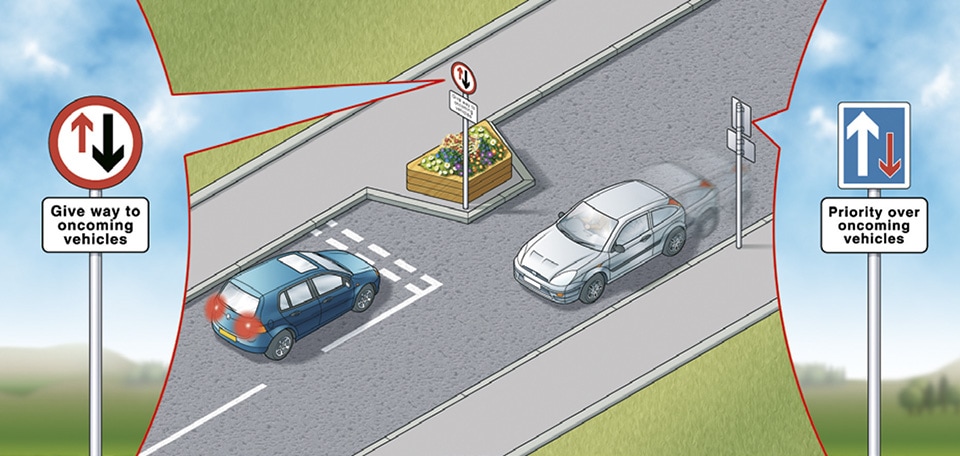
Country roads
Take extra care on country roads and reduce your speed at approaches to bends, which can be sharper than they appear, and at junctions and turnings, which may be partially hidden. Be prepared for pedestrians, horse riders, cyclists, slow-moving farm vehicles or mud on the road surface. Make sure you can stop within the distance you can see to be clear. You should also reduce your speed where country roads enter villages.
Single-track roads. These are only wide enough for one vehicle. They may have special passing places. If you see a vehicle coming towards you, or the driver behind wants to overtake, pull into a passing place on your left, or wait opposite a passing place on your right. Give way to vehicles coming uphill whenever you can. If necessary, reverse until you reach a passing place to let the other vehicle pass. Slow down when passing pedestrians, cyclists and horse riders.
Do not park in passing places.
Vehicles prohibited from using roads and pavements
Certain motorised vehicles do not meet the construction and technical requirements for road vehicles and are generally not intended, not suitable and not legal for road, pavement, footpath, cycle path or bridleway use. These include most types of miniature motorcycles, also called mini motos, and motorised scooters, also called go peds, which are powered by electric or internal combustion engines. These types of vehicle MUST NOT be used on roads, pavements, footpaths or bridleways.
Laws RTA 1988 sects 34, 41a, 42, 47, 63 & 66, HA 1835, sect 72, & R(S)A sect 129
Certain models of motorcycles, motor tricycles and quadricycles, also called quad bikes, are suitable only for off-road use and do not meet legal standards for use on roads. Vehicles that do not meet these standards MUST NOT be used on roads. They MUST NOT be used on pavements, footpaths, cycle paths or bridleways either. You MUST make sure that any motorcycle, motor tricycle, quadricycle or any other motor vehicle meets legal standards and is properly registered, taxed and insured before using it on the roads. Even when registered, taxed and insured for the road, vehicles MUST NOT be used on pavements.
Laws RTA 1988 sects 34, 41a, 42, 47, 63, 66 & 156, HA 1835, sect 72, R(S)A sect 129, & VERA Ss 1, 29, 31A, & 43A
1. General rules (159 to 161)
159
Before moving off you should
- use all mirrors to check the road is clear
- look round to check the blind spots (the areas you are unable to see in the mirrors)
- signal if necessary before moving out
- look round for a final check.
Move off only when it is safe to do so.
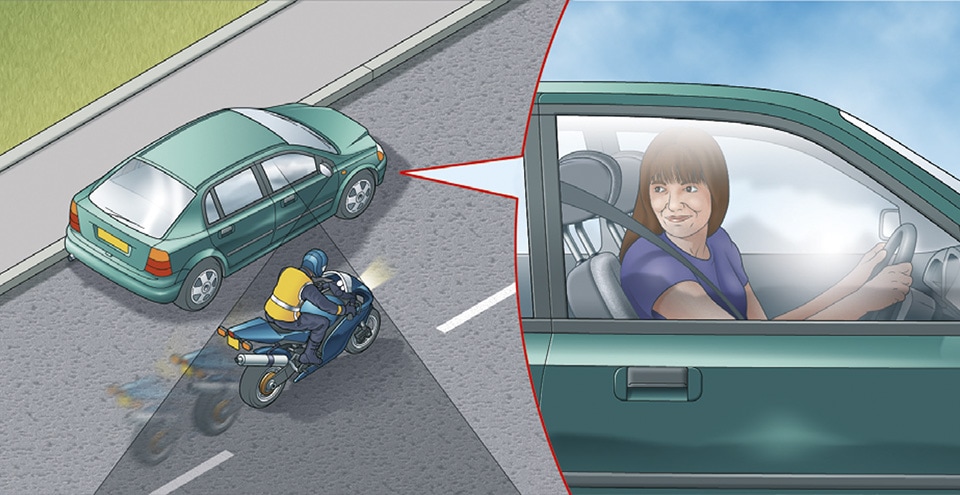
160
Once moving you should
- keep to the left, unless road signs or markings indicate otherwise. The exceptions are when you want to overtake, turn right or pass parked vehicles or pedestrians in the road
- keep well to the left on right-hand bends. This will improve your view of the road and help avoid the risk of colliding with traffic approaching from the opposite direction
- drive or ride with both hands on the wheel or handlebars where possible. This will help you to remain in full control of the vehicle at all times. You may use driver assistance systems while you are driving. Make sure you use any system according to the manufacturer’s instructions.
- be aware of other road users, especially cycles and motorcycles who may be filtering through the traffic. These are more difficult to see than larger vehicles and their riders are particularly vulnerable. Give them plenty of room, especially if you are driving a long vehicle or towing a trailer. You should give way to cyclists when you are changing direction or lane – do not cut across them.
- select a lower gear before you reach a long downhill slope. This will help to control your speed
- when towing, remember the extra length will affect overtaking and manoeuvring. The extra weight will also affect the braking and acceleration.
161
Mirrors. All mirrors should be used effectively throughout your journey. You should
- use your mirrors frequently so that you always know what is behind and to each side of you
- use them in good time before you signal or change direction or speed
- be aware that mirrors do not cover all areas and there will be blind spots.
You will need to look round and check.
Remember: Mirrors – Signal – Manoeuvre
2. Overtaking (162 to 169)
162
Before overtaking you should make sure
- the road is sufficiently clear ahead
- road users are not beginning to overtake you
- there is a suitable gap in front of the road user you plan to overtake.
163
Overtake only when it is safe and legal to do so. You should
- not get too close to the vehicle you intend to overtake
- use your mirrors, signal when it is safe to do so, take a quick sideways glance if necessary into the blind spot area and then start to move out
- not assume that you can simply follow a vehicle ahead which is overtaking; there may only be enough room for one vehicle
- move quickly past the vehicle you are overtaking, once you have started to overtake. Allow plenty of room. Move back to the left as soon as you can but do not cut in
- take extra care at night and in poor visibility when it is harder to judge speed and distance
- give way to oncoming vehicles before passing parked vehicles or other obstructions on your side of the road
- only overtake on the left if the vehicle in front is signalling to turn right, and there is room to do so
- stay in your lane if traffic is moving slowly in queues. If the queue on your right is moving more slowly than you are, you may pass on the left. Cyclists may pass slower moving or stationary traffic on their right or left and should proceed with caution as the driver may not be able to see you. Be careful about doing so, particularly on the approach to junctions, and especially when deciding whether it is safe to pass lorries or other large vehicles.
- give motorcyclists, cyclists and horse riders and horse drawn vehicles at least as much room as you would when overtaking a car (see Rules 211 to 215). As a guide:
- leave at least 1.5 metres when overtaking cyclists at speeds of up to 30mph, and give them more space when overtaking at higher speeds
- pass horse riders and horse-drawn vehicles at speeds under 10 mph and allow at least 2 metres of space
- allow at least 2 metres of space and keep to a low speed when passing a pedestrian who is walking in the road (for example, where there is no pavement)
- take extra care and give more space when overtaking motorcyclists, cyclists, horse riders, horse drawn vehicles and pedestrians in bad weather (including high winds) and at night
- you should wait behind the motorcyclist, cyclist, horse rider, horse drawn vehicle or pedestrian and not overtake if it is unsafe or not possible to meet these clearances.
Remember: Mirrors – Signal – Manoeuvre
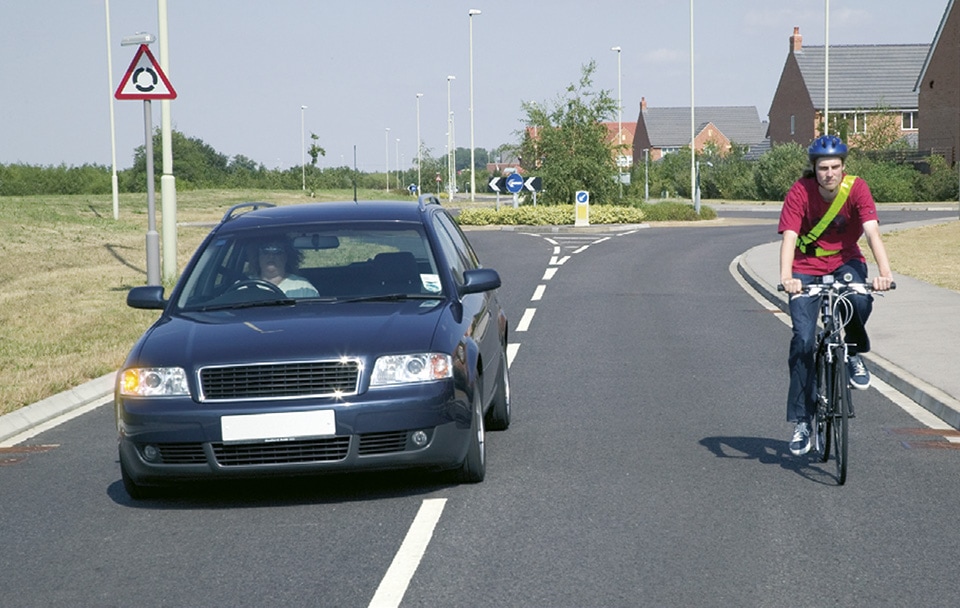
164
Large vehicles. Overtaking these is more difficult. You should
- drop back. This will increase your ability to see ahead and should allow the driver of the large vehicle to see you in their mirrors. Getting too close to large vehicles, including agricultural vehicles such as a tractor with a trailer or other fixed equipment, will obscure your view of the road ahead and there may be another slow-moving vehicle in front
- make sure that you have enough room to complete your overtaking manoeuvre before committing yourself. It takes longer to pass a large vehicle. If in doubt do not overtake
- not assume you can follow a vehicle ahead which is overtaking a long vehicle. If a problem develops, they may abort overtaking and pull back in.
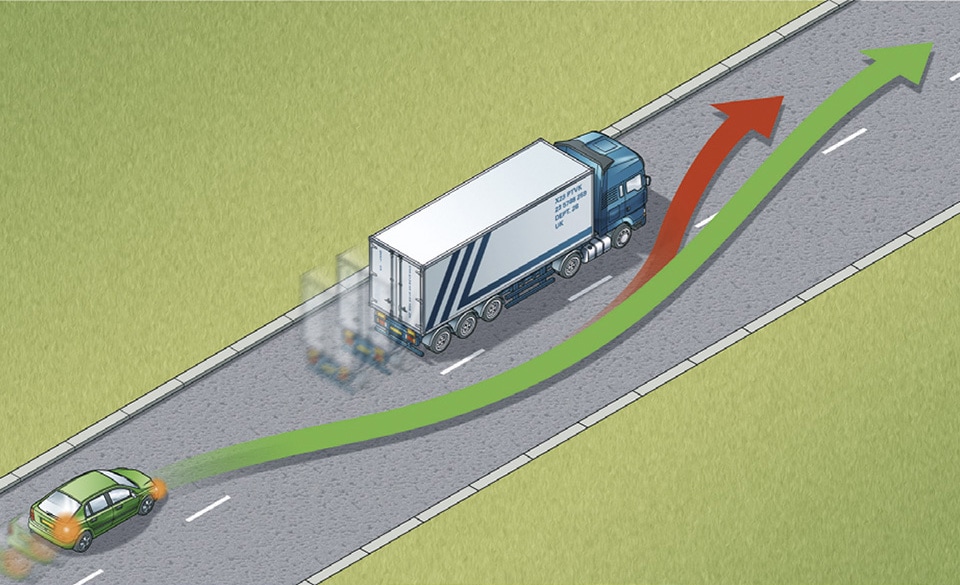
165
You MUST NOT overtake
- if you would have to cross or straddle double white lines with a solid line nearest to you (but see Rule 129)
- if you would have to enter an area designed to divide traffic, if it is surrounded by a solid white line
- the nearest vehicle to a pedestrian crossing, especially when it has stopped to let pedestrians cross
- if you would have to enter a lane reserved for buses, trams or cycles during its hours of operation
- after a ‘No Overtaking’ sign and until you pass a sign cancelling the restriction.
Laws RTA 1988 sect 36, TSRGD regs 10, 22, 23 & 24, ZPPPCRGD reg 24
166
DO NOT overtake if there is any doubt, or where you cannot see far enough ahead to be sure it is safe. For example, when you are approaching
- a corner or bend
- a hump bridge
- the brow of a hill.
167
DO NOT overtake where you might come into conflict with other road users. For example
- approaching or at a road junction on either side of the road
- where the road narrows
- when approaching a school crossing patrol
- on the approach to crossing facilities
- where a vehicle ahead is slowing to stop for a pedestrian that is crossing from a pedestrian island (see Rule 165)
- between the kerb and a bus or tram when it is at a stop
- where traffic is queuing at junctions or road works
- when you would force another road user to swerve or slow down
- at a level crossing
- when a road user is indicating right, even if you believe the signal should have been cancelled. Do not take a risk; wait for the signal to be cancelled
- stay behind if you are following a cyclist approaching a roundabout or junction, and you intend to turn left. Do not cut across cyclists going ahead, including those using cycle lanes and cycle tracks (see Rule H3)
- stay behind if you are following a horse rider or horse drawn vehicle approaching a roundabout or junction, and you intend to turn left. Do not cut across a horse rider or horse drawn vehicle going ahead
- when a tram is standing at a kerbside tram stop and there is no clearly marked passing lane for other traffic.
168
Being overtaken. If a driver is trying to overtake you, maintain a steady course and speed, slowing down if necessary to let the vehicle pass. Never obstruct drivers who wish to pass. Speeding up or driving unpredictably while someone is overtaking you is dangerous. Drop back to maintain a two-second gap if someone overtakes and pulls into the gap in front of you.
169
Do not hold up a long queue of traffic, especially if you are driving a large or slow-moving vehicle. Check your mirrors frequently, and if necessary, pull in where it is safe and let traffic pass.
3. Road junctions (170 to 183)
170
Take extra care at junctions. You should
- watch out for cyclists, motorcyclists and pedestrians including powered wheelchairs/mobility scooter users as they are not always easy to see. Be aware that they may not have seen or heard you if you are approaching from behind
- give way to pedestrians crossing or waiting to cross a road into which or from which you are turning. If they have started to cross they have priority, so give way (see Rule H2)
- remain behind cyclists, horse riders, horse drawn vehicles and motorcyclists at junctions even if they are waiting to turn and are positioned close to the kerb
- watch out for long vehicles which may be turning at a junction ahead; they may have to use the whole width of the road to make the turn (see Rule 221)
- watch out for horse riders who may take a different line on the road from that which you would expect
- not assume, when waiting at a junction, that a vehicle coming from the right and signalling left will actually turn. Wait and make sure
- look all around before emerging. Do not cross or join a road until there is a gap large enough for you to do so safely.
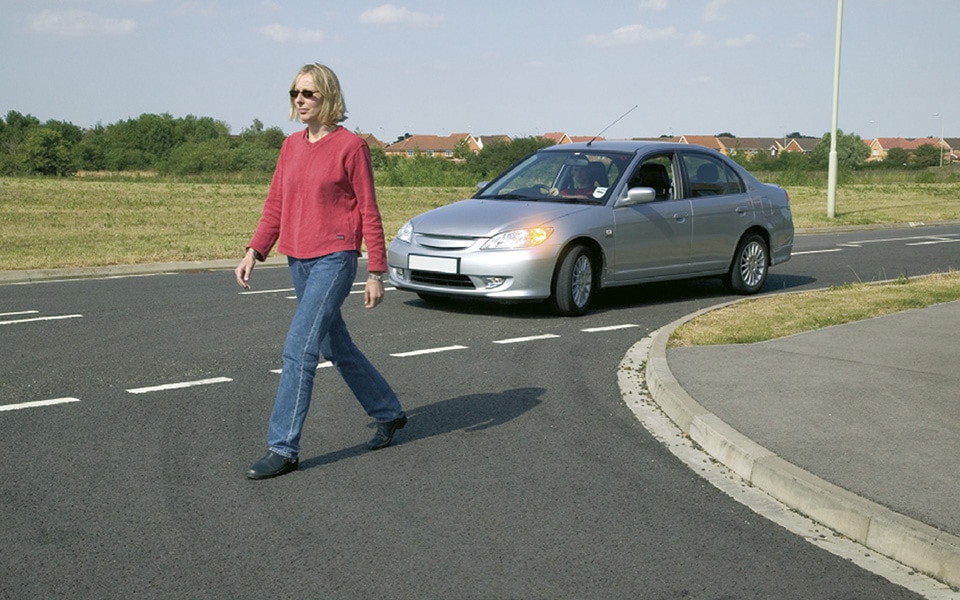
171
You MUST stop behind the line at a junction with a ‘Stop’ sign and a solid white line across the road. Wait for a safe gap in the traffic before you move off.
Laws RTA 1988 sect 36 & TSRGD regs 10 & 16
172
The approach to a junction may have a ‘Give Way’ sign or a triangle marked on the road. You MUST give way to traffic on the main road when emerging from a junction with broken white lines across the road.
Laws RTA 1988 sect 36 & TSRGD regs 10(1),16(1) & 25
173
Dual carriageways. When crossing or turning right, first assess whether the central reservation is deep enough to protect the full length of your vehicle.
- If it is, then you should treat each half of the carriageway as a separate road. Wait in the central reservation until there is a safe gap in the traffic on the second half of the road.
- If the central reservation is too shallow for the length of your vehicle, wait until you can cross both carriageways in one go.
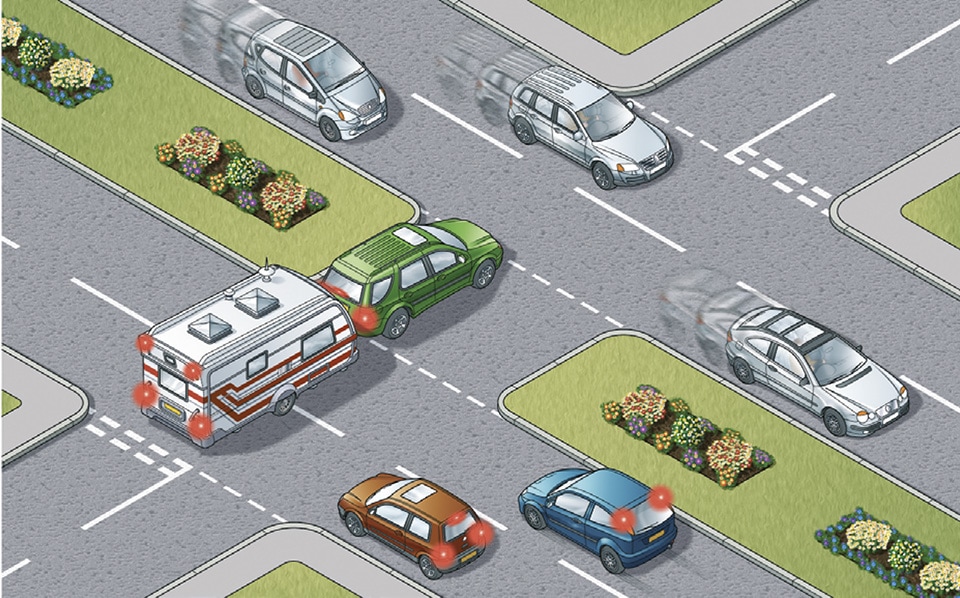
174
Box junctions. These have criss-cross yellow lines painted on the road (download ‘Road markings’). You MUST NOT enter the box until your exit road or lane is clear. However, you may enter the box and wait when you want to turn right, and are only stopped from doing so by oncoming traffic, or by other vehicles waiting to turn right. At signalled roundabouts you MUST NOT enter the box unless you can cross over it completely without stopping.
Law TSRGD regs 10(1) & 29(2)
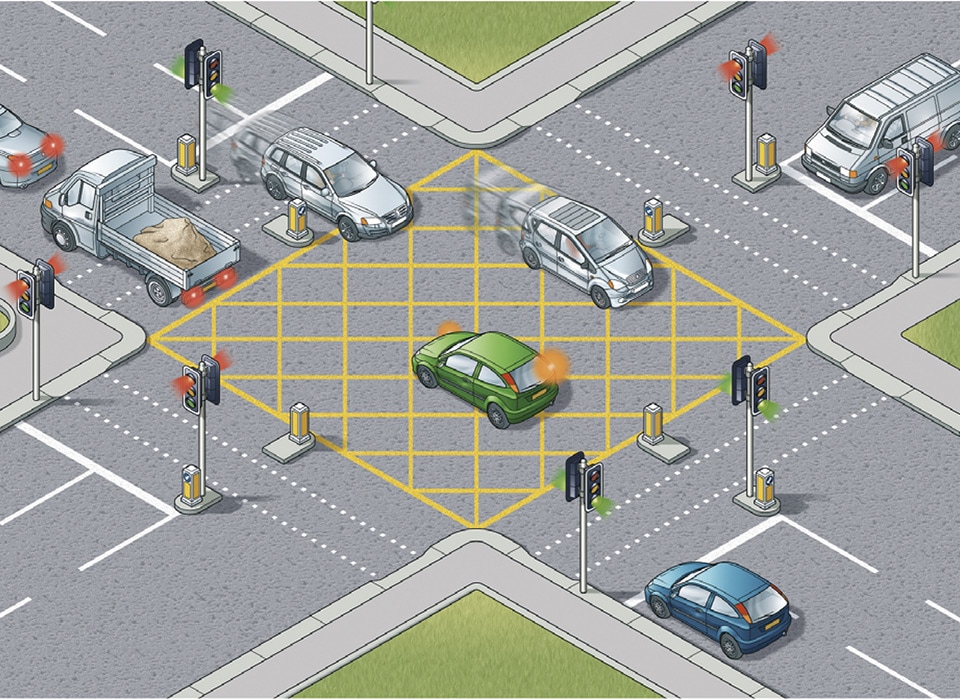
Junctions controlled by traffic lights
175
You MUST stop behind the white ‘Stop’ line across your side of the road unless the light is green. If the amber light appears you may go on only if you have already crossed the stop line or are so close to it that to stop might cause a collision.
Laws RTA 1988 sect 36 & TSRGD regs 10 & 36
176
You MUST NOT move forward over the white line when the red light is showing. Only go forward when the traffic lights are green if there is room for you to clear the junction safely or you are taking up a position to turn right. If the traffic lights are not working, treat the situation as you would an unmarked junction and proceed with great care.
Laws RTA 1988 sect 36 & TSRGD regs 10 & 36
177
Green filter arrow. This indicates a filter lane only. Do not enter that lane unless you want to go in the direction of the arrow. You may proceed in the direction of the green arrow when it, or the full green light shows. Give other traffic, especially cyclists, time and room to move into the correct lane.
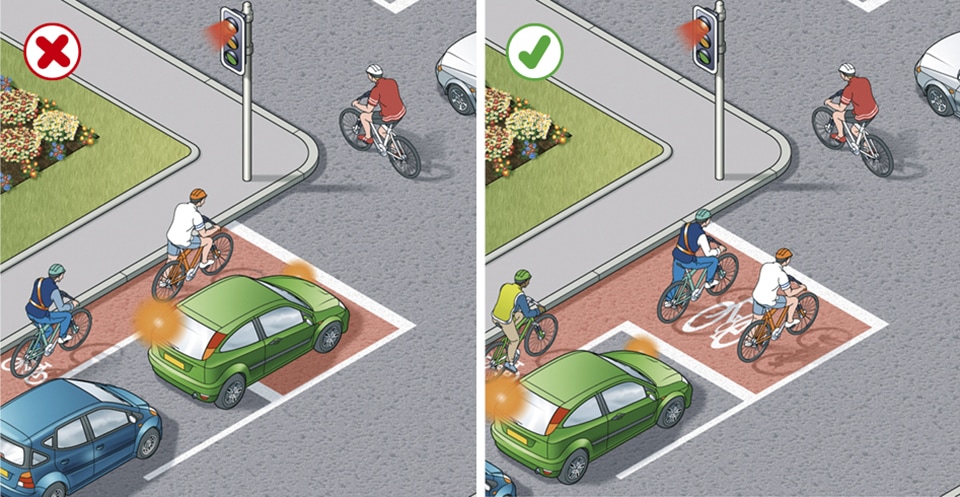
178
Advanced stop lines. Some signal-controlled junctions have advanced stop lines to allow cycles to be positioned ahead of other traffic. Motorists, including motorcyclists, MUST stop at the first white line reached if the lights are amber or red and should avoid blocking the way or encroaching on the marked area at other times, e.g. if the junction ahead is blocked. If your vehicle has proceeded over the first white line at the time that the signal goes red, you MUST stop at the second white line, even if your vehicle is in the marked area. Allow cyclists time and space to move off when the green signal shows.
Laws RTA 1988 sect 36 & TSRGD regs 10, 36(1) & 43(2)
Turning right
179
Well before you turn right you should
- use your mirrors to make sure you know the position and movement of traffic behind you
- give a right-turn signal
- take up a position just left of the middle of the road or in the space marked for traffic turning right
- leave room for other vehicles to pass on the left, if possible.
180
Wait until there is a safe gap between you and any oncoming vehicle. Watch out for cyclists, motorcyclists, pedestrians and other road users. Check your mirrors and blind spot again to make sure you are not being overtaken, then make the turn. Do not cut the corner. Take great care when turning into a main road; you will need to watch for traffic in both directions and wait for a safe gap.
Remember: Mirrors – Signal – Manoeuvre
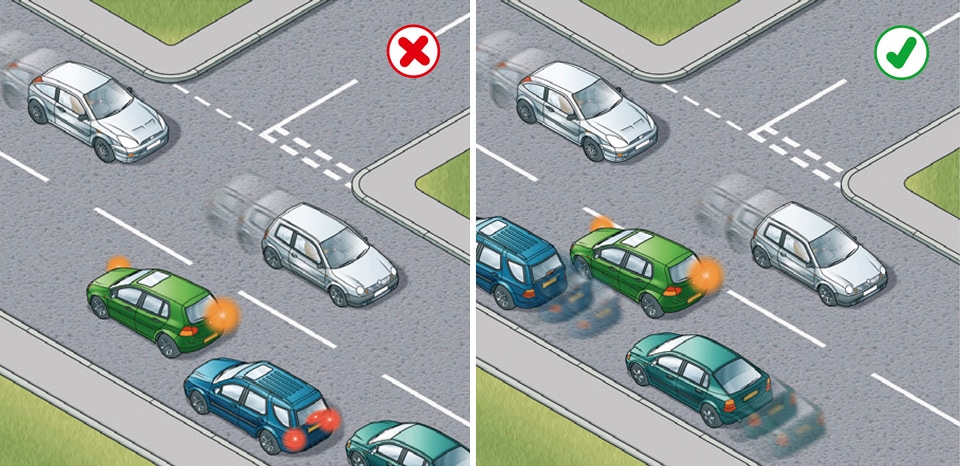
181
When turning right at crossroads where an oncoming vehicle is also turning right, there is a choice of two methods
- turn right side to right side; keep the other vehicle on your right and turn behind it. This is generally the safer method as you have a clear view of any approaching traffic when completing your turn
- left side to left side, turning in front of each other. This can block your view of oncoming vehicles, so take extra care. Cyclists and motorcyclists in particular may be hidden from your view. Road layout, markings or how the other vehicle is positioned can determine which course should be taken.
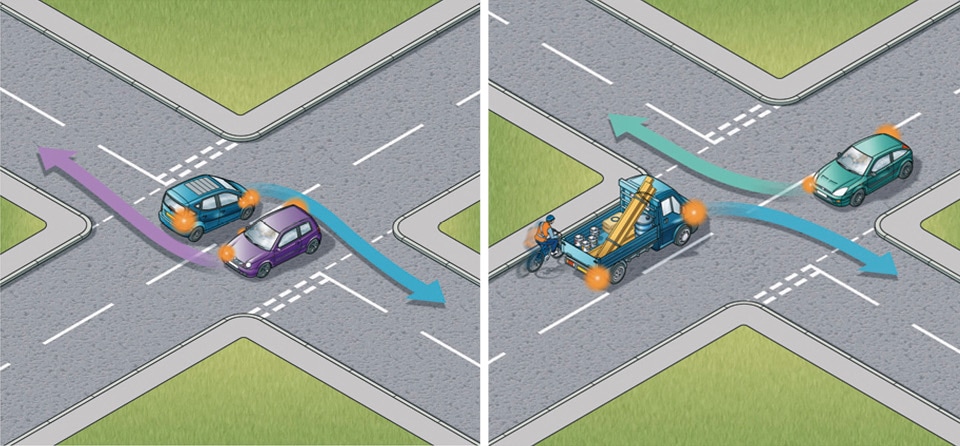
Turning left
182
Use your mirrors and give a left-turn signal well before you turn left. Do not overtake just before you turn left and watch out for traffic coming up on your left before you make the turn, especially if driving a large vehicle. Cyclists, motorcyclists and other road users in particular may be hidden from your view.
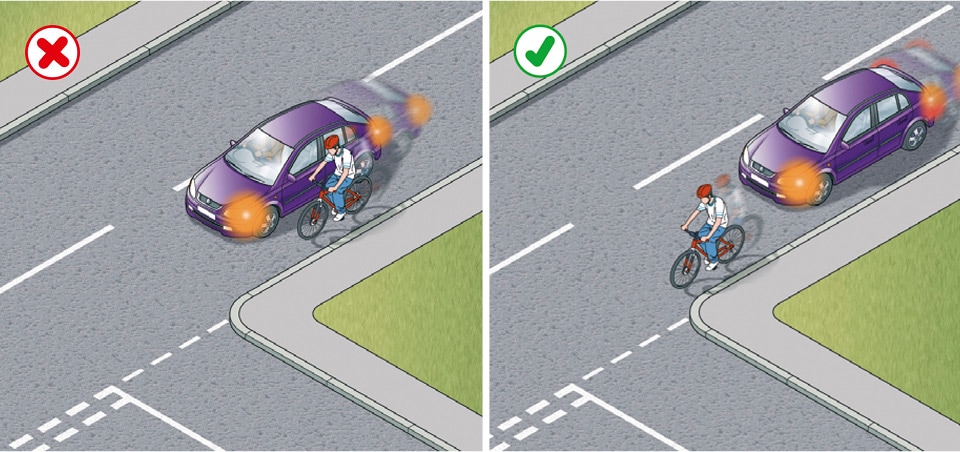
183
When turning
- keep as close to the left as is safe and practicable
- give way to any vehicles using a bus lane, cycle lane, cycle track or tramway from either direction, including when they are passing slow moving or stationary vehicles on either side.
4. Roundabouts (184 to 190)
184
On approaching a roundabout take notice and act on all the information available to you, including traffic signs, traffic lights and lane markings which direct you into the correct lane. You should
- use Mirrors – Signal – Manoeuvre at all stages
- decide as early as possible which exit you need to take
- give an appropriate signal (see Rule 186, below). Time your signals so as not to confuse other road users
- get into the correct lane
- adjust your speed and position to fit in with traffic conditions
- be aware of the speed and position of all the road users around you.
185
When reaching the roundabout you should
- give priority to traffic approaching from your right, unless directed otherwise by signs, road markings or traffic lights
- check whether road markings allow you to enter the roundabout without giving way. If so, proceed, but still look to the right before joining
- watch out for all other road users already on the roundabout; be aware they may not be signalling correctly or at all
- look forward before moving off to make sure traffic in front has moved off.
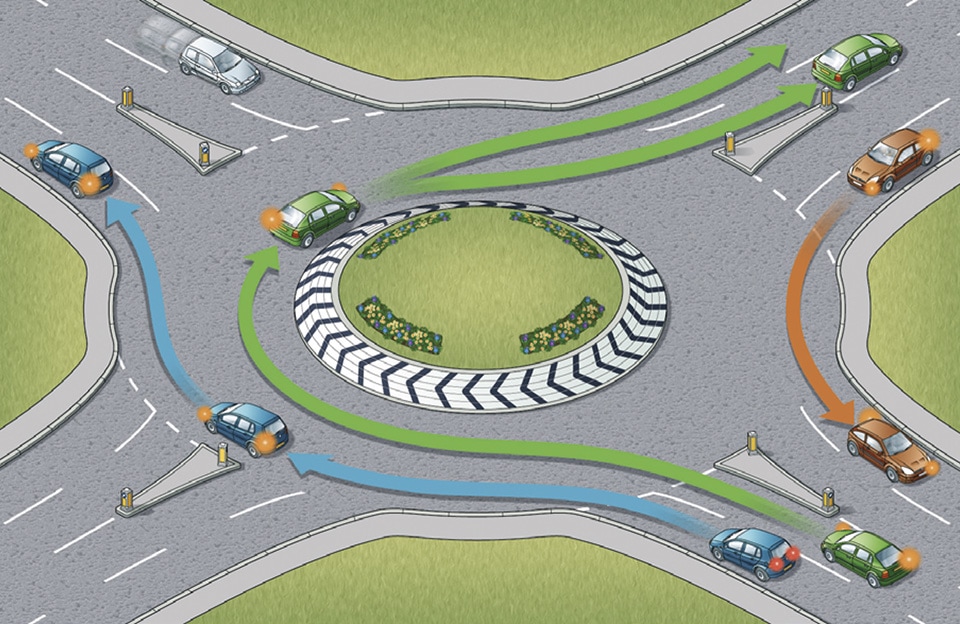
186
Signals and position. When taking the first exit to the left, unless signs or markings indicate otherwise
- signal left and approach in the left-hand lane
- keep to the left on the roundabout and continue signalling left to leave.
When taking an exit to the right or going full circle, unless signs or markings indicate otherwise
- signal right and approach in the right-hand lane
- keep to the right on the roundabout until you need to change lanes to exit the roundabout
- signal left after you have passed the exit before the one you want.
When taking any intermediate exit, unless signs or markings indicate otherwise
- select the appropriate lane on approach to the roundabout
- you should not normally need to signal on approach
- stay in this lane until you need to alter course to exit the roundabout
- signal left after you have passed the exit before the one you want.
When there are more than three lanes at the entrance to a roundabout, use the most appropriate lane on approach and through it.
You should give priority to cyclists on the roundabout. They will be travelling more slowly than motorised traffic. Give them plenty of room and do not attempt to overtake them within their lane. Allow them to move across your path as they travel around the roundabout.
Cyclists, horse riders and horse drawn vehicles may stay in the left-hand lane when they intend to continue across or around the roundabout and should signal right to show you they are not leaving the roundabout. Drivers should take extra care when entering a roundabout to ensure that they do not cut across cyclists, horse riders or horse drawn vehicles in the left-hand lane, who are continuing around the roundabout.
187
In all cases watch out for and give plenty of room to
- pedestrians who may be crossing the approach and exit roads
- traffic crossing in front of you on the roundabout, especially vehicles intending to leave by the next exit
- traffic which may be straddling lanes or positioned incorrectly
- motorcyclists
- long vehicles (including those towing trailers). These might have to take a different course or straddle lanes either approaching or on the roundabout because of their length. Watch out for their signals.
188
Mini-roundabouts. Approach these in the same way as normal roundabouts. All vehicles MUST pass round the central markings except large vehicles which are physically incapable of doing so. Remember, there is less space to manoeuvre and less time to signal. Avoid making U-turns at mini-roundabouts. Beware of others doing this.
Laws RTA 1988 sect 36 & TSRGD regs 10(1) & 16(1)
189
At double mini-roundabouts treat each roundabout separately and give way to traffic from the right.
190
Multiple roundabouts. At some complex junctions, there may be a series of mini-roundabouts at each intersection. Treat each mini-roundabout separately and follow the normal rules.
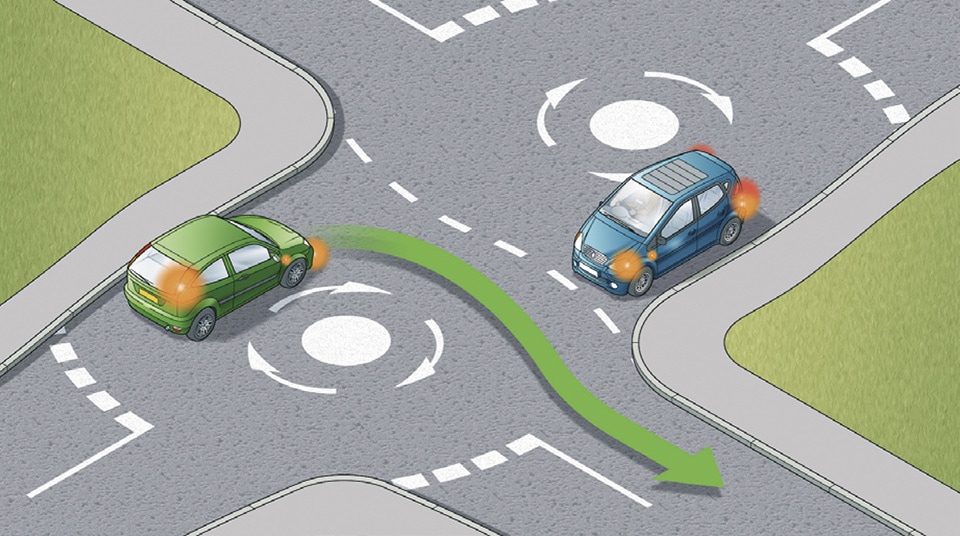
5. Pedestrian crossings (191 to 199)
191
You MUST NOT park on a crossing or in the area covered by the zig-zag lines. You MUST NOT overtake the moving vehicle nearest the crossing or the vehicle nearest the crossing which has stopped to give way to pedestrians.
Laws ZPPPCRGD regs 18, 20 & 24, RTRA sect 25(5) & TSRGD regs 10, 27 & 28
192
In slow-moving and queuing traffic you should keep crossings completely clear, as blocking these makes it difficult and dangerous for pedestrians to cross. You should not enter a pedestrian crossing if you are unable to completely clear the crossing. Nor should you block advanced stop lines for cycles.
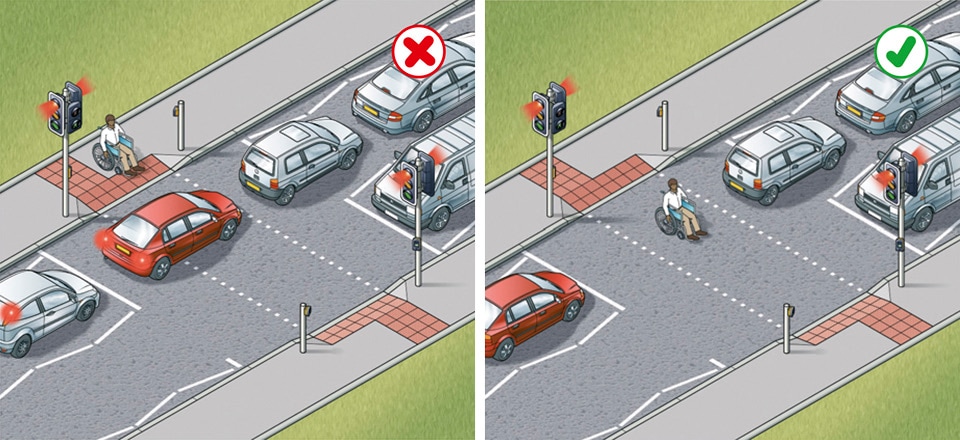
193
You should take extra care where the view of either side of the crossing is blocked by queuing traffic or incorrectly parked vehicles. Pedestrians may be crossing between stationary vehicles.
194
Allow pedestrians plenty of time to cross and do not harass them by revving your engine or edging forward.
195
Zebra and parallel crossings. As you approach a zebra crossing
- look out for pedestrians waiting to cross and be ready to slow down or stop to let them cross
- you should give way to pedestrians waiting to cross
- you MUST give way when a pedestrian has moved onto a crossing
- allow more time for stopping on wet or icy roads
- do not wave, flash your lights or use your horn to invite pedestrians across; this could be dangerous if another vehicle is approaching
- be patient, do not sound your horn or rev your engine as this can be intimidating
- be aware of pedestrians approaching from the side of the crossing.
A zebra crossing with a central island is two separate crossings (see Rules 19 and 20).
Parallel crossings are similar to zebra crossings, but include a cycle route alongside the black and white stripes.
As you approach a parallel crossing
- look out for pedestrians or cyclists waiting to cross and slow down or stop
- you should give way to pedestrians or cyclists waiting to cross
- you MUST give way when a pedestrian or cyclist has moved onto a crossing
- allow more time for stopping on wet or icy roads
- do not wave, flash your lights or use your horn to invite pedestrians or cyclists across; this could be dangerous if another vehicle is approaching
- be patient, do not sound your horn or rev your engine as this can be intimidating
- be aware of pedestrians or cyclists approaching from the side of the crossing.
A parallel crossing with a central island is two separate crossings (see Rules 19 and 20).
Law ZPPPCRGD reg 25
Signal-controlled crossings
196
Pelican crossings. These are signal-controlled crossings where flashing amber follows the red ‘Stop’ light. You MUST stop when the red light shows. When the amber light is flashing, you MUST give way to any pedestrians on the crossing. If the amber light is flashing and there are no pedestrians on the crossing, you may proceed with caution.
Laws ZPPPCRGD regs 23 & 26 & RTRA sect 25(5)
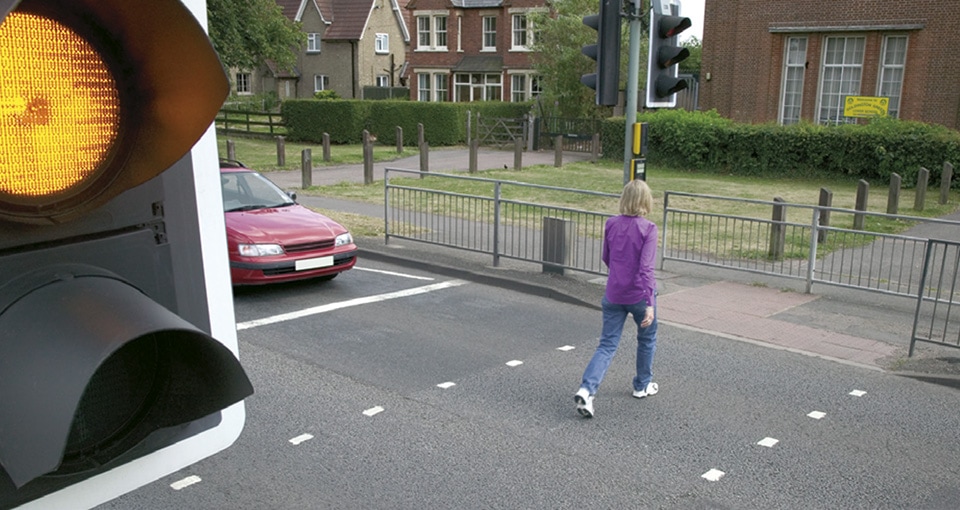
197
Pelican crossings which go straight across the road are one crossing, even when there is a central island. You MUST wait for pedestrians who are crossing from the other side of the island.
Laws ZPPPCRGD reg 26 & RTRA sect 25(5)
198
Give way to anyone still crossing after the signal for vehicles has changed to green. This advice applies to all crossings.
199
Toucan, puffin and equestrian crossings. These are similar to pelican crossings, but there is no flashing amber phase; the light sequence for traffic at these three crossings is the same as at traffic lights. If the signal-controlled crossing is not working, proceed with extreme caution. Do not enter the crossing if you are unable to completely clear it, to avoid obstructing pedestrians, cyclists or horse riders.
6. Reversing (200 to 203)
200
Choose an appropriate place to manoeuvre. If you need to turn your vehicle around, wait until you find a safe place. Try not to reverse or turn round in a busy road; find a quiet side road or drive round a block of side streets.
201
Do not reverse from a side road into a main road. When using a driveway, reverse in and drive out if you can.
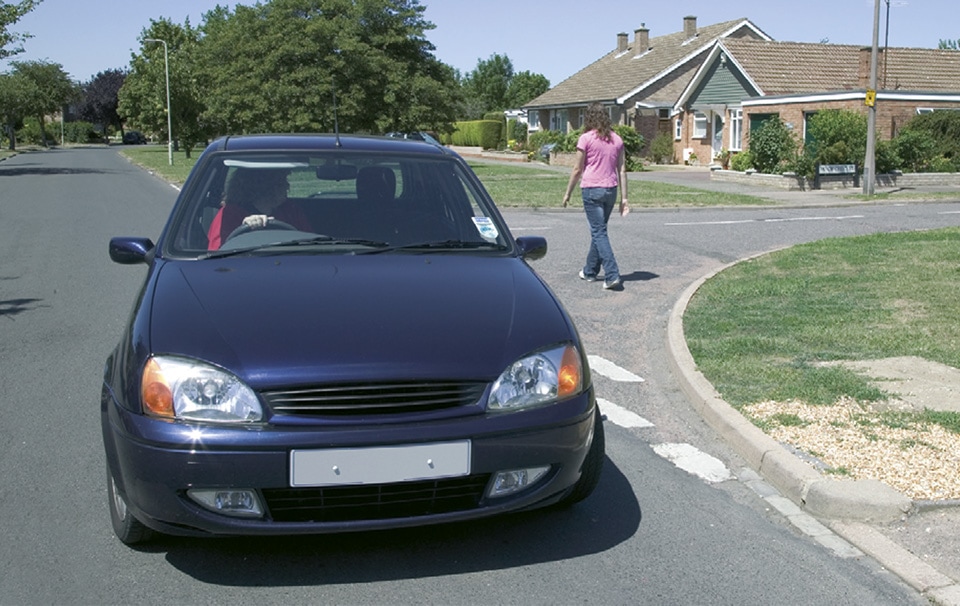
202
Look carefully before you start reversing. You should
- use all your mirrors
- check the ‘blind spot’ behind you (the part of the road you cannot see easily in the mirrors)
- check there are no pedestrians (particularly children), cyclists, other road users or obstructions in the road behind you.
Reverse slowly while
- checking all around
- looking mainly through the rear window
- being aware that the front of your vehicle will swing out as you turn.
Get someone to guide you if you cannot see clearly.
203
You MUST NOT reverse your vehicle further than necessary.
Law CUR reg 106
1. Overview (204)
204
The road users most at risk from road traffic are pedestrians, in particular children, older adults and disabled people, cyclists, horse riders and motorcyclists. It is particularly important to be aware of children, older adults and disabled people, and learner and inexperienced drivers and riders. In any interaction between road users, those who can cause the greatest harm have the greatest responsibility to reduce the danger or threat they pose to others.
2. Pedestrians (205 to 210)
205
There is a risk of pedestrians, especially children, stepping unexpectedly into the road. You should drive with the safety of children in mind at a speed suitable for the conditions.
206
Drive carefully and slowly when
- in crowded shopping streets, Home Zones and Quiet Lanes (see Rule 218) or residential areas
- driving past bus and tram stops; pedestrians may emerge suddenly into the road
- passing parked vehicles, especially ice cream vans; children are more interested in ice cream than traffic and may run into the road unexpectedly
- needing to cross a pavement, cycle lane or cycle track; for example, to reach or leave a driveway or private access. Give way to pedestrians on the pavement and cyclists using a cycle lane or cycle track
- reversing into a side road; look all around the vehicle and give way to any pedestrians who may be crossing the road
- turning at road junctions; you should give way to pedestrians who are crossing or waiting to cross the road into which or from which you are turning
- going through road works or when passing roadside rescue and recovery vehicles, as there may be people working in or at the side of the road
- the pavement is closed due to street repairs and pedestrians are directed to use the road
- approaching pedestrians on narrow rural roads without a footway or footpath. Always slow down and be prepared to stop if necessary, giving them plenty of room as you drive past
- approaching zebra and parallel crossings as you MUST give way to pedestrians and cyclists on the crossing (see Rule 195)
- approaching pedestrians who have started to cross the road ahead of you. They have priority when crossing at a junction or side road so you should give way (see Rule H2).
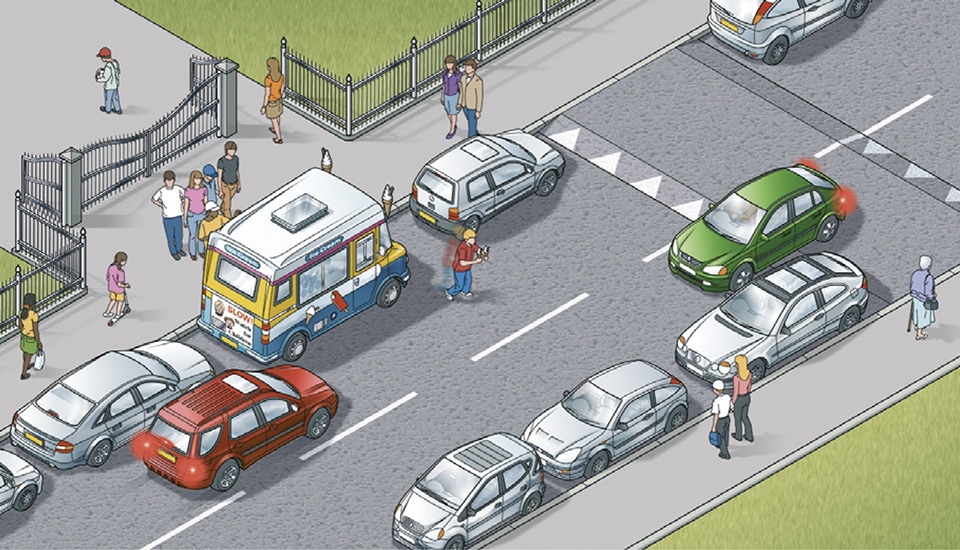
207
Particularly vulnerable pedestrians. These include:
- children and older pedestrians who may not be able to judge your speed and could step into the road in front of you. At 40 mph (64 km/h) your vehicle will probably kill any pedestrians it hits. At 20 mph (32 km/h) there is only a 1 in 20 chance of the pedestrian being killed. So kill your speed
- older pedestrians who may need more time to cross the road. Be patient and allow them to cross in their own time. Do not hurry them by revving your engine or edging forward
- people with disabilities. People with hearing impairments may not be aware of your vehicle approaching. Those with walking difficulties require more time
- blind or partially sighted people, who may be carrying a white cane using a guide dog. They may not be able to see you approaching
- deafblind people who may be carrying a white cane with a red band or using a dog with a red and white harness. They may not see or hear instructions or signals.
208
Near schools. Drive slowly and be particularly aware of young cyclists and pedestrians. In some places, there may be a flashing amber signal below the ‘School’ warning sign which tells you that there may be children crossing the road ahead. Drive very slowly until you are clear of the area.
209
Drive carefully and slowly when passing a stationary bus showing a ‘School Bus’ sign as children may be getting on or off.
You MUST stop when a school crossing patrol shows a ‘Stop for children’ sign (download ‘Signals by authorised persons’) and
‘Traffic signs’).
Law RTRA sect 28
3. Motorcyclists and cyclists (211 to 213)
211
It is often difficult to see motorcyclists and cyclists, especially when they are waiting alongside you, coming up from behind, coming out of or moving off from junctions, at roundabouts, overtaking you or filtering through traffic. Always look out for them before you emerge from a junction; they could be approaching faster than you think.
Do not turn at a junction if to do so would cause the cyclist going straight ahead to stop or swerve, just as you would do with a motor vehicle.
When turning right across a line of slow-moving or stationary traffic, look out for and give way to cyclists or motorcyclists on the inside of the traffic you are crossing. Be especially careful when moving off, turning, and when changing direction or lane. Be sure to check mirrors and blind spots carefully.
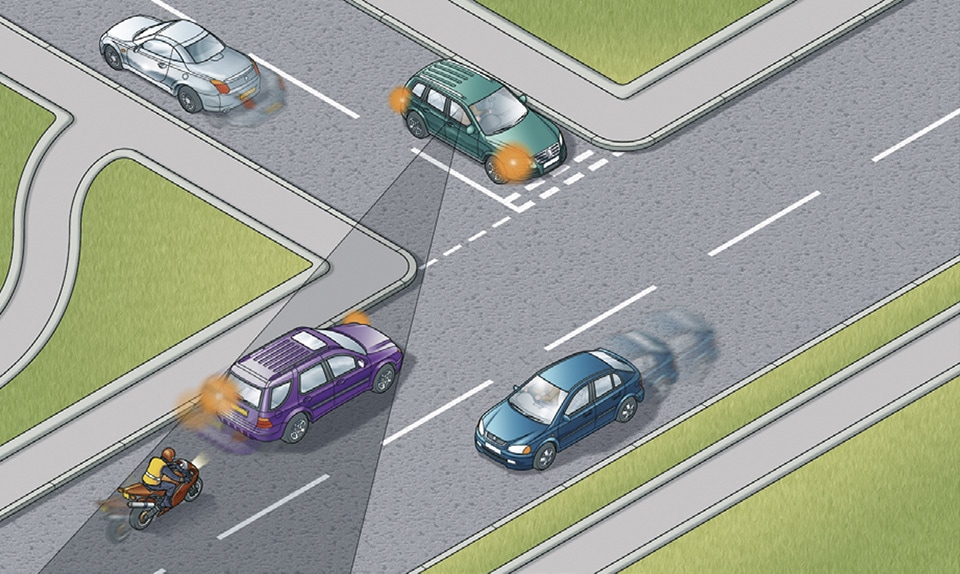
212
Give motorcyclists, cyclists, horse riders, horse drawn vehicles and pedestrians walking in the road (for example, where there is no pavement), at least as much room as you would when overtaking a car (see Rules 162 to 167). Drivers should take extra care and give more space when overtaking motorcyclists, cyclists, horse riders, horse drawn vehicles and pedestrians in bad weather (including high winds) and at night. If the rider looks over their shoulder it could mean that they intend to pull out, turn right or change direction. Give them time and space to do so.
213
On narrow sections of road, on quiet roads or streets, at road junctions and in slower-moving traffic, cyclists may sometimes ride in the centre of the lane, rather than towards the side of the road. It can be safer for groups of cyclists to ride two abreast in these situations. Allow them to do so for their own safety, to ensure they can see and be seen. Cyclists are also advised to ride at least a door’s width or 1 metre from parked cars for their own safety.
On narrow sections of road, horse riders may ride in the centre of the lane. Allow them to do so for their own safety to ensure they can see and be seen.
Motorcyclists, cyclists, horse riders and horse drawn vehicles may suddenly need to avoid uneven road surfaces and obstacles such as drain covers or oily, wet or icy patches on the road. Give them plenty of room and pay particular attention to any sudden change of direction they may have to make.
4. Other road users (214 to 218)
214
Animals. When passing animals, drive slowly. Give them plenty of room and be ready to stop. Do not scare animals by sounding your horn, revving your engine or accelerating rapidly once you have passed them. Look out for animals being led, driven or ridden on the road and take extra care. Keep your speed down at bends and on narrow country roads. If a road is blocked by a herd of animals, stop and switch off your engine until they have left the road. Watch out for animals on unfenced roads.
215
Horse riders and horse-drawn vehicles. Be particularly careful of horse riders and horse-drawn vehicles especially when approaching, overtaking, passing or moving away. Always pass wide and slowly. When you see a horse on a road, you should slow down to a maximum of 10 mph. Be patient, do not sound your horn or rev your engine. When safe to do so, pass wide and slow, allowing at least 2 metres of space.
Feral or semi feral ponies found in areas such as the New Forest, Exmoor and Dartmoor require the same consideration as ridden horses when approaching or passing.
Horse riders are often children, so take extra care and remember riders may ride in double file when escorting a young or inexperienced horse or rider. Look out for horse riders’ and horse drivers’ signals and heed a request to slow down or stop. Take great care and treat all horses as a potential hazard; they can be unpredictable, despite the efforts of their rider/driver. Remember there are three brains at work when you pass a horse; the rider’s, the driver’s and the horse’s. Do not forget horses are flight animals and can move incredibly quickly if startled.
216
Older drivers. Their reactions may be slower than other drivers. Make allowance for this.
217
Learners and inexperienced drivers. They may not be so skilful at anticipating and responding to events. Be particularly patient with learner drivers and young drivers. Drivers who have recently passed their test may display a ‘new driver’ plate or sticker (see Safety code for new drivers).
218
Home Zones and Quiet Lanes. These are places where people could be using the whole of the road for a range of activities such as children playing or for a community event. You should drive slowly and carefully and be prepared to stop to allow people extra time to make space for you to pass them in safety.
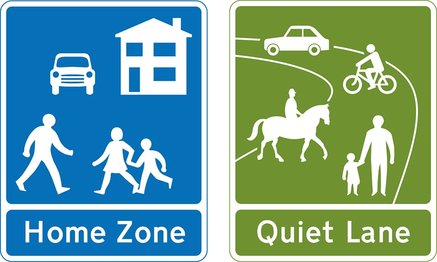
5. Other vehicles (219 to 225)
219
Emergency and Incident Support vehicles. You should look and listen for ambulances, fire engines, police, doctors or other emergency vehicles using flashing blue, red or green lights and sirens or flashing headlights, or Highways Agency Traffic Officer and Incident Support vehicles using flashing amber lights. When one approaches do not panic. Consider the route of such a vehicle and take appropriate action to let it pass, while complying with all traffic signs. If necessary, pull to the side of the road and stop, but try to avoid stopping before the brow of a hill, a bend or narrow section of road. Do not endanger yourself, other road users or pedestrians and avoid mounting the kerb. Do not brake harshly on approach to a junction or roundabout, as a following vehicle may not have the same view as you.
220
Powered vehicles used by disabled people. These small vehicles travel at a maximum speed of 8 mph (12 km/h). On a dual carriageway where the speed limit exceeds 50 mph (80 km/h) they MUST have a flashing amber beacon, but on other roads you may not have that advance warning (see Rules 36 to 46 inclusive).
Law RVLR reg 17(1) & 26
221
Large vehicles. These may need extra road space to turn or to deal with a hazard that you are not able to see. If you are following a large vehicle, such as a bus or articulated lorry, be aware that the driver may not be able to see you in the mirrors. Be prepared to stop and wait if it needs room or time to turn.
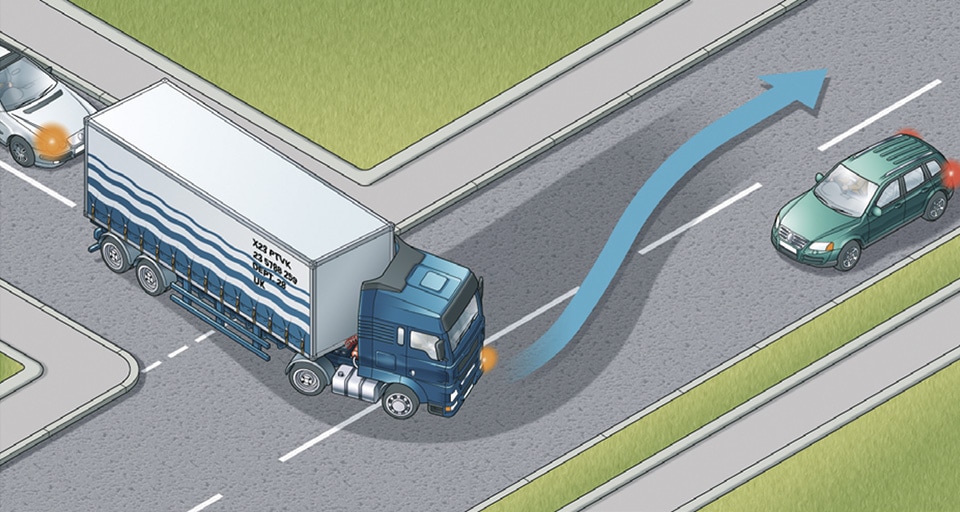
222
Large vehicles can block your view. Your ability to see and to plan ahead will be improved if you pull back to increase your separation distance. Be patient, as larger vehicles are subject to lower speed limits than cars and motorcycles. Many large vehicles may be fitted with speed limiting devices which will restrict speed to 56 mph (90 km/h) even on a motorway.
223
Buses, coaches and trams. Give priority to these vehicles when you can do so safely, especially when they signal to pull away from stops. Look out for people getting off a bus or tram and crossing the road.
224
Electric vehicles. Be careful of electric vehicles such as milk floats and trams. Trams move quickly but silently and cannot steer to avoid you.
225
Vehicles with flashing amber beacons. These warn of a slow-moving or stationary vehicle (such as a Traffic Officer vehicle, salt spreader, snow plough or recovery vehicle) or abnormal loads, so approach with caution. On unrestricted dual carriageways, motor vehicles first used on or after 1 January 1947 with a maximum speed of 25 mph (40 km/h) or less (such as tractors) MUST use a flashing amber beacon (also see Rule 220 above). Law RVLR 1989, reg 17
1. Overview (226)
226
You MUST use headlights when visibility is seriously reduced, generally when you cannot see for more than 100 metres (328 feet). You may also use front or rear fog lights but you MUST switch them off when visibility improves (see Rule 236). Law RVLR regs 25 & 27
2. Wet weather (227)
227
Wet weather
In wet weather, stopping distances will be at least double those required for stopping on dry roads (see ‘Typical stopping distances). This is because your tyres have less grip on the road. In wet weather
- you should keep well back from the vehicle in front. This will increase your ability to see and plan ahead
- if the steering becomes unresponsive, it probably means that water is preventing the tyres from gripping the road. Ease off the accelerator and slow down gradually
- the rain and spray from vehicles may make it difficult to see and be seen
- be aware of the dangers of spilt diesel that will make the surface very slippery (see Annex 6: Vehicle maintenance, safety and security)
- take extra care around pedestrians, cyclists, motorcyclists and horse riders.
3. Icy and snowy weather (228 to 231)
228
In winter check the local weather forecast for warnings of icy or snowy weather. DO NOT drive in these conditions unless your journey is essential. If it is, take great care and allow more time for your journey. Take an emergency kit of de-icer and ice scraper, torch, warm clothing and boots, first aid kit, jump leads and a shovel, together with a warm drink and emergency food in case you get stuck or your vehicle breaks down.
229
Before you set off
- you MUST be able to see, so clear all snow and ice from all your windows
- you MUST ensure that lights are clean and number plates are clearly visible and legible
- make sure the mirrors are clear and the windows are demisted thoroughly
- remove all snow that might fall off into the path of other road users
- check your planned route is clear of delays and that no further snowfalls or severe weather are predicted.
Laws CUR reg 30, RVLR reg 23, VERA sect 43 & RV(DRM)R reg 11
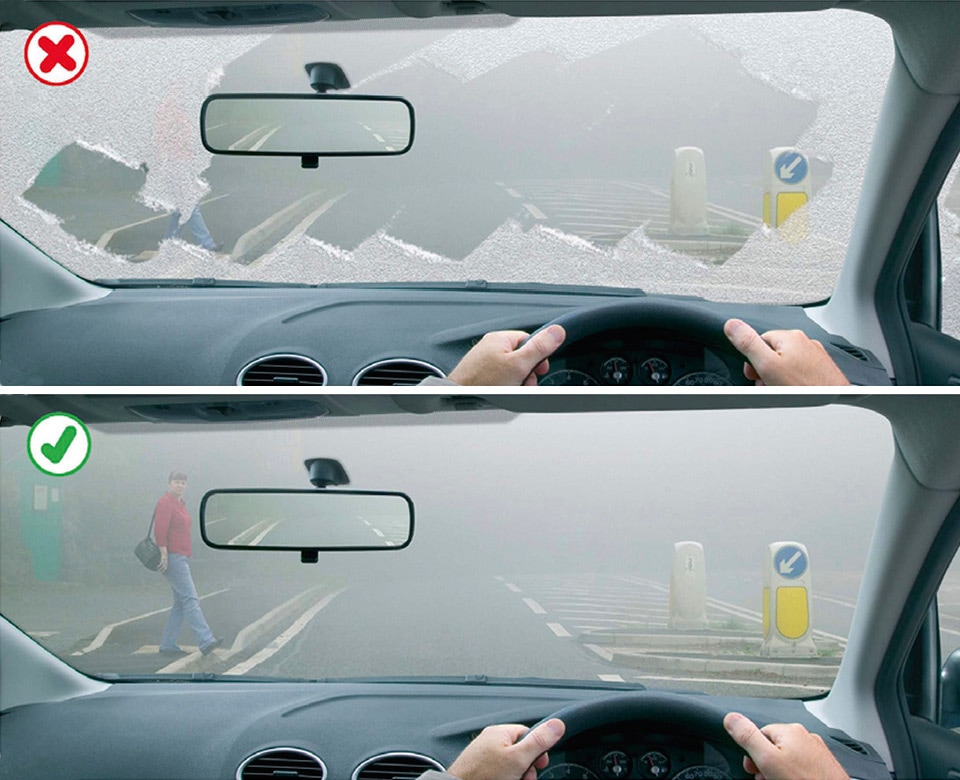
230
When driving in icy or snowy weather
- drive with care, even if the roads have been treated
- keep well back from the road user in front as stopping distances can be ten times greater than on dry roads
- take care when overtaking vehicles spreading salt or other de-icer, particularly if you are riding a motorcycle or cycle
- watch out for snowploughs which may throw out snow on either side. Do not overtake them unless the lane you intend to use has been cleared
- be prepared for the road conditions to change over relatively short distances
- listen to travel bulletins and take note of variable message signs that may provide information about weather, road and traffic conditions ahead.
231
Drive extremely carefully when the roads are icy. Avoid sudden actions as these could cause loss of control. You should
- drive at a slow speed in as high a gear as possible; accelerate and brake very gently
- drive particularly slowly on bends where loss of control is more likely. Brake progressively on the straight before you reach a bend. Having slowed down, steer smoothly round the bend, avoiding sudden actions
- check your grip on the road surface when there is snow or ice by choosing a safe place to brake gently. If the steering feels unresponsive this may indicate ice and your vehicle losing its grip on the road. When travelling on ice, tyres make virtually no noise.
4. Windy weather (232 to 233)
232
High-sided vehicles are most affected by windy weather, but strong gusts can also blow a car, cyclist, motorcyclist or horse rider off course. This can happen on open stretches of road exposed to strong crosswinds, or when passing bridges or gaps in hedges.
233
In very windy weather your vehicle may be affected by turbulence created by large vehicles. Motorcyclists are particularly affected, so keep well back from them when they are overtaking a high-sided vehicle.
5. Fog (234 to 236)
234
Before entering fog check your mirrors then slow down. If ‘Fog’ is shown on a sign but the road is clear, be prepared for a bank of fog or drifting patchy fog ahead. Even if it seems to be clearing, you can suddenly find yourself in thick fog.
235
When driving in fog you should
- use your lights as required (see Rule 226)
- keep a safe distance behind the vehicle in front. Rear lights can give a false sense of security
- be able to pull up well within the distance you can see clearly. This is particularly important on motorways and dual carriageways, as vehicles are travelling faster
- use your windscreen wipers and demisters
- beware of other drivers not using headlights
- not accelerate to get away from a vehicle which is too close behind you
- check your mirrors before you slow down. Then use your brakes so that your brake lights warn drivers behind you that you are slowing down
- stop in the correct position at a junction with limited visibility and listen for traffic. When you are sure it is safe to emerge, do so positively and do not hesitate in a position that puts you directly in the path of approaching vehicles.
236
You MUST NOT use front or rear fog lights unless visibility is seriously reduced (see Rule 226) as they dazzle other road users and can obscure your brake lights. You MUST switch them off when visibility improves.
Law RVLR regs 25 & 27
6. Hot weather (237)
237
Keep your vehicle well ventilated to avoid drowsiness. Be aware that the road surface may become soft or if it rains after a dry spell it may become slippery. These conditions could affect your steering and braking. If you are dazzled by bright sunlight, slow down and if necessary, stop.
1. Waiting and parking (238)
238
You MUST NOT wait or park on yellow lines during the times of operation shown on nearby time plates (or zone entry signs if in a Controlled Parking Zone) – download ‘Traffic signs’ and ‘Road markings’. Double yellow lines indicate a prohibition of waiting at any time even if there are no upright signs. You MUST NOT wait or park, or stop to set down and pick up passengers, on school entrance markings when upright signs indicate a prohibition of stopping.
Law RTRA sects 5 & 8
2. Parking (239 to 247)
239
Use off-street parking areas, or bays marked out with white lines on the road as parking places, wherever possible. If you have to stop on the roadside:
- do not park facing against the traffic flow
- stop as close as you can to the side
- do not stop too close to a vehicle displaying a Blue Badge: remember, the occupant may need more room to get in or out
- you MUST switch off the engine, headlights and fog lights
- you MUST apply the handbrake before leaving the vehicle
- you MUST ensure you do not hit anyone when you open your door. Check for cyclists or other traffic by looking all around and using your mirrors
- where you are able to do so, you should open the door using your hand on the opposite side to the door you are opening; for example, use your left hand to open a door on your right-hand side. This will make you turn your head to look over your shoulder. You are then more likely to avoid causing injury to cyclists or motorcyclists passing you on the road, or to people on the pavement
- it is safer for your passengers (especially children) to get out of the vehicle on the side next to the kerb
- put all valuables out of sight and make sure your vehicle is secure
- lock your vehicle.
Before using a hand-held device to help you to park, you MUST make sure it is safe to do so. Then, you should move the vehicle into the parking space in the safest way, and by the shortest route possible.
When you use a hand-held device to help you to park, you MUST remain in control of the vehicle at all times. Do not use the hand-held device for anything else while you are using it to help you park, and do not put anyone in danger. Use the hand-held device according to the manufacturer’s instructions.
When using an electric vehicle charge point, you should park close to the charge point and avoid creating a trip hazard for pedestrians from trailing cables. Display a warning sign if you can. After using the charge point, you should return charging cables and connectors neatly to minimise the danger to pedestrians and avoid creating an obstacle for other road users.
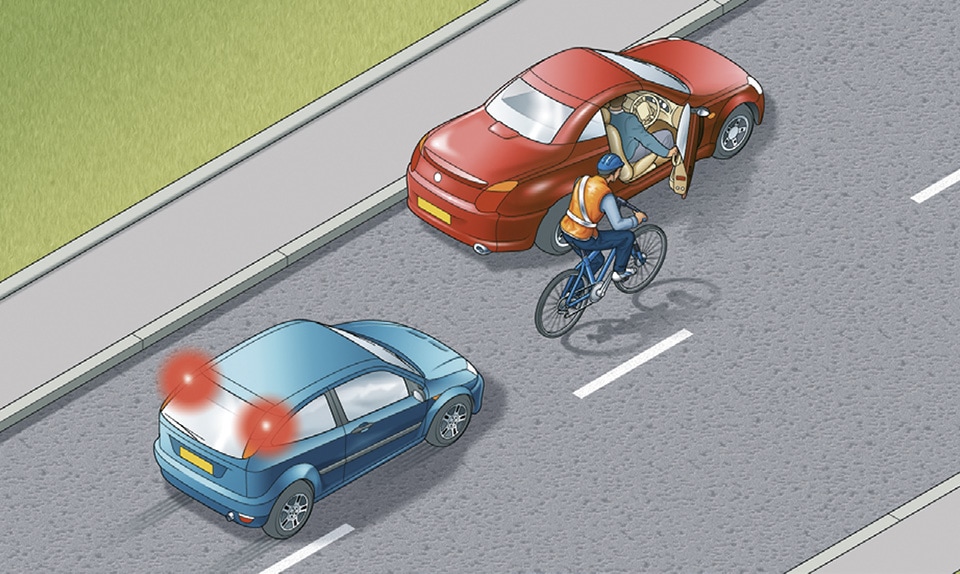
240
You MUST NOT stop or park on
- the carriageway, an emergency area or a hard shoulder of a motorway except in an emergency (see Rules 270 and 271)
- a pedestrian crossing, including the area marked by the zig-zag lines (see Rule 191)
- a clearway (download ‘Traffic signs’)
- taxi bays as indicated by upright signs and markings
- an Urban Clearway within its hours of operation, except to pick up or set down passengers
- a road marked with double white lines, even when a broken white line is on your side of the road, except to pick up or set down passengers, or to load or unload goods
- a tram or cycle lane during its period of operation
- a cycle track
- red lines, in the case of specially designated ‘red routes’, unless otherwise indicated by signs. Any vehicle may enter a bus lane to stop, load or unload where this is not prohibited (see Rule 141).
Laws MT(E&W)R regs 7 & 9, MT(S)R regs 6 & 8, ZPPPCRGD regs 18 & 20, RTRA sects 5, 6 & 8, TSRGD regs 10, 26 & 27, RTA 1988 sects 21(1) & 36
241
You MUST NOT park in parking spaces reserved for specific users, such as Blue Badge holders, residents or motorcycles, unless entitled to do so.
Laws CSDPA sect 21 & RTRA sects 5 & 8
242
You MUST NOT leave your vehicle or trailer in a dangerous position or where it causes any unnecessary obstruction of the road.
Laws RTA 1988, sect 22 & CUR reg 103
243
DO NOT stop or park:
- near a school entrance
- anywhere you would prevent access for Emergency Services
- at or near a bus or tram stop or taxi rank
- on the approach to a level crossing/tramway crossing
- opposite or within 10 metres (32 feet) of a junction, except in an authorised parking space
- near the brow of a hill or hump bridge
- opposite a traffic island or (if this would cause an obstruction) another parked vehicle
- where you would force other traffic to enter a tram lane
- where the kerb has been lowered to help wheelchair users and powered mobility vehicles
- in front of an entrance to a property
- on a bend
- where you would obstruct cyclists’ use of cycle facilities
except when forced to do so by stationary traffic.
In Scotland you MUST NOT double park or park anywhere the kerb has been lowered to help pedestrians or cyclists. Exceptions are allowed in limited circumstances.
Law T(Scot)A part 6
244
You MUST NOT park partially or wholly on the pavement in London or Scotland. Exceptions are allowed in limited circumstances. You should not park partially or wholly on the pavement elsewhere unless signs permit it. Parking on the pavement can obstruct and seriously inconvenience pedestrians, people in wheelchairs or with visual impairments and people with prams or pushchairs.
Law GL(GP)A sect 15 & T(Scot)A part 6
245
Controlled Parking Zones. The zone entry signs indicate the times when the waiting restrictions within the zone are in force. Parking may be allowed in some places at other times. Otherwise parking will be within separately signed and marked bays.
246
Goods vehicles. Vehicles with a maximum laden weight of over 7.5 tonnes (including any trailer) MUST NOT be parked on a verge, pavement or any land situated between carriageways, without police permission. The only exception is when parking is essential for loading and unloading, in which case the vehicle MUST NOT be left unattended.
Law RTA 1988 sect 19
247
Loading and unloading. Do not load or unload where there are yellow markings on the kerb and upright signs advise restrictions are in place (see pages 115-116). This may be permitted where parking is otherwise restricted. On red routes, specially marked and signed bays indicate where and when loading and unloading is permitted.
Law RTRA sects 5 & 8
3. Parking at night (248 to 252)
248
You MUST NOT park on a road at night facing against the direction of the traffic flow unless in a recognised parking space. Laws CUR reg 101 & RVLR reg 24
249
All vehicles MUST display parking lights when parked on a road or a lay-by on a road with a speed limit greater than 30 mph (48 km/h).
Law RVLR reg 24
250
Cars, goods vehicles not exceeding 1525 kg unladen weight, invalid carriages, motorcycles and pedal cycles may be parked without lights on a road (or lay-by) with a speed limit of 30 mph (48 km/h) or less if they are
- at least 10 metres (32 feet) away from any junction, close to the kerb and facing in the direction of the traffic flow
- in a recognised parking place or lay-by.
Other vehicles and trailers, and all vehicles with projecting loads,MUST NOT be left on a road at night without lights.
Laws RVLR reg 24 & CUR reg 82(7)
251
Parking in fog. It is especially dangerous to park on the road in fog. If it is unavoidable, leave your parking lights or sidelights on.
252
Parking on hills. If you park on a hill you should
- park close to the kerb and apply the handbrake firmly
- select a forward gear and turn your steering wheel away from the kerb when facing uphill
- select reverse gear and turn your steering wheel towards the kerb when facing downhill
- use ‘park’ if your car has an automatic gearbox.
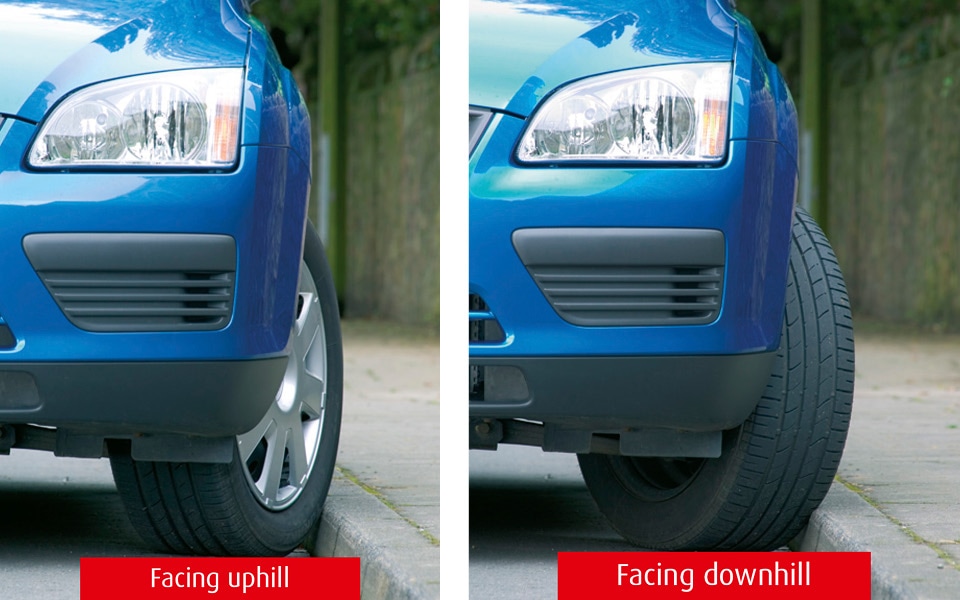
4. Decriminalised Parking Enforcement
DPE is becoming increasingly common as more authorities take on this role. The local traffic authority assumes responsibility for enforcing many parking contraventions in place of the police. Further details on DPE may be found at the following websites:
Traffic penalty tribunal (outside London)
Parking and traffic appeals service (inside London)
1. General (253 to 254)
Rules for motorways, including rules for signals, joining the motorway, driving on the motorway, lane discipline, overtaking, stopping and leaving the motorway. A number of the rules for motorways also apply to other high-speed roads.
A number of the rules for motorways also apply to other high-speed roads. Many other Rules apply to motorway driving, either wholly or in part: Rules 46, 57, 83 to 88, 89 to 102, 103 to 126, 130 to 134, 139, 144, 146 to 151, 160 to 161, 219, 221 to 222, 225, 226-237, 274 to 278, 280 to 287 and 288 to 290.
253
Prohibited vehicles. Motorways MUST NOT be used by pedestrians, holders of provisional motorcycle or car licences, riders of motorcycles under 50 cc, cyclists, horse riders, certain slow-moving vehicles and those carrying oversized loads (except by special permission), agricultural vehicles, and powered wheelchairs/powered mobility scooters (see Rules 36 to 46 inclusive).
Provisional car licence holders MUST NOT drive on the motorway unless they are accompanied by a DVSA Approved Driving Instructor (ADI) and are driving a car displaying red L plates (or D plates in Wales) with dual controls.
Laws HA 1980 sects 16, 17 & sch 4, MT(E&W)R regs 3(d), 4 & 11, MT(E&W)(A)R, R(S)A sects 7, 8 & sch 3, RTRA sects 17(2) & (3), & MT(S)R reg 10
254
Traffic on motorways usually travels faster than on other roads, so you have less time to react. It is especially important to use your mirrors earlier and look much further ahead than you would on other roads.
2. Motorway signals (255 to 258)
255
Signs and signals (download ‘Light signals controlling traffic’) are used to warn you of hazards ahead. For example, there may be an incident, fog, a spillage or road workers on the carriageway which you may not immediately be able to see.
256
A single sign or signal can display advice, restrictions and warnings for all lanes.
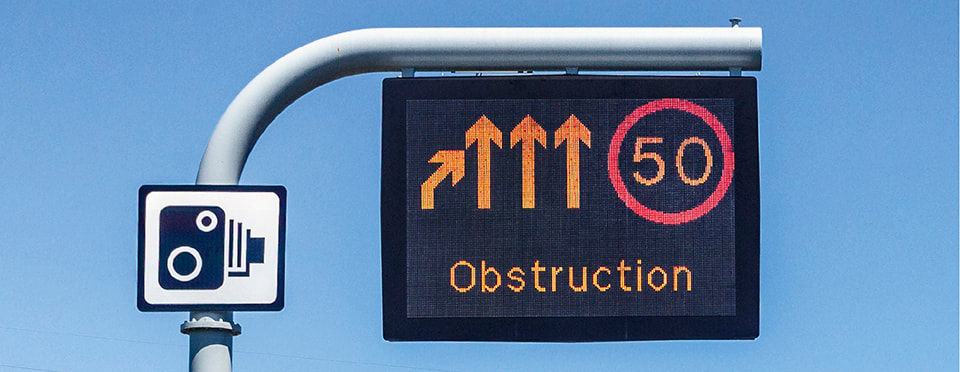
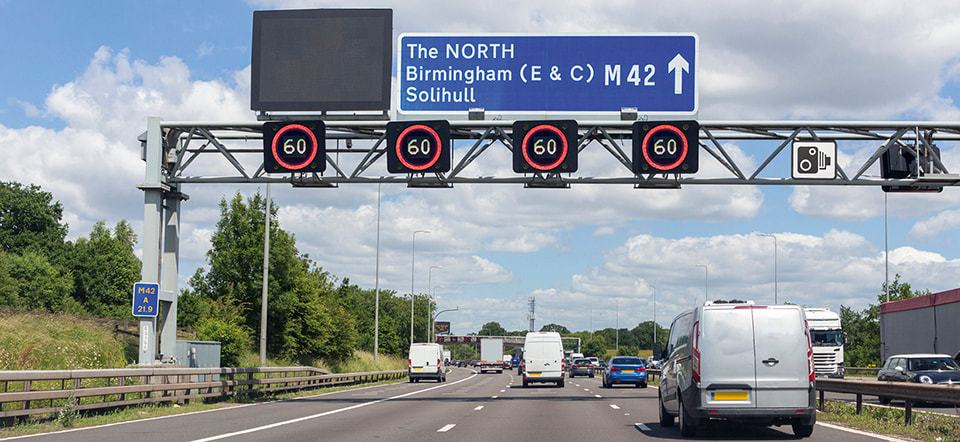
257
Amber flashing lights. These signals warn of a hazard ahead. You should
- reduce your speed
- be prepared for the hazard
- only increase your speed when you pass a signal that is not flashing, or a sign displaying a national speed limit or the word ‘END’, and you are sure it is safe to do so.
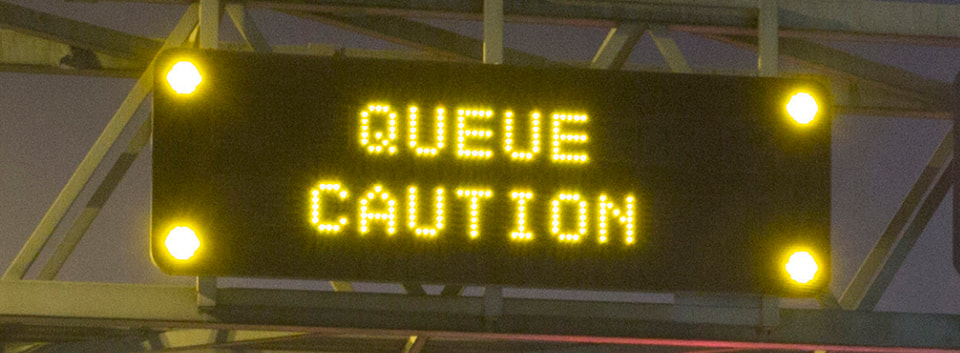
258
Red flashing light signals and a red ‘X’ on a sign identify a closed lane in which people, stopped vehicles or other hazards are present. You
- MUST follow the instructions on signs in advance of a closed lane to move safely to an open lane
- MUST NOT drive in a closed lane. A sign will inform you when the lane is no longer closed by displaying a speed limit or the word ‘END’
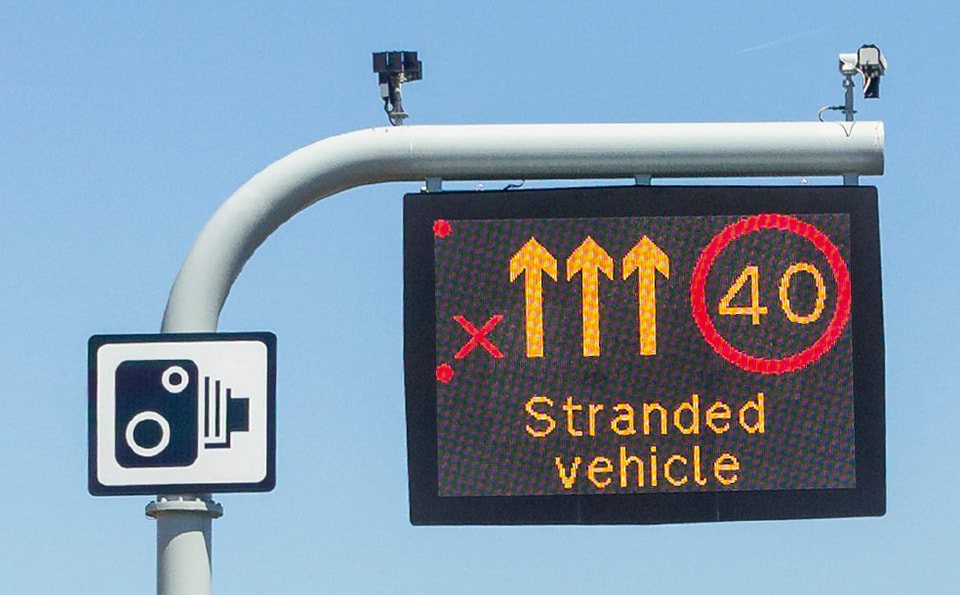
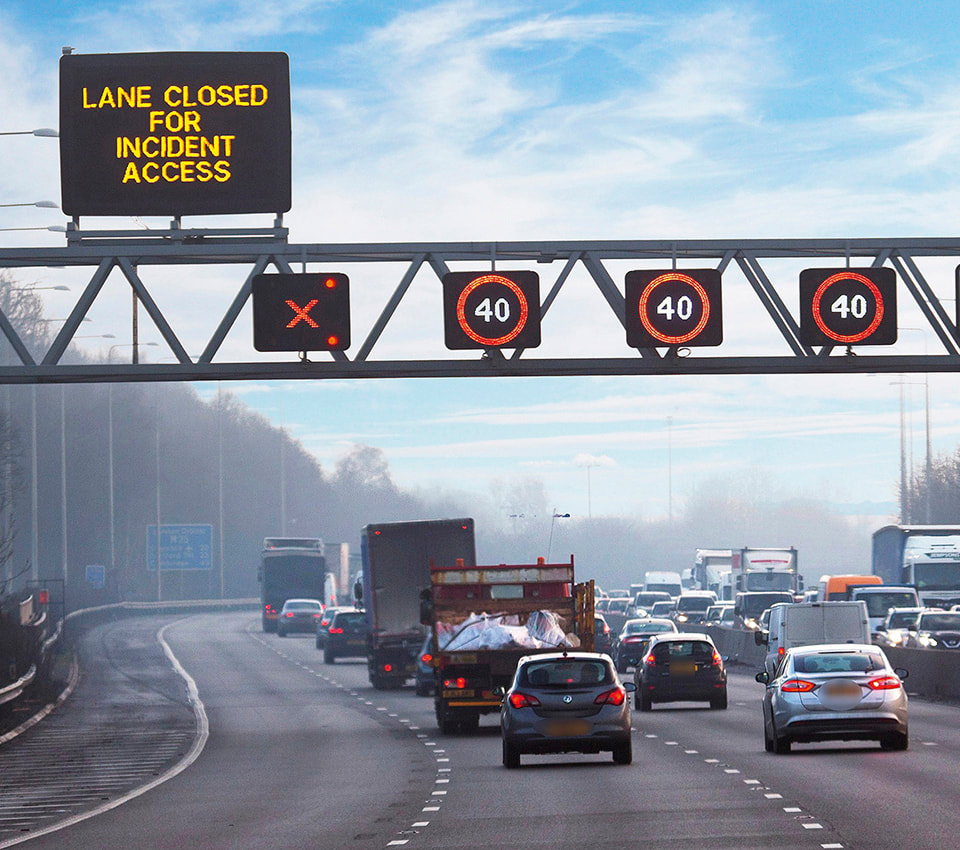
Be aware that
- there can be several hazards in a closed lane
- emergency services and traffic authorities use closed lanes to reach incidents and help people in need
- where the left lane is closed at an exit slip road, this means that the exit cannot be used.
Where red flashing light signals and closure of all lanes are shown on a sign, the road is closed. You
- MUST NOT go beyond the sign in any lane or use the hard shoulder to avoid the road closure unless directed to do so by a police or traffic officer.
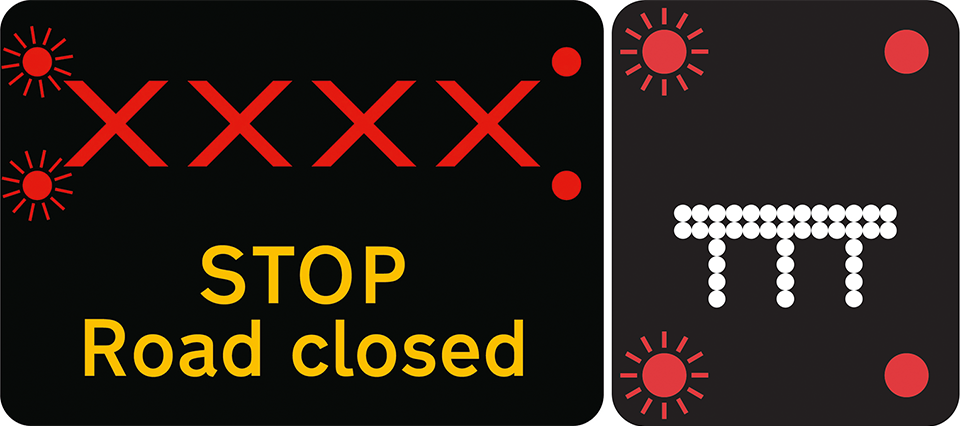
Laws RTA 1988 sects 35 & 36 as amended by TMA sect 6, TSRGD 2016 reg 3 and sched 15, MT(E&W)R reg 9 & MT(S)R reg 8.
3. Joining the motorway (259)
259
Joining the motorway. When you join the motorway you will normally approach it from a road on the left (a slip road) or from an adjoining motorway. You should
- give priority to traffic already on the motorway
- check the traffic on the motorway and match your speed to fit safely into the traffic flow in the left-hand lane
- not cross solid white lines that separate lanes or use the hard shoulder
- stay on the slip road if it continues as an extra lane on the motorway
- remain in the left-hand lane long enough to adjust to the speed of traffic before considering overtaking.
4. On the motorway (260 to 263)
260
When you can see well ahead and the road conditions are good, you should
- drive at a steady cruising speed which you and your vehicle can handle safely and is within the speed limit (see the Speed limits table)
- keep a safe distance from the vehicle in front and increase the gap on wet or icy roads, or in fog (see Rules 126 and 235).
261
You MUST NOT exceed
- a speed limit displayed within a red circle on a sign
- the maximum speed limit for the road and for your vehicle (see Rule 124).
Speed limits are enforced by the police (see Rule 124).
Law RTRA sects 17, 86, 89 & sch 6
262
The monotony of driving on motorways and other high-speed roads can make you feel sleepy. To minimise the risk, follow the advice in Rule 91 about ensuring you are fit to drive and taking breaks.
Service areas are located along motorways to allow you to take breaks and to obtain refreshments. Refreshment and rest facilities on the local road network may also be accessible from motorway exits.
263
Unless directed to do so by a police or traffic officer, you MUST NOT
- reverse along any part of a motorway, including slip roads, hard shoulders and emergency areas
- cross the central reservation
- drive against the traffic flow.
If you have missed your exit, or have taken the wrong route, carry on to the next exit.
Laws MT(E&W)R regs 6, 8 & 10 & MT(S)R regs 4, 5, 7 & 9
5. Lane discipline (264 to 266)
264
Keep in the left lane unless overtaking.
- If you are overtaking, you should return to the left lane when it is safe to do so (see also Rules 267 and 268).
- Be aware of emergency services, traffic officers, recovery workers and other people or vehicles stopped on the hard shoulder or in an emergency area. If you are driving in the left lane, and it is safe to do so, you should move into the adjacent lane to create more space between your vehicle and the people and stopped vehicles.
Laws MT(E&W)R regs 5, 9 & 16(1)(a), MT(S)R regs 4, 8 & 14(1)(a), and RTA 1988, sects 35 & 186, as amended by TMA 2004 sect 6
265
The right-hand lane of a motorway with three or more lanes MUST NOT be used (except in prescribed circumstances) if you are driving
- any vehicle drawing a trailer
- a goods vehicle with a maximum laden weight exceeding 3.5 tonnes but not exceeding 7.5 tonnes, which is required to be fitted with a speed limiter
- a goods vehicle with a maximum laden weight exceeding 7.5 tonnes
- a passenger vehicle with a maximum laden weight exceeding 7.5 tonnes constructed or adapted to carry more than eight seated passengers in addition to the driver
- a passenger vehicle with a maximum laden weight not exceeding 7.5 tonnes which is constructed or adapted to carry more than eight seated passengers in addition to the driver, which is required to be fitted with a speed limiter.
Laws MT(E&W)R reg 12, MT(E&W)AR (2004), MT(S)R reg 11 & MT(S)AR (2004)
266
Approaching a junction. Look well ahead for signals, signs and road markings. Direction signs may be placed over the road. If you need to, you should change lanes well ahead of a junction. At some junctions, a lane may lead directly off the road. Only get in that lane if you wish to go in the direction indicated by signs or road markings.
6. Overtaking (267 to 269)
267
Do not overtake unless you are sure it is safe and legal to do so. Overtake only on the right. You should
- check your mirrors
- take time to judge the speeds correctly
- make sure that the lane you will be joining is sufficiently clear ahead and behind
- take a quick sideways glance into the blind spot area to verify the position of a vehicle that may have disappeared from your view in the mirror
- remember that traffic may be coming up behind you very quickly. Check all your mirrors carefully. Look out for motorcyclists. When it is safe to do so, signal in plenty of time, then move out
- ensure you do not cut in on the vehicle you have overtaken
- be especially careful at night and in poor visibility when it is harder to judge speed and distance.
268
Do not overtake on the left or move to a lane on your left to overtake. In congested conditions, where adjacent lanes of traffic are moving at similar speeds, traffic in left-hand lanes may sometimes be moving faster than traffic to the right. In these conditions you may keep up with the traffic in your lane even if this means passing traffic in the lane to your right. Do not weave in and out of lanes to overtake.
269
Hard shoulder (where present). You MUST NOT use a hard shoulder except in an emergency or if directed to do so by the police, traffic officers or a traffic sign.
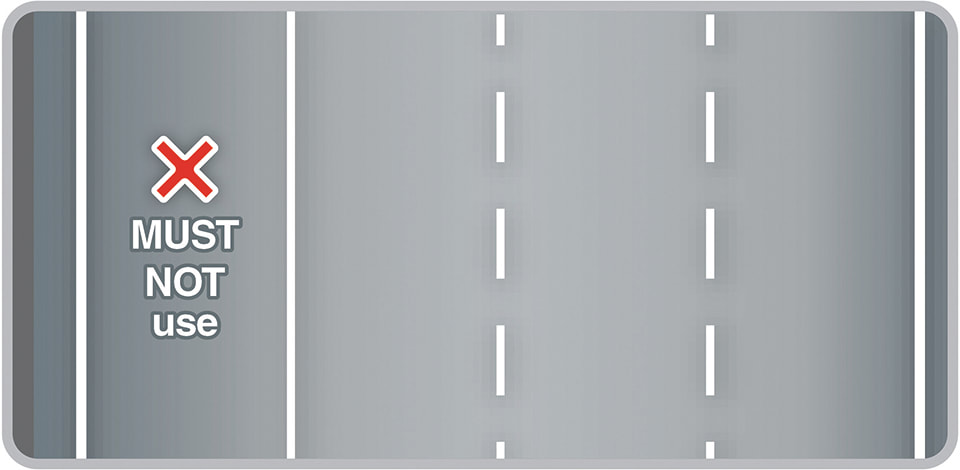
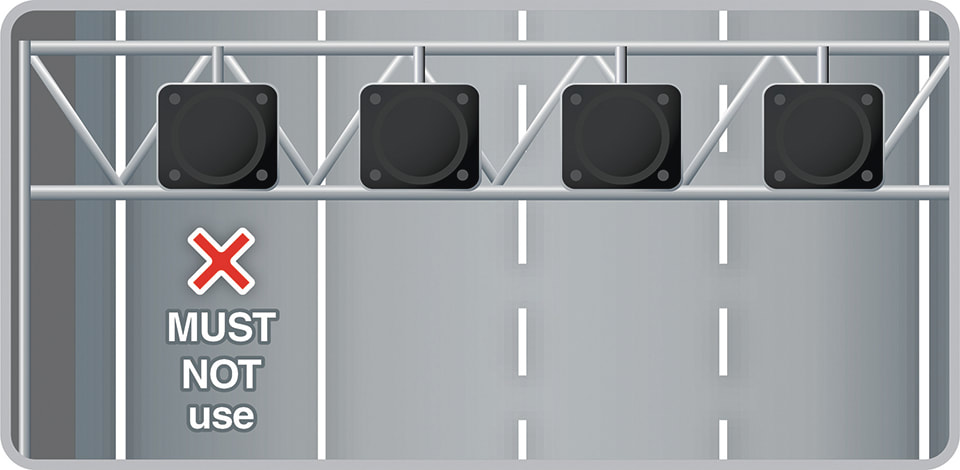
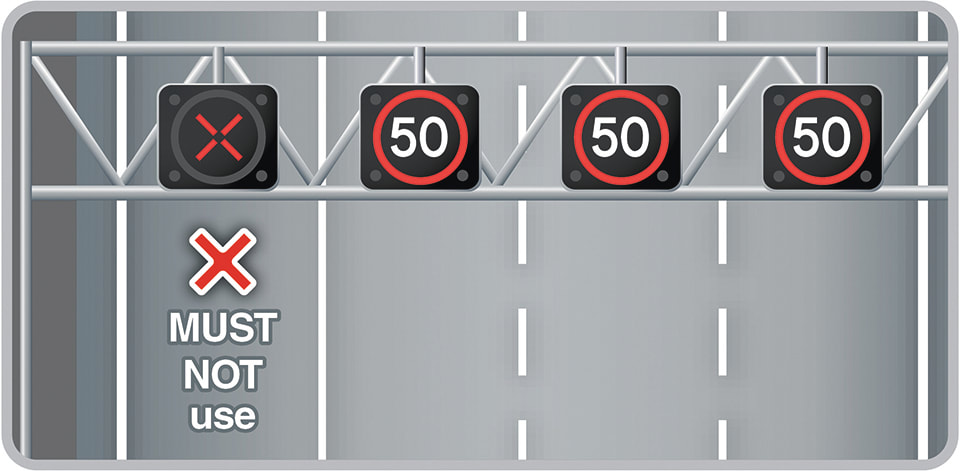
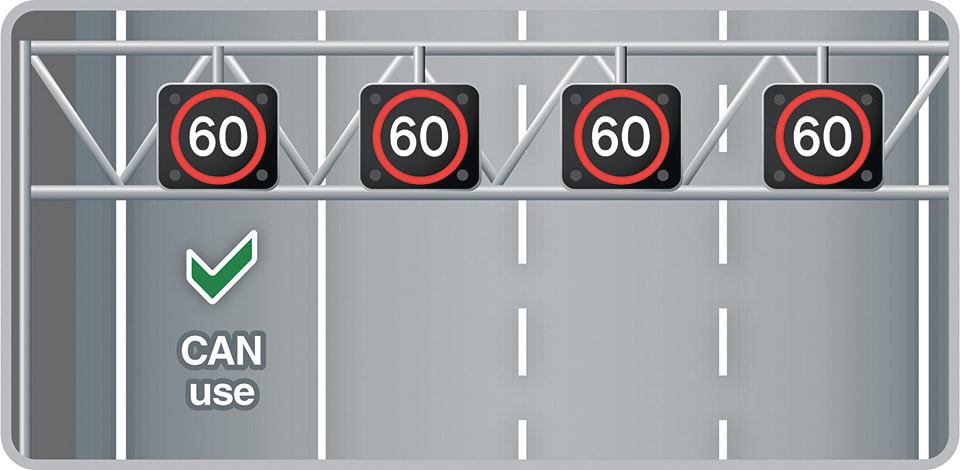
7. Stopping (270 to 271)
Emergency areas are located along motorways with no hard shoulder or where the hard shoulder can be used as an extra lane (see Rule 269) and MUST only be used in an emergency.
They are marked by blue signs with an orange SOS telephone symbol and may have orange surfacing.
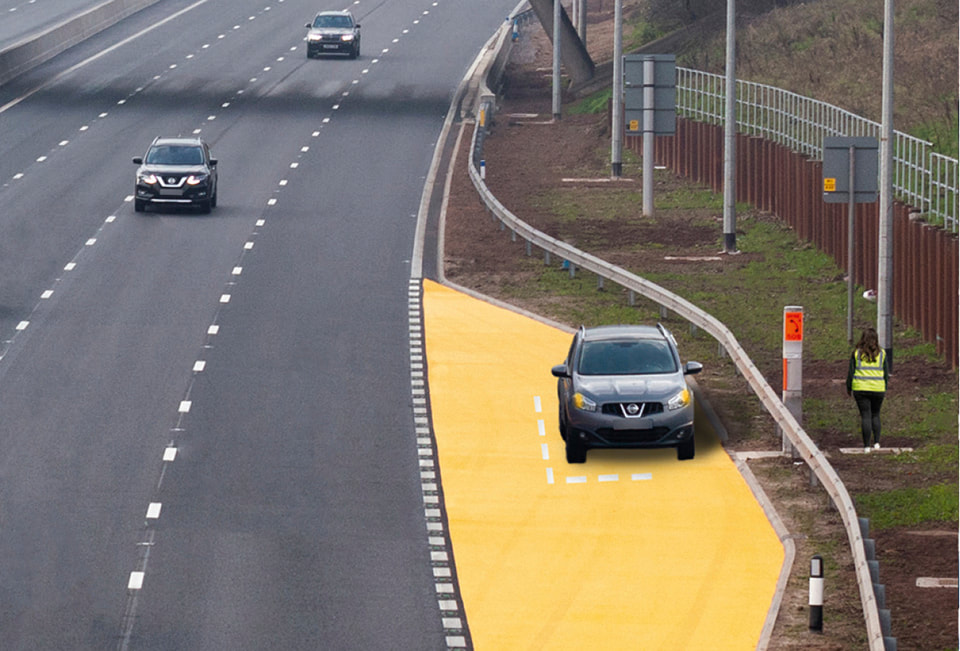
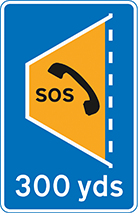
Follow the requirements and advice in
- Rule 277 if your vehicle develops a problem on the motorway
- Rule 278 to rejoin the carriageway from an emergency area.
Laws MT(E&W)R regs 5A, 7, 9, 10 & 16,MT(S)R regs 6(1), 8, 9 & 14, PRA 2002 sect 41 & sched 5(8), & RTA 1988 sects 35 & 163 as amended by TMA 2004, sect 6
271
You MUST NOT stop on any carriageway, emergency area, hard shoulder, slip road, central reservation or verge except in an emergency, or when told to do so by the police, traffic officers, an emergency sign or by red flashing light signals.
Do not stop on any part of a motorway to make or receive mobile telephone calls, except in an emergency.
272
You MUST NOT pick up or set down anyone, or walk on a motorway, except in an emergency.
Laws RTRA sect 17 & MT(E&W)R reg 15
8. Leaving the motorway (273 to 274)
273
Unless signs indicate that a lane leads directly off the motorway, you will normally leave the motorway by a slip road on your left. You should
- watch for the signs letting you know you are getting near your exit
- move into the left-hand lane well before reaching your exit
- signal left in good time and reduce your speed on the slip road as necessary.
274
On leaving the motorway or using a link road between motorways, your speed may be higher than you realise - 50 mph may feel like 30 mph. Check your speedometer and adjust your speed accordingly. Some slip-roads and link roads have sharp bends, so you will need to slow down.
Place of relative safety (rule 275)
275
If you need to stop your vehicle in the event of a breakdown or incident, try to stop in a place of relative safety. A place of relative safety is where you, your passengers and your vehicle are less likely to be at risk from moving traffic.
The safest place to stop is a location which is designed for parking. On motorways and other high-speed roads, the safest place to stop is a service area. Other places of relative safety include
- lay-bys
- emergency areas (see Rule 270)
- hard shoulders (see Rule 269).
Be aware that hard shoulders provide less protection than other places of relative safety because they are so close to high-speed traffic.
You and your passengers should, where possible, keep well away from your vehicle and moving traffic. Otherwise moving traffic could collide with your vehicle, forcing it into you and your passengers.
Breakdowns (276)
276
If your vehicle breaks down, think first of all other road users and
- get your vehicle off the road if possible
- warn other traffic by using your hazard warning lights if your vehicle is causing an obstruction
- help other road users see you by wearing light-coloured or fluorescent clothing in daylight and reflective clothing at night or in poor visibility
- put a warning triangle on the road at least 45 metres (147 feet) behind your broken-down vehicle on the same side of the road, or use other permitted warning devices if you have them. Always take great care when placing or retrieving them, but never use them on motorways
- if possible, keep your sidelights on if it is dark or visibility is poor
- do not stand (or let anybody else stand) between your vehicle and oncoming traffic
- at night or in poor visibility do not stand where you will prevent other road users seeing your lights
Additional rules for motorways (276 to 279)
277
If your vehicle develops a problem, leave the carriageway at the next exit or pull into a service area if possible (see Rule 275 for places of relative safety). If you cannot, you should
Go left
- move into the left lane
- pull into an emergency area or onto a hard shoulder if you can
- stop as far to the left as possible, leaving space to exit your vehicle and with your wheels turned to the left
- if you can, stop just beyond an emergency telephone
- switch your hazard warning lights on
- if it’s dark or visibility is poor, use sidelights.
Get safe
- exit your vehicle by the side furthest from traffic, if it is safe and possible to do so, and ensure passengers do the same
If you can’t
- get your vehicle to the left lane or a place of relative safety (see Rule 275), and
- exit your vehicle safely to get well away from it and moving traffic,
you should
- stay in your vehicle
- keep your seatbelts and hazard warning lights on
- call 999 immediately and ask for the police. Alternatively, press your SOS button if your vehicle has one and ask for the police.
- put on high-visibility clothing if you have it and it is within easy reach
- get behind a safety barrier where there is one, but be aware of any unseen hazards such as sudden drops, uneven ground or debris
- DO NOT stand in a place where your vehicle could be forced into you if moving traffic collides with it
- DO NOT return to your vehicle even if it’s raining, cold or dark
- remain alert and aware of vehicles or debris coming towards you
- keep passengers away from the carriageway and children under control
- DO NOT attempt repairs on your vehicle
- DO NOT place a warning triangle on the carriageway
- animals MUST be kept in the vehicle or, in an emergency, under control on the verge.
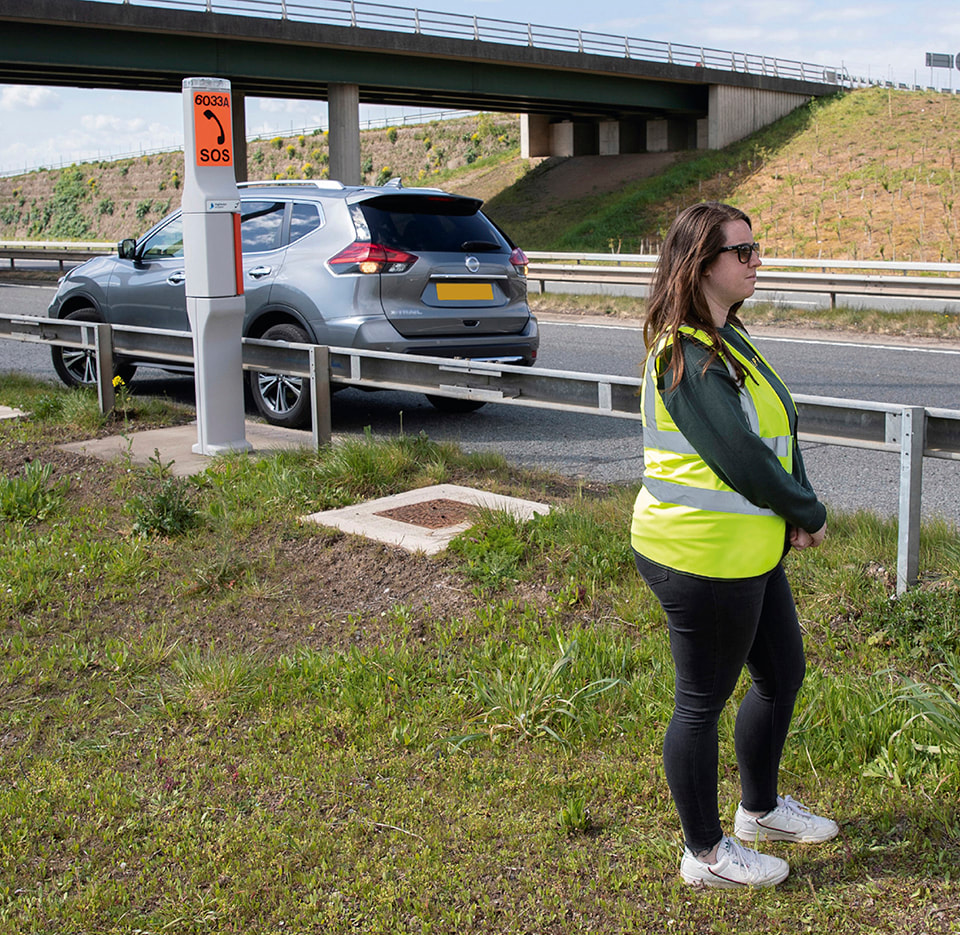
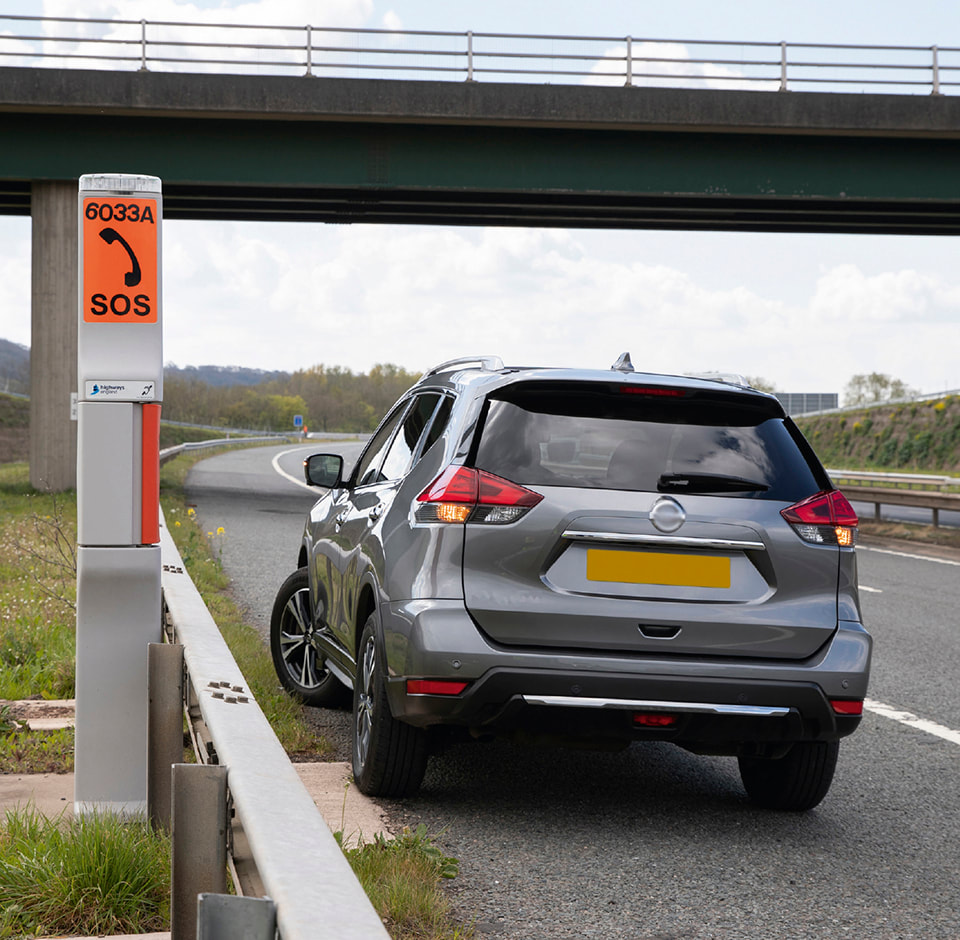
Get help
- use the free emergency telephone to obtain advice and assistance
- contact a breakdown recovery service
- always face the traffic when you speak to remain aware of vehicles or debris coming towards you
- inform them if you are a vulnerable motorist such as disabled, older or travelling alone
- wait well away from your vehicle and moving traffic, behind the safety barrier where there is one
- if you are unable to exit your vehicle or if you have not stopped near a free emergency telephone, call 999 immediately and ask for the police. Alternatively, press your SOS button if your vehicle has one and ask for the police.
Communicating your location. How to identify your location to the emergency services.
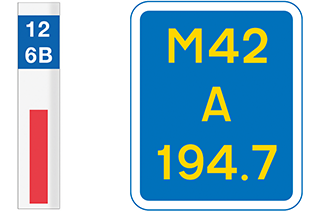
278
To rejoin the carriageway after a breakdown from
- a hard shoulder, build up speed, indicate and watch for a safe gap in the traffic. Be aware that vehicles, obstructions or debris may be present on the hard shoulder
- an emergency area, you MUST use the emergency telephone provided and follow the operator’s advice for exiting the emergency area. A lane may need to be closed so that you can rejoin the carriageway safely.
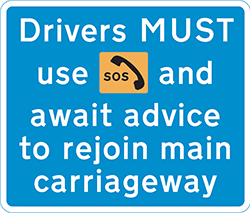
Rule 297
Disabled drivers. If you have a disability that prevents you from following the above advice in Rules 277 and 278, you should
- switch on your hazard warning lights
- stay in your vehicle and keep your seat belt on
- call 999 immediately and ask for the police. Alternatively, press your SOS button if your vehicle has one and ask for the police.
If you are deaf, hard of hearing or speech impaired, it is recommended that you register for the 999 text service (emergencySMS.net) before making a journey.
Obstructions (280)
280
If anything falls from a vehicle on to a motorway or other high-speed road, DO NOT remove the obstruction yourself. Stop in a place of relative safety (see Rule 275) and call the emergency services on 999.
On other roads, you should only remove obstructions if it is safe to do so.
Incidents (281 to 283)
281
Warning signs or flashing lights. If you see emergency or incident support vehicles displaying flashing lights in the distance, be aware there may be an incident ahead (see Rule 219). You should slow down and be prepared to move safely into another lane or stop.
The emergency services, traffic officers and recovery workers may be required to work in the carriageway; for example, dealing with debris, collisions or conducting rolling roadblocks. You MUST follow any directions given by police or traffic officers as to whether you can safely pass the incident or obstruction.
Laws RTA1988, sects 35 &163, and as amended by TMA 2004, sect 6
282
When passing the scene of an incident, remain alert for hazards (such as debris or slow-moving vehicles) and do not slow down unnecessarily (for example, if an incident is on the other side of a dual carriageway). You should focus on the road ahead when passing an incident because a lack of attention may cause a further incident, collision or congestion (see also Rule 283, below).
283
If you are involved in an incident or collision or stop to give assistance
- if possible, stop in a place of relative safety (see Rule 275)
- use your hazard warning lights to warn other traffic
- put on high-visibility clothing if you have it
- ask drivers to switch off their engines
- ask drivers and passengers to stop smoking
- contact the emergency services on 999 and provide full details of the incident location and any casualties. Use an emergency telephone, a mobile telephone, or press the SOS button if your vehicle has one (see Rule 277 on how to identify your location on a motorway or other high-speed road)
- move uninjured people away from the vehicles to a place of relative safety (see Rule 275)
- DO NOT move injured people from their vehicles unless they are in immediate danger
- DO NOT remove a motorcyclist’s helmet unless it is essential and you are trained to do so
- be prepared to give first aid (see Annex 7 and Useful websites)
- stay at the scene until the emergency services arrive
- be prepared to exchange details (see Rule 286).
If you are involved in any other medical emergency, you should contact the emergency services in the same way.
Incidents involving dangerous goods (284 to 285)
284
Vehicles carrying dangerous goods in packages will be marked with plain orange reflective plates. Road tankers and vehicles carrying tank containers of dangerous goods will have hazard warning plates (download ‘Vehicle markings’).
285
If an incident involves a vehicle containing dangerous goods, follow the advice in Rule 283 and, in particular
- switch off engines and DO NOT SMOKE
- keep well away from the vehicle and do not be tempted to try to rescue casualties as you yourself could become one
- call the emergency services and give as much information as possible about the labels and markings on the vehicle. DO NOT use a mobile phone close to a vehicle carrying flammable loads.
Documentation (286 to 287)
286
If you are involved in a collision which causes damage or injury to any other person, vehicle, animal or property, you MUST
- stop. If possible, stop in a place of relative safety (see Rule 275
- give your own and the vehicle owner’s name and address, and the registration number of the vehicle, to anyone having reasonable grounds for requiring them
- if you do not give your name and address at the time of the collision, report it to the police as soon as reasonably practicable, and in any case within 24 hours.
Law RTA 1988 sect 170
287
If another person is injured and you do not produce your insurance certificate at the time of the crash to a police officer or to anyone having reasonable grounds to request it, you MUST
- report it to the police as soon as possible and in any case within 24 hours
- produce your insurance certificate for the police within seven days.
Law RTA 1988 sect 170
1. Road works (288)
288
When the ‘Road Works Ahead’ sign is displayed, take extra care and look for additional signs providing more specific instructions. Observe all signs – they are there for your safety and the safety of road workers.
- You MUST NOT exceed any temporary maximum speed limit.
- Keep a safe distance from the vehicle in front (see Rule 126).
- Use your mirrors and get into the correct lane for your vehicle in good time and as signs direct.
- Do not switch lanes to overtake queuing traffic.
- Take extra care near cyclists and motorcyclists as they are vulnerable to skidding on grit, mud or other debris at road works.
- Where lanes are restricted due to road works, merge in turn (see Rule 134).
- Do not drive through an area marked off by traffic cones.
- Watch out for vehicles entering or leaving the works area. Where vehicles are travelling in the road and are displaying amber warning lights, leave extra space and expect them to slow or turn into a works area.
- Concentrate on the road ahead, not the road works.
- Bear in mind that the road ahead may be obstructed by the works or by slow-moving or stationary traffic.
2. Additional rules for high-speed roads (289 to 290)
289
Take special care on motorways and other high-speed dual carriageways.
- Lanes may be closed to traffic and a lower speed limit may apply.
- Works vehicles may be used to close lanes or carriageways for repairs. Where large ‘Keep Left’ or ‘Keep Right’ signs are displayed on the back, you MUST move over and pass the works vehicle on the side indicated and not return to the closed lane until you can see it is safe to do so.
- Where a vehicle displays the sign ‘CONVOY VEHICLE NO OVERTAKING’, you MUST NOT pass the vehicle. A flashing light arrow or red ‘X’ may also be used to make the works vehicle more visible from a distance and give earlier warning to drivers.
290
Road works may contain features that require extra care.
- Narrow lanes. Lanes may be narrower than normal and will be marked by studs or temporary road markings. Keep a safe distance (see Rule 126) from the vehicle in front and make sure you can clearly see the edges of the lane ahead.
- Contraflow systems. These mean that you may be travelling in a narrower lane than normal and with no permanent barrier between you and oncoming traffic. At the start and finish of contraflows, you should slow down and increase the distance to the vehicle in front because changes in the camber of the road may affect vehicle stability.
- Breakdown advice. If your vehicle breaks down in road works, follow Rules 275, 277 and 278 but be aware that areas marked off by cones contain significant hazards. Where available, you should move your vehicle into a signed road works refuge location. Signs indicate where dedicated recovery services are provided.
3. Level crossings (291 to 299)
291
A level crossing is where a road crosses a railway or tramway line. Approach and cross it with care. Never drive onto a crossing until the road is clear on the other side and do not get too close to the car in front. Never stop or park on, or near, a crossing.
Overhead electric lines
292
It is dangerous to touch overhead electric lines. You MUST obey the safe height warning road signs and you should not continue forward onto the railway if your vehicle touches any height barrier or bells. The clearance available is usually 5 metres (16 feet 6 inches) but may be lower.
Laws RTA 1988 sect 36, TSRGD 2002 reg 17(5)
293
Controlled Crossings. Most crossings have traffic light signals with a steady amber light, twin flashing red stop lights (download ‘Light signals controlling traffic’ and ‘Traffic signs’) and an audible alarm for pedestrians. They may have full, half or no barriers.
- You MUST always obey the flashing red stop lights.
- You MUST stop behind the white line across the road.
- Keep going if you have already crossed the white line when the amber light comes on.
- Do not reverse onto or over a controlled crossing.
- You MUST wait if a train goes by and the red lights continue to flash. This means another train will be passing soon.
- Only cross when the lights go off and barriers open.
- Never zig-zag around half-barriers, they lower automatically because a train is approaching.
- At crossings where there are no barriers, a train is approaching when the lights show.
Laws RTA 1988 sect 36 & TSRGD regs 10 & 40
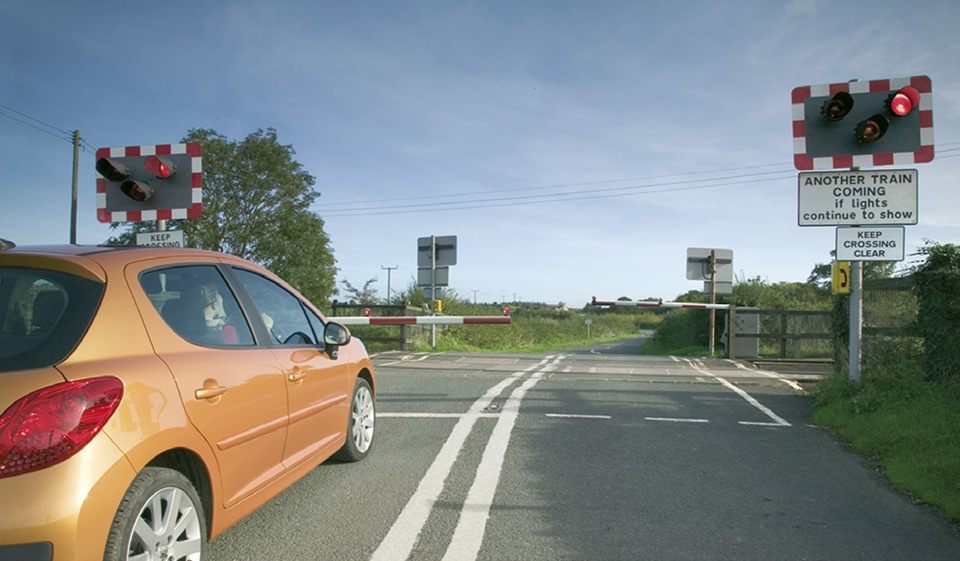
294
Railway telephones. If you are driving a large or slow- moving vehicle, a long, low vehicle with a risk of grounding, or herding animals, a train could arrive before you are clear of the crossing. You MUST obey any sign instructing you to use the railway telephone to obtain permission to cross. You MUST also telephone when clear of the crossing if requested to do so.
Laws RTA 1988 sect 36 & TSRGD regs 10 & 16(1)
295
Crossings without traffic lights. Vehicles should stop and wait at the barrier or gate when it begins to close and not cross until the barrier or gate opens.
296
User-operated gates or barriers. Some crossings have ‘Stop’ signs and small red and green lights. You MUST NOT cross when the red light is showing, only cross if the green light is on. If crossing with a vehicle, you should
- open the gates or barriers on both sides of the crossing
- check that the green light is still on and cross quickly
- close the gates or barriers when you are clear of the crossing.
Laws RTA 1988 sect 36 & TSRGD regs 10 & 52(2)
297
If there are no lights, follow the procedure in Rule 295. Stop, look both ways and listen before you cross. If there is a railway telephone, always use it to contact the signal operator to make sure it is safe to cross. Inform the signal operator again when you are clear of the crossing.
298
Open crossings. These have no gates, barriers, attendant or traffic lights but will have a ‘Give Way’ sign. You should look both ways, listen and make sure there is no train coming before you cross.
299
Incidents and breakdowns. If your vehicle breaks down, or if you have an incident on a crossing you should
- get everyone out of the vehicle and clear of the crossing immediately
- use a railway telephone if available to tell the signal operator. Follow the instructions you are given
- move the vehicle clear of the crossing if there is time before a train arrives. If the alarm sounds, or the amber light comes on, leave the vehicle and get clear of the crossing immediately.
4. Tramways (300 to 307)
300
You MUST NOT enter a road, lane or other route reserved for trams. Take extra care where trams run along the road. You should avoid driving directly on top of the rails and should take care where trams leave the main carriageway to enter the reserved route, to ensure you do not follow them. The width taken up by trams is often shown by tram lanes marked by white lines, yellow dots or by a different type of road surface. Diamond-shaped signs and white light signals give instructions to tram drivers only.
Law RTRA sects 5 & 8
301
Take extra care where the track crosses from one side of the road to the other and where the road narrows and the tracks come close to the kerb. Tram drivers usually have their own traffic signals and may be permitted to move when you are not. Always give way to trams. Do not try to race or overtake them or pass them on the inside, unless they are at tram stops or stopped by tram signals and there is a designated tram lane for you to pass.
302
You MUST NOT park your vehicle where it would get in the way of trams or where it would force other drivers to do so. Do not stop on any part of a tram track, except in a designated bay where this has been provided alongside and clear of the track. When doing so, ensure that all parts of your vehicle are outside the delineated tram path. Remember that a tram cannot steer round an obstruction.
Law RTRA sects 5 & 8
303
Tram stops. Where the tram stops at a platform, either in the middle or at the side of the road, you MUST follow the route shown by the road signs and markings. At stops without platforms you MUST NOT drive between a tram and the left-hand kerb when a tram has stopped to pick up passengers. If there is no alternative route signed, do not overtake the tram - wait until it moves off.
Law RTRA sects 5 & 8
304
Look out for pedestrians, especially children, running to catch a tram approaching a stop.
305
Always give priority to trams, especially when they signal to pull away from stops, unless it would be unsafe to do so. Remember that they may be carrying large numbers of standing passengers who could be injured if the tram had to make an emergency stop. Look out for people getting off a bus or tram and crossing the road.
306
All road users, but particularly cyclists and motorcyclists, should take extra care when driving or riding close to or crossing the tracks, especially if the rails are wet. You should take particular care when crossing the rails at shallow angles, on bends and at junctions. It is safest to cross the tracks directly at right angles. Other road users should be aware that cyclists and motorcyclists may need more space to cross the tracks safely.
307
Overhead electric lines. Tramway overhead wires are normally 5.8 metres above any carriageway, but can be lower. You should ensure that you have sufficient clearance between the wire and your vehicle (including any load you are carrying) before driving under an overhead wire. Drivers of vehicles with extending cranes, booms, tipping apparatus or other types of variable height equipment should ensure that the equipment is fully lowered. Where overhead wires are set lower than 5.8 metres, these will be indicated by height clearance markings - similar to ‘low bridge’ signs. The height clearances on these plates should be carefully noted and observed. If you are in any doubt as to whether your vehicle will pass safely under the wires, you should always contact the local police or the tramway operator. Never take a chance as this can be extremely hazardous.
Direction signs on roads and motorways
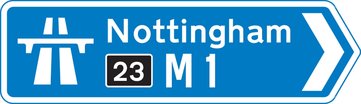
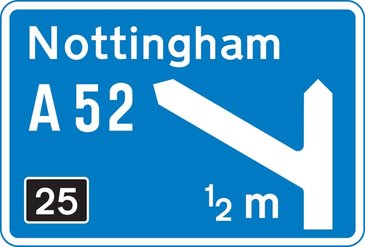
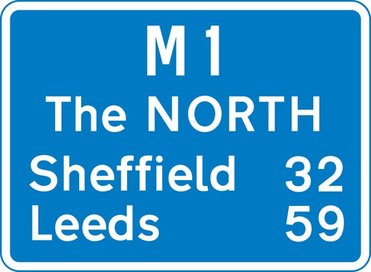


Blue panels indicate that the motorway starts at the junction ahead. Motorways shown in brackets can also be reached along the route indicated. White panels indicate local or non-primary routes leading from the junction ahead. Brown panels show the route to tourist attractions. The name of the junction may be shown at the top of the sign. The aircraft symbol indicates the route to an airport. A symbol may be included to warn of a hazard or restriction along that route.
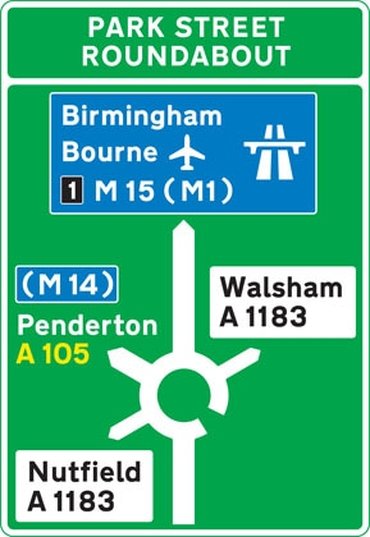
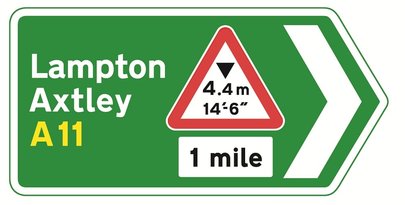
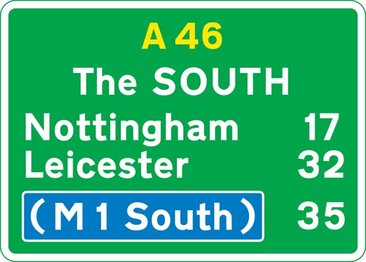
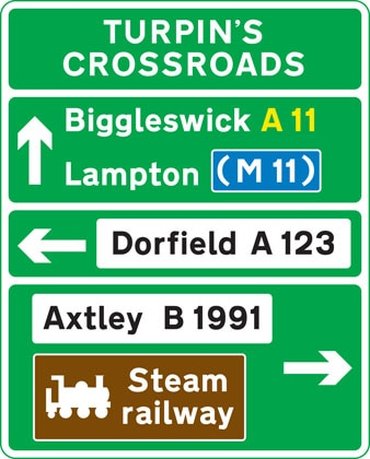
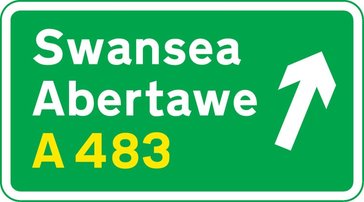
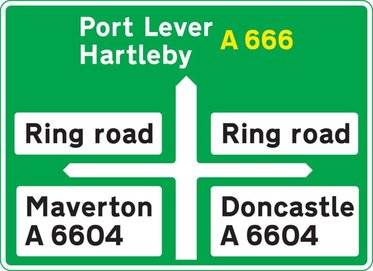

Green panels indicate that the primary route starts at the junction ahead. Route numbers on a blue background show the direction to a motorway. Route numbers on a green background show the direction to a primary route.
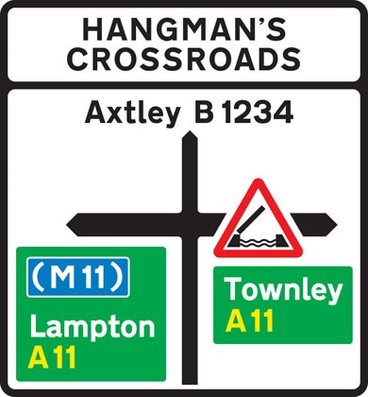
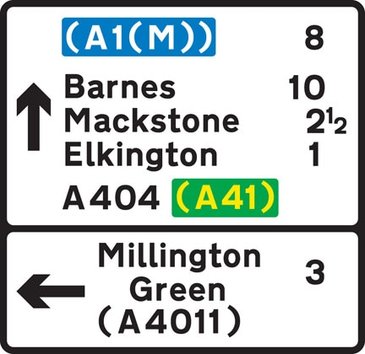
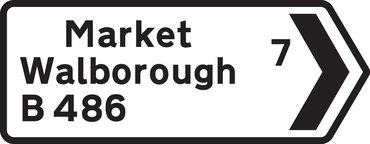
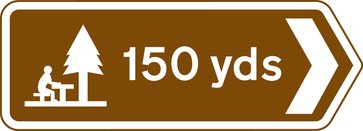

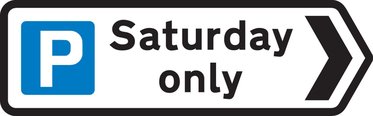
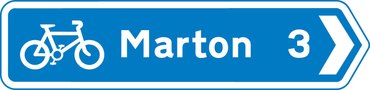
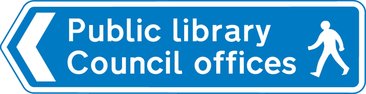


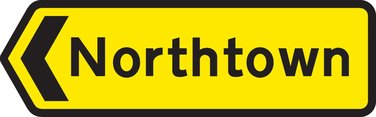
Information signs
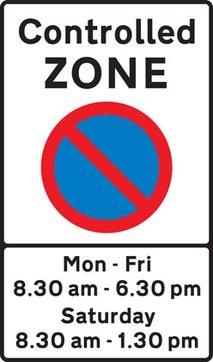
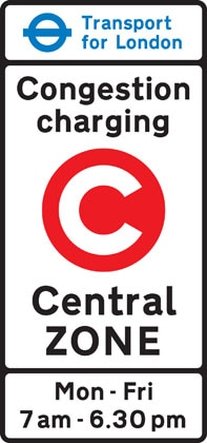
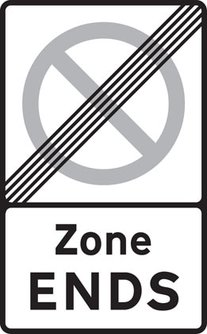
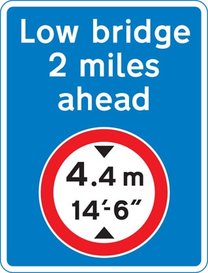
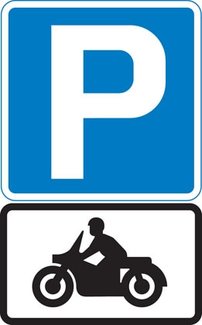
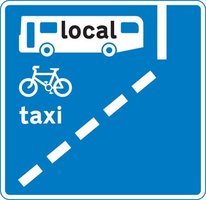
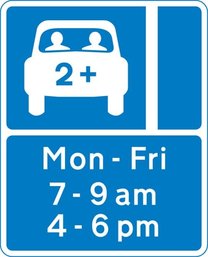
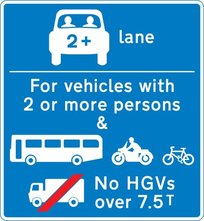
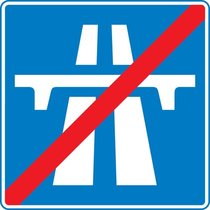
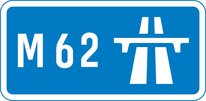
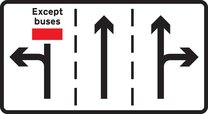
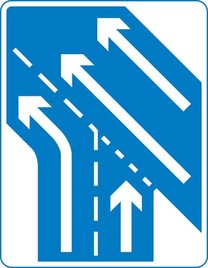
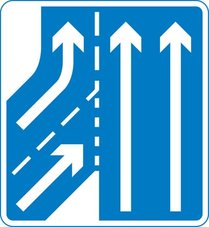
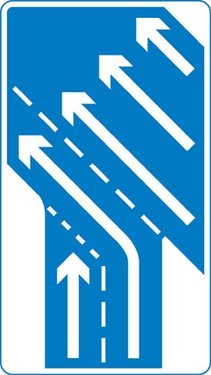
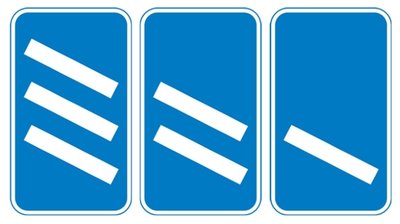
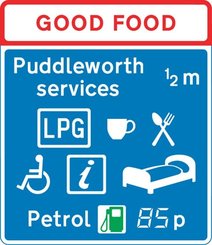
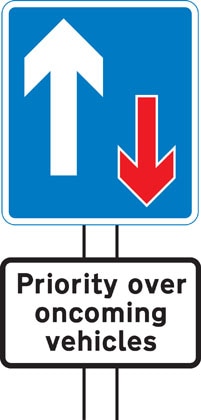
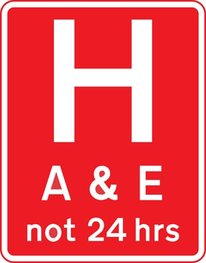
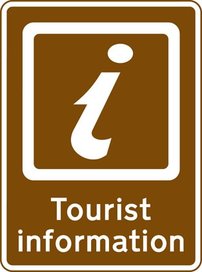
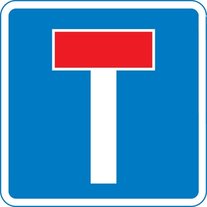
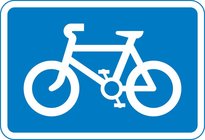
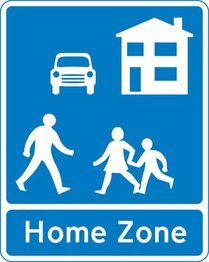
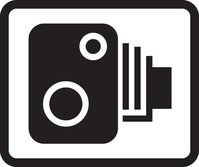
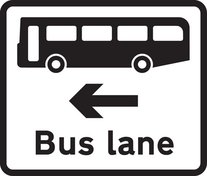
Light signals controlling traffic
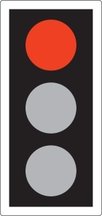
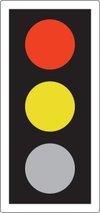
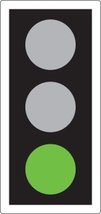
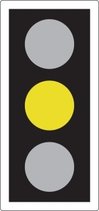
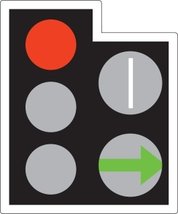
At level crossings, lifting bridges, airfields, fire stations, etc.
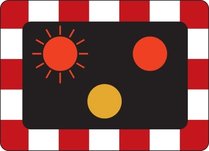
Motorway signals


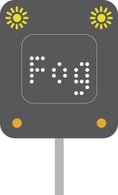
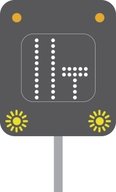
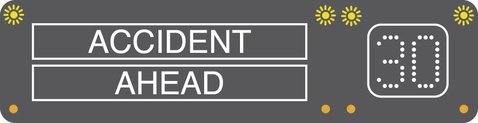
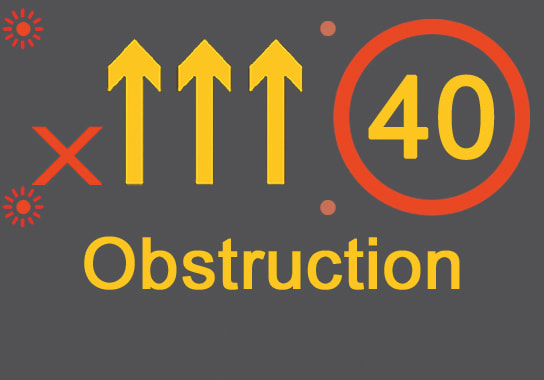

Lane control signals
Red crosses - lane closed to traffic facing the sign
White diagonal arrow - change lanes in direction shown
Road markings
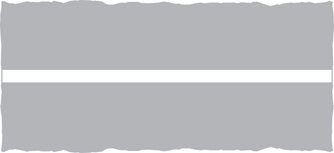
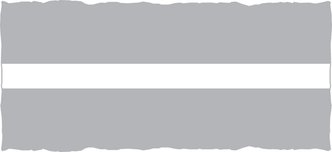
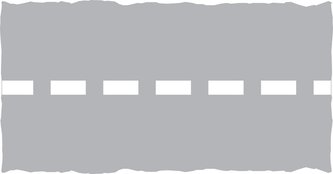
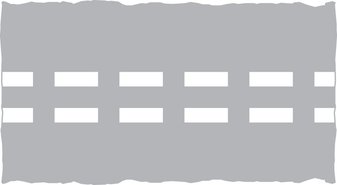
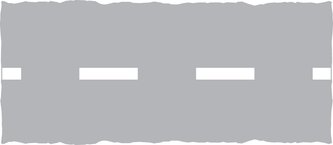
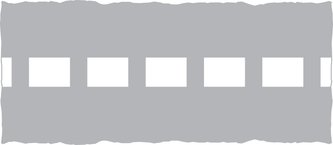
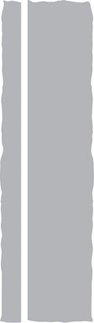
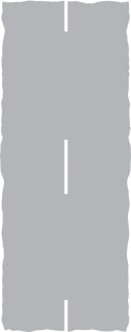

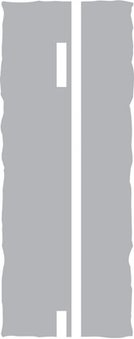
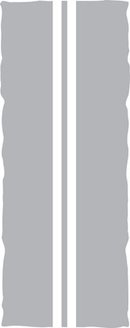

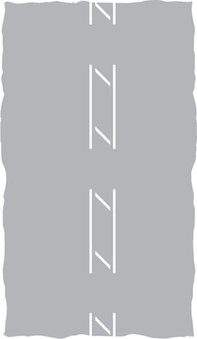
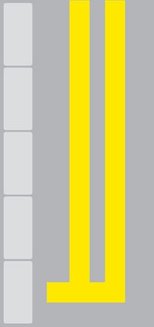
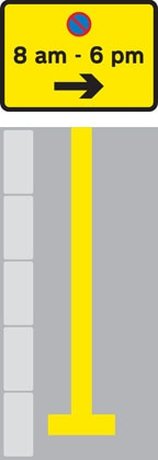

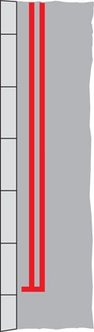
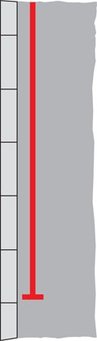
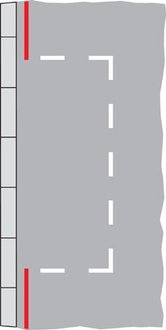
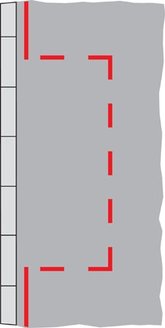
On the kerb or at the edge of the carriageway
Loading restrictions on roads other than Red Routes
Yellow marks on the kerb or at the edge of the carriageway indicate that loading or unloading is prohibited at the times shown on the nearby black and white plates. You may stop while passengers board or alight. If no days are indicated on the signs the restrictions are in force every day including Sundays and Bank Holidays.
ALWAYS CHECK THE TIMES SHOWN ON THE PLATES.
Lengths of road reserved for vehicles loading and unloading are indicated by a white ‘bay’ marking with the words ‘Loading Only’ and a sign with the white on blue ‘trolley’ symbol. This sign also shows whether loading and unloading is restricted to goods vehicles and the times at which the bay can be used. If no times or days are shown it may be used at any time. Vehicles may not park here if they are not loading or unloading.
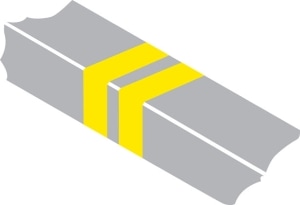
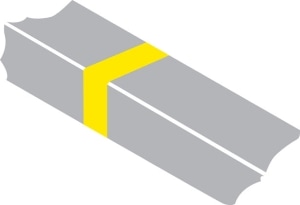
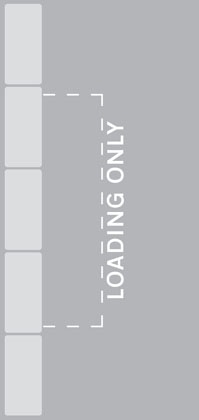


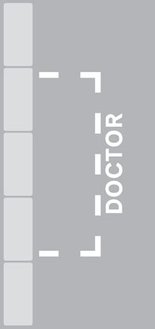
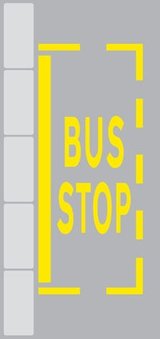
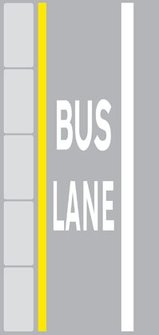
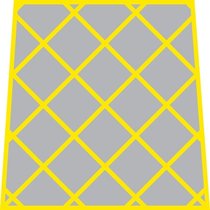
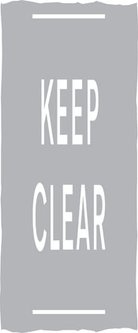
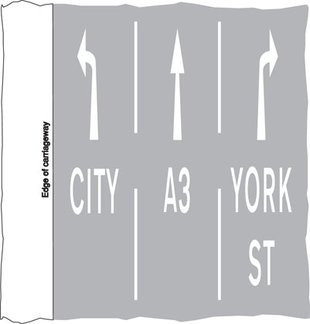
Road signs giving orders
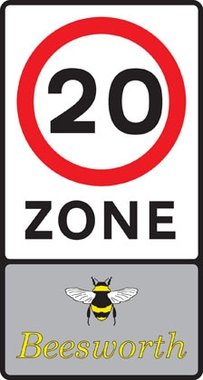
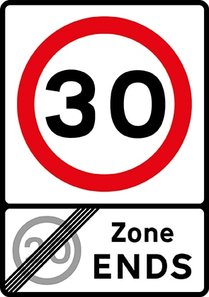
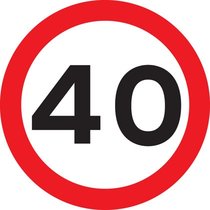
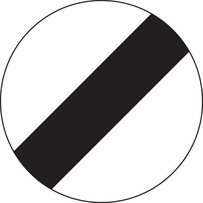
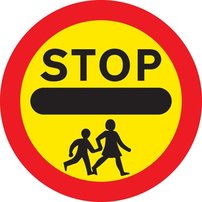
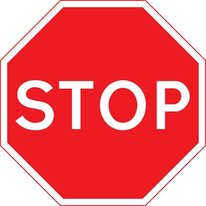
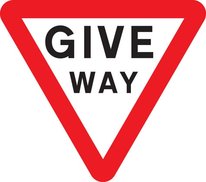
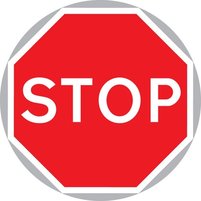
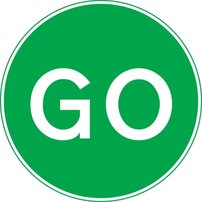
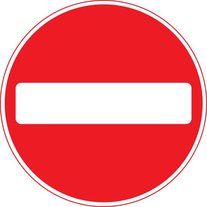
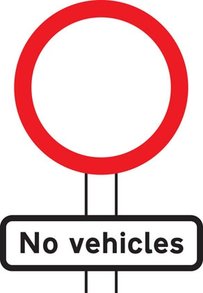
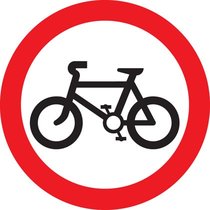
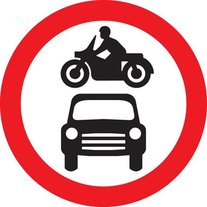
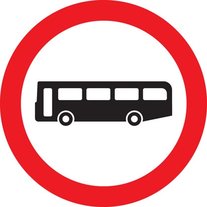
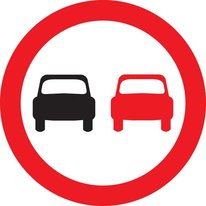
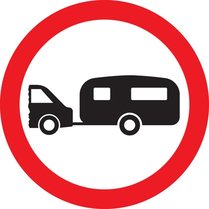
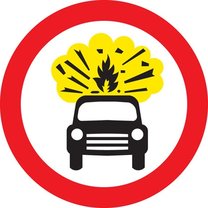
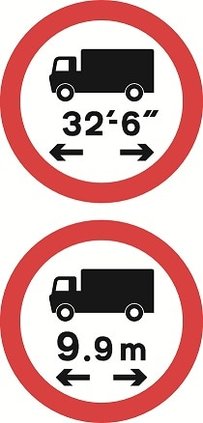
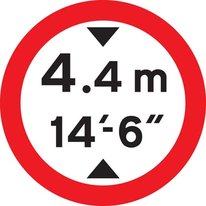
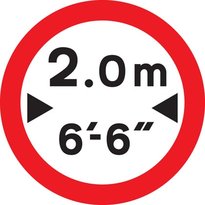
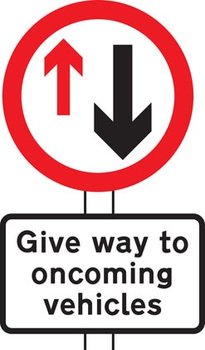
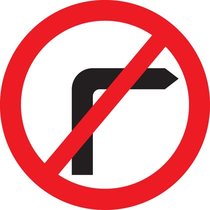
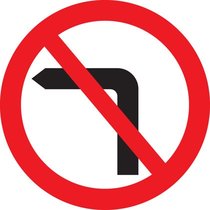
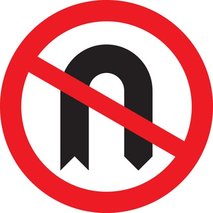
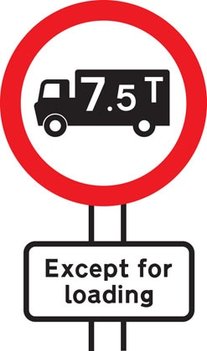
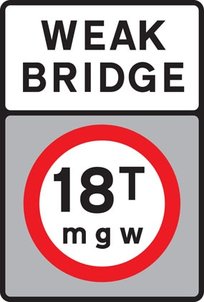
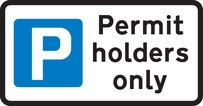
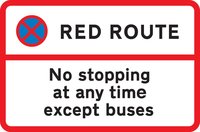
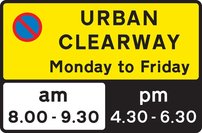
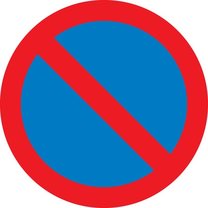
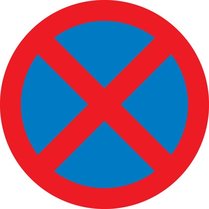
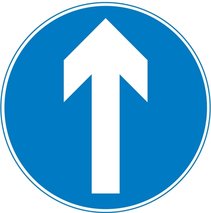
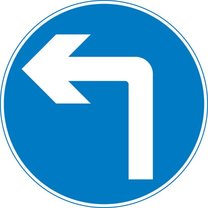
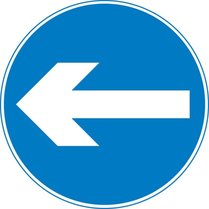
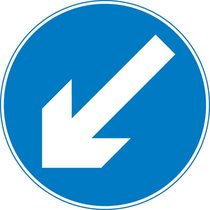
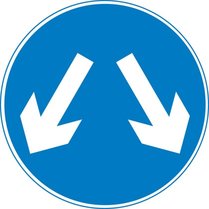
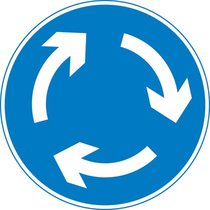
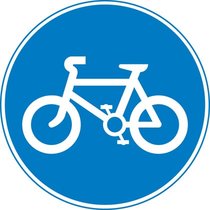
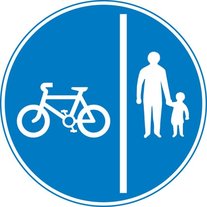
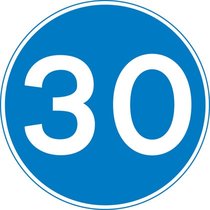
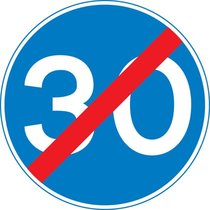
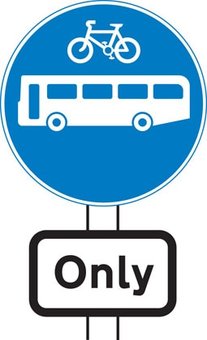
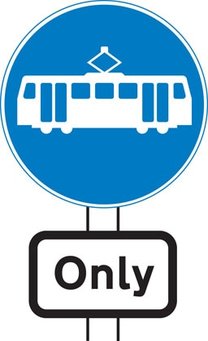
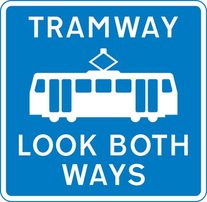
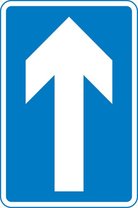
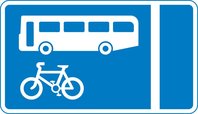
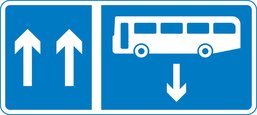
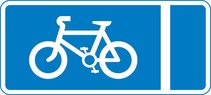
Road works signs
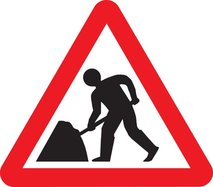
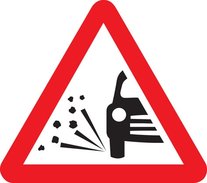
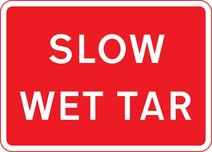
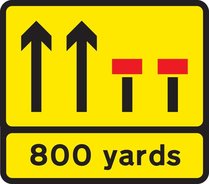
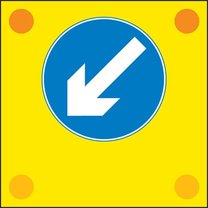
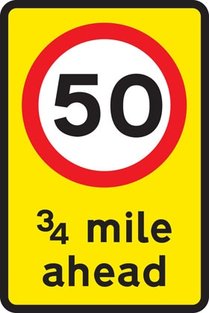
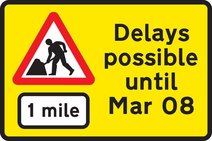
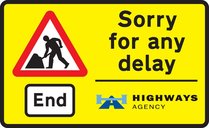
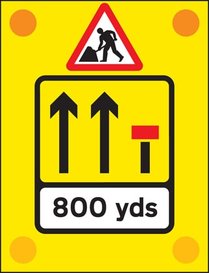
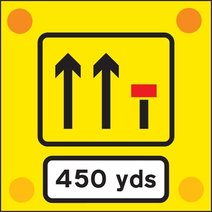
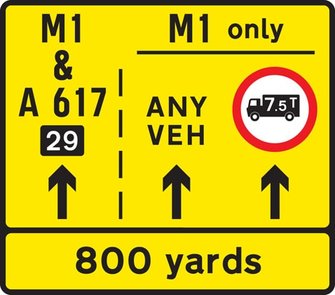
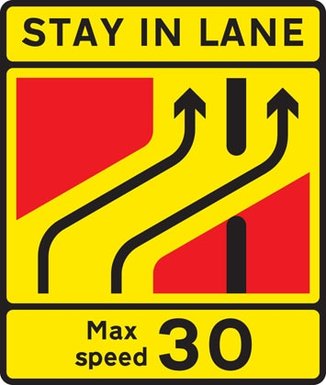
Signals by authorised persons
Police officers
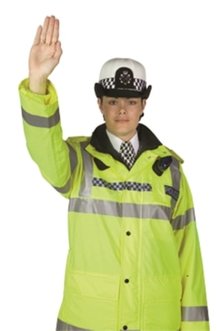
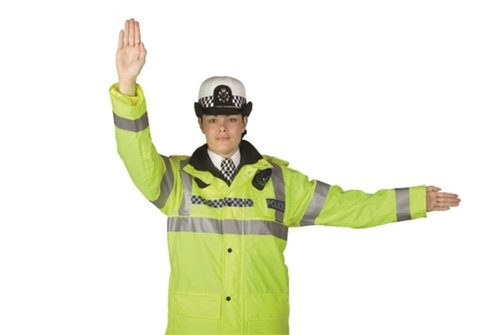
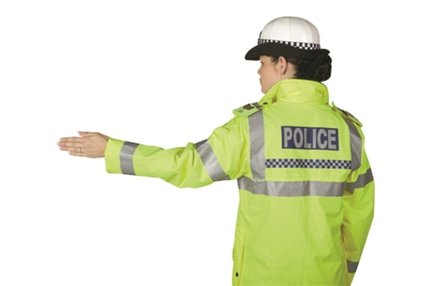
To beckon traffic on
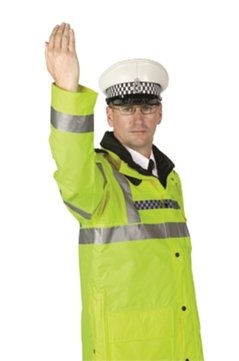
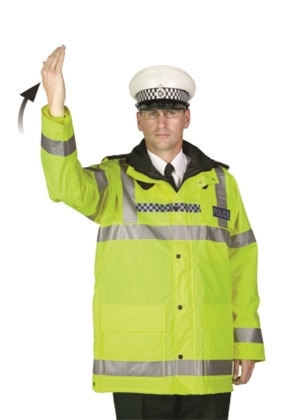
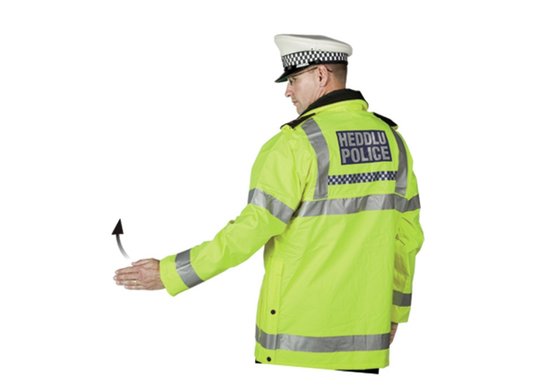
Arm signals to persons controlling traffic
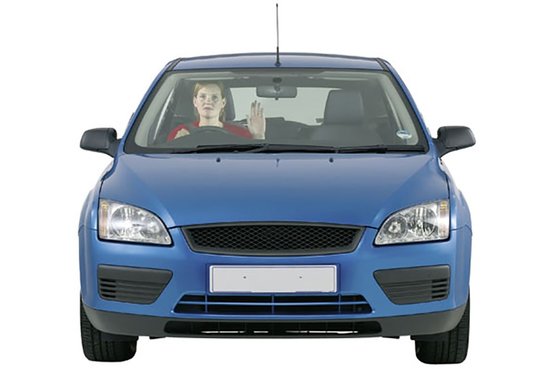
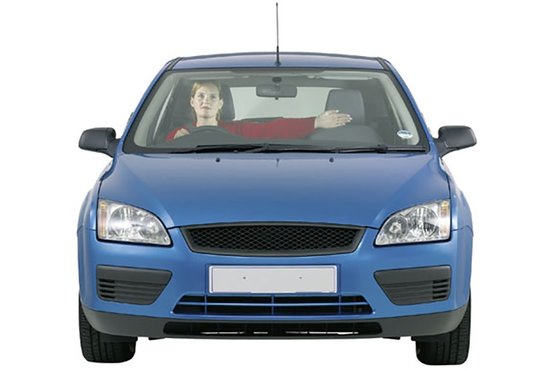
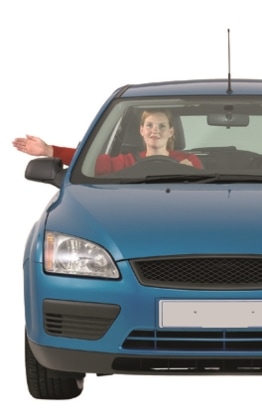
Driver and Vehicle Standards Agency officers and traffic officers
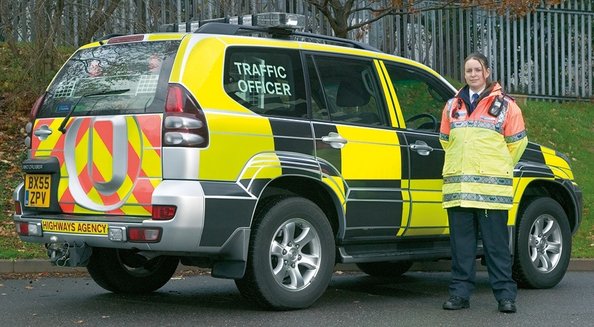
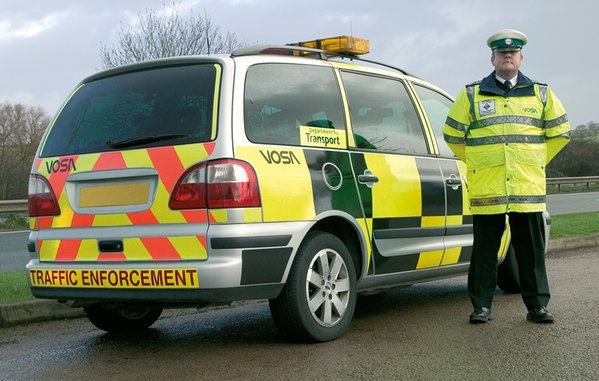
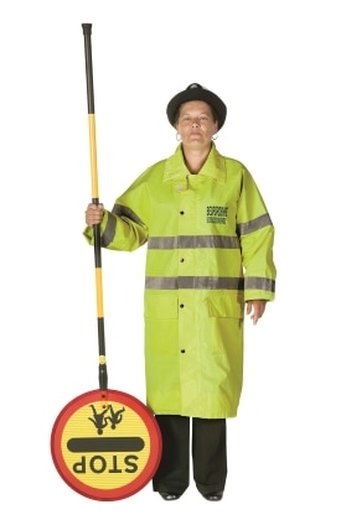
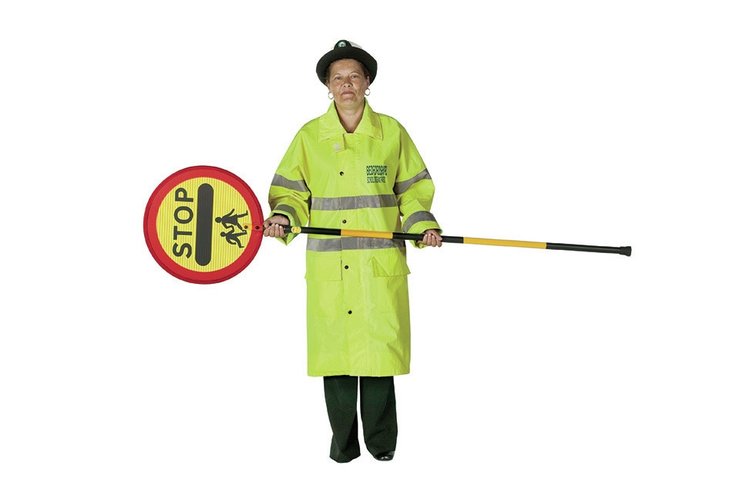
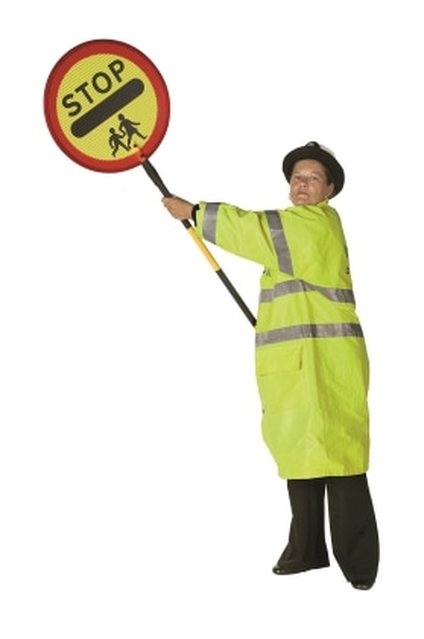
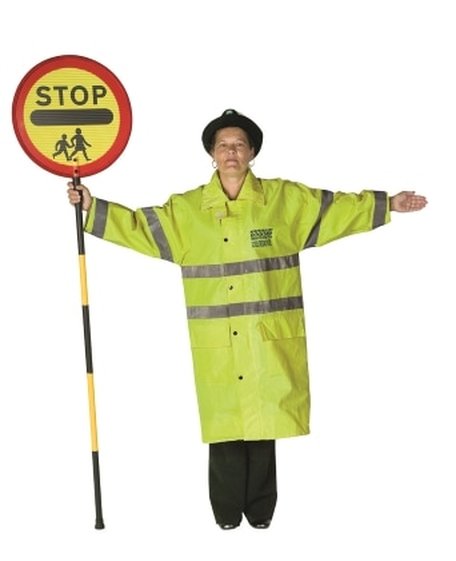
Signals to other road users
Direction indicator signals
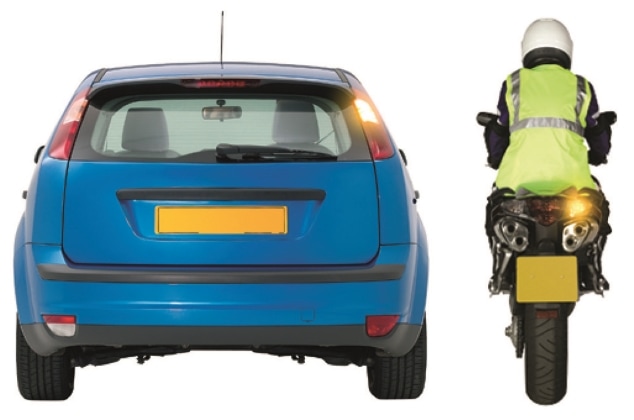
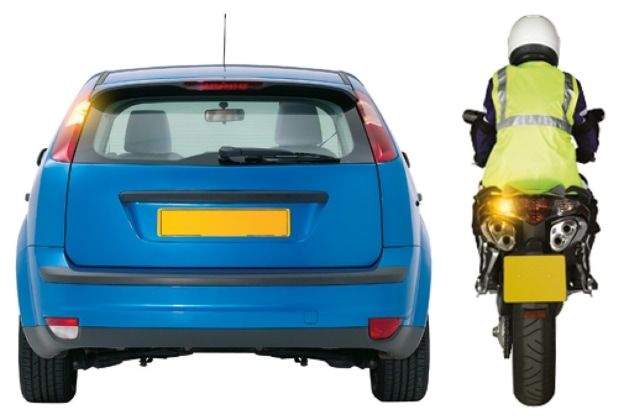
Brake light signals
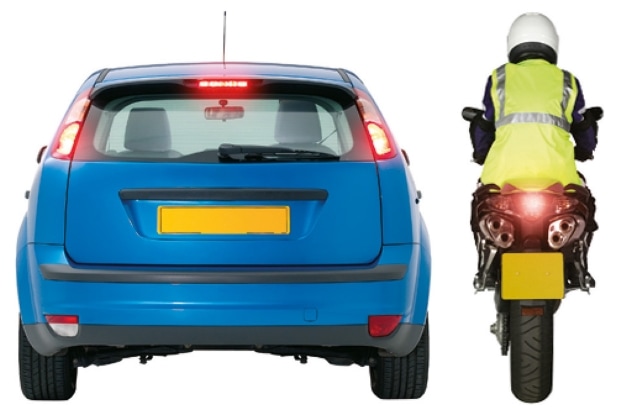
Reversing light signals
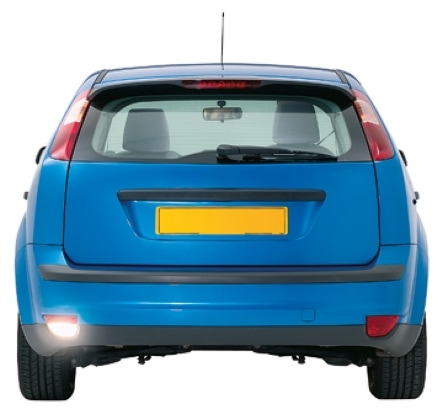
Arm signals
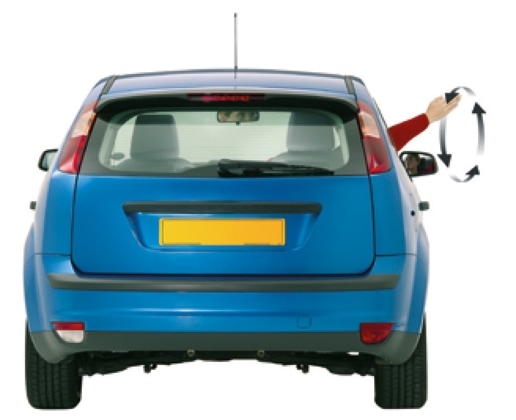
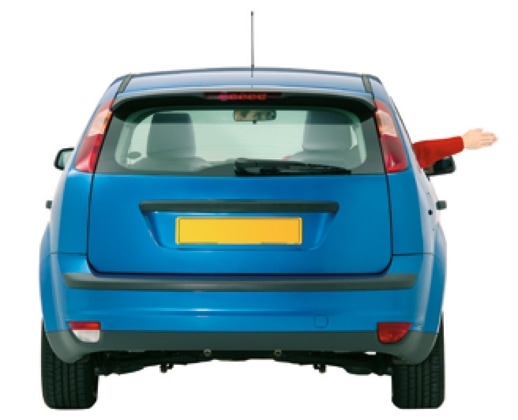
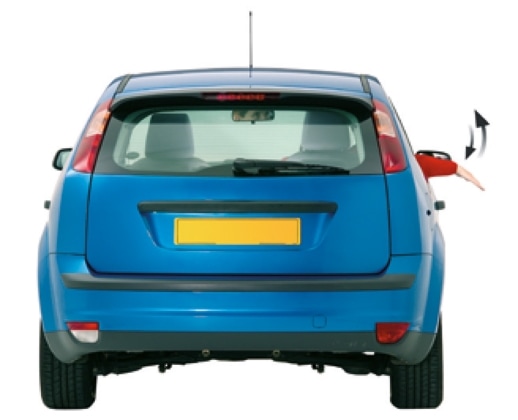
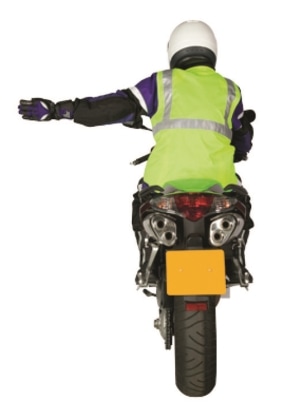
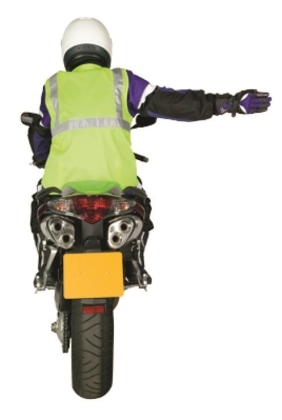
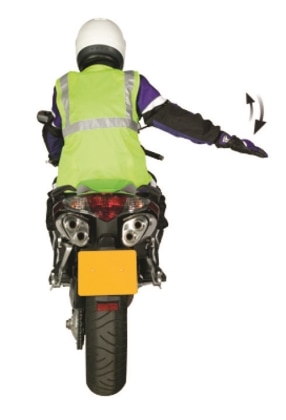
Hazard lights
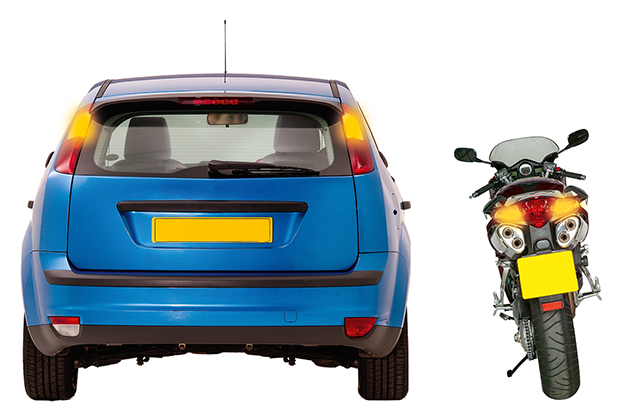
Vehicle markings
Large goods vehicle rear markings
Motor vehicles over 7500 kilograms maximum gross weight and trailers over 3500 kilograms maximum gross weight
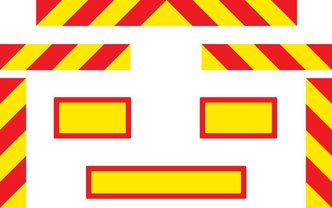
Hazard warning plates
Certain tank vehicles carrying dangerous goods must display hazard information panels
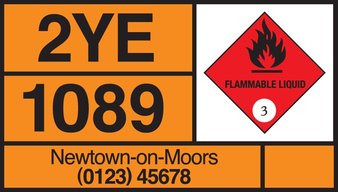

Diamond symbols indicating other risks include:
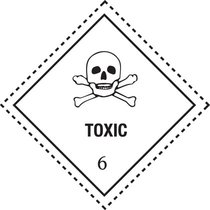
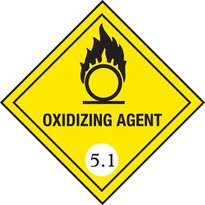
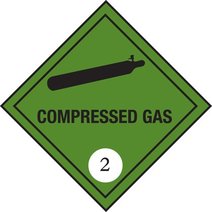
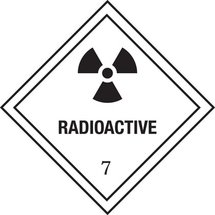
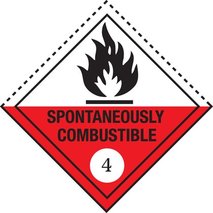
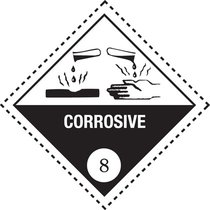
Projections markers

Other
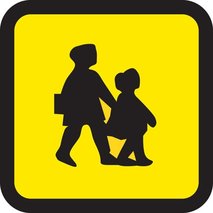
Warning signs on the road
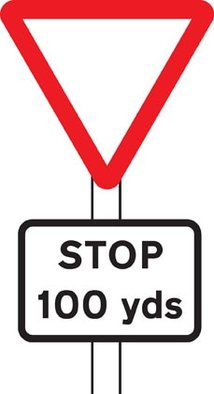
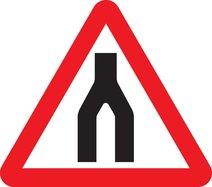
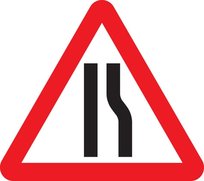
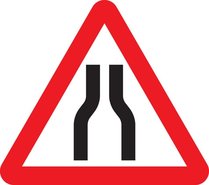
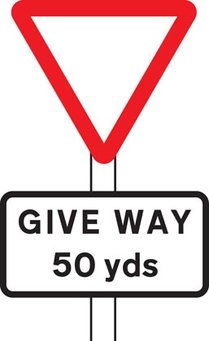
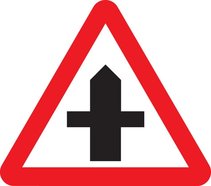
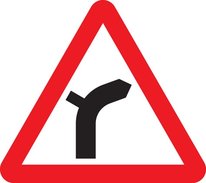
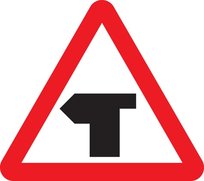
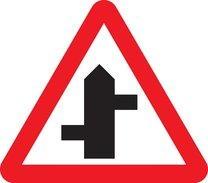
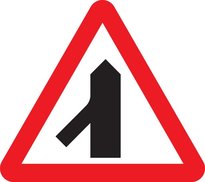
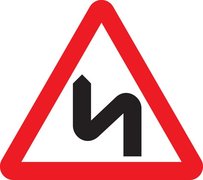
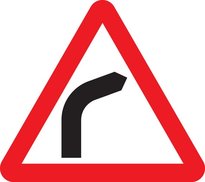
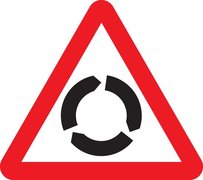
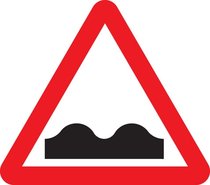
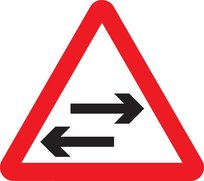
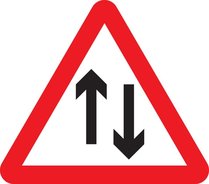
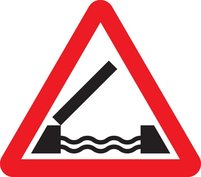
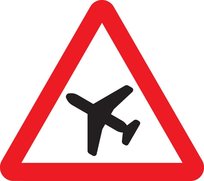
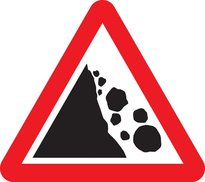
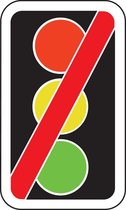
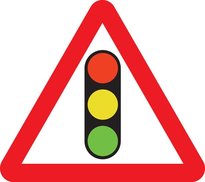
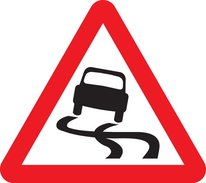
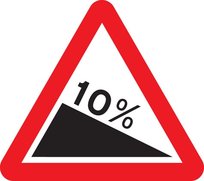
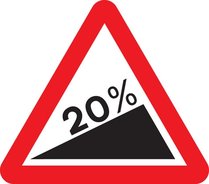
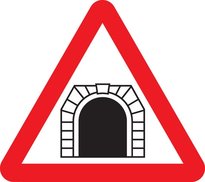
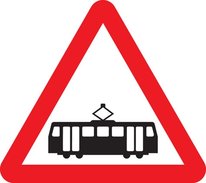
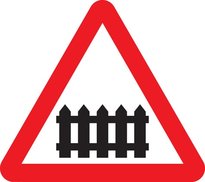
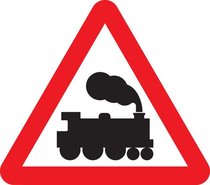

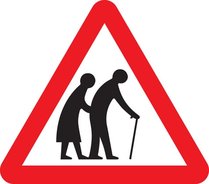
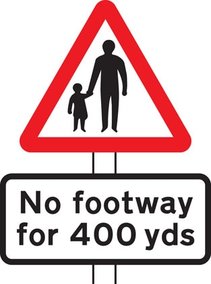
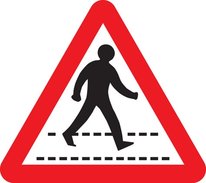
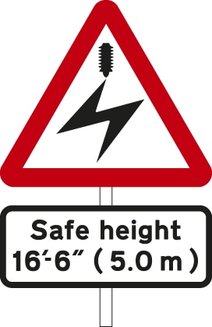
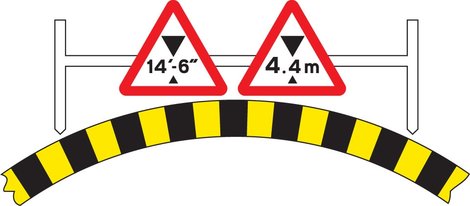

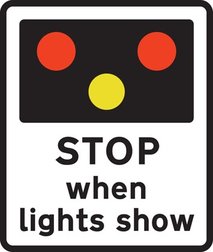
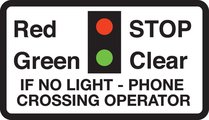
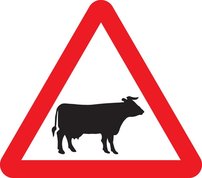
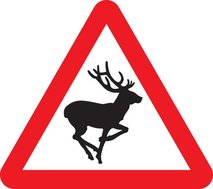
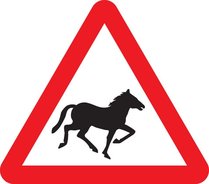
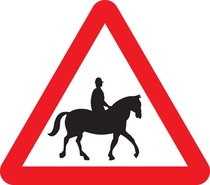
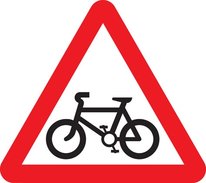
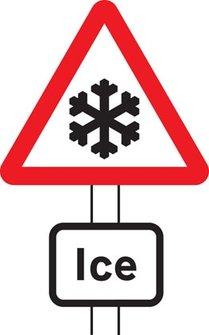
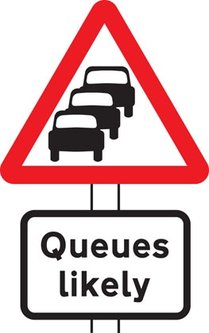
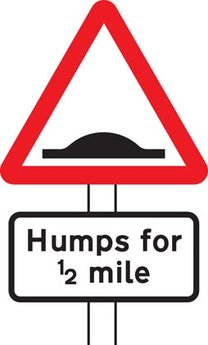
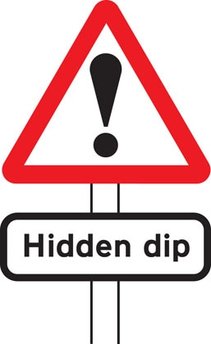
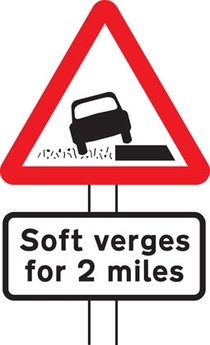
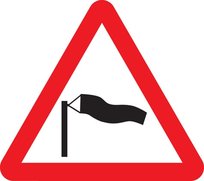
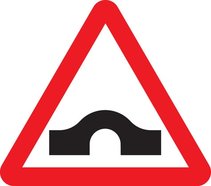
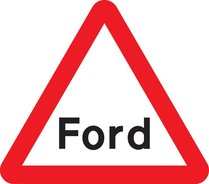
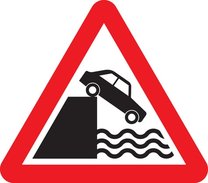
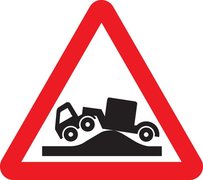
Annex 1 - You and your bicycle
Annex 1 - You and your bicycle
Make sure that you feel confident of your ability to ride safely on the road. Be sure that
- you have the right size and type of cycle for your comfort and safety
- the lights and reflectors are kept clean and in good working order
- the tyres are in good condition and inflated to the pressure shown on the tyre
- the wheels spin freely
- the gears are working correctly
- the chain is properly adjusted and oiled
- the saddle and handlebars are adjusted to the correct height.
You should fit a bell to your cycle.
You MUST
- ensure your brakes are efficient
- have white front and red rear lights lit when cycling at night.
Laws PCUR regs 6 & 10 & RVLR reg 18
Cycle training: If you are an inexperienced cyclist or have not ridden for a while, consider taking a cycle training course. Some councils offer national standard cycle training such as Bikeability and in certain areas, this is free of charge. It can help build up your skills and confidence.
There are three levels to Bikeability, starting with the basics of balancing, stopping and starting safely, through to handling complex and busy junctions. You will also learn about traffic signs and the rules of the road, planning routes, safe road positioning and signalling (particularly at junctions) and basic cycle maintenance. For more information, see www.bikeability.org.uk and www.cycling.scot.
Annex 2 - Motorcycle licence requirements
If you have a provisional motorcycle licence, you MUST satisfactorily complete a Compulsory Basic Training (CBT) course. You can then ride a motorcycle up to 125 cc with a power output not exceeding 11 kW on the public road, with L plates (in Wales either D plates, L plates or both can be used), for up to two years. Under direct access you can practise on a motorcycle that exceeds 125 cc provided that
- you meet the minimum age for the category concerned
- you’re accompanied at all times by a qualified approved trainer, who is on another motorcycle and in radio contact with you
- fluorescent or reflective safety clothing is worn during supervision
- red L plates (D plates in Wales) are fitted and provisional licence restrictions followed.
To obtain your full motorcycle licence you MUST pass a motorcycle theory test and then a practical test.
Law MV(DL)R regs 16 & 68
A1 motorcycle licence: At age 17 or over, you take a test on a motorcycle without sidecar of between 120 and 125 cc. If you pass you may ride a motorcycle up to 125 cc with power output up to 11 kW, or a motor tricycle with power not exceeding 15 kW.
A2 motorcycle licence: At age 19 or over, you take a test on a motorcycle without sidecar of at least 395 cc with a power output of at least 25 kW but not exceeding 35 kW. If you pass, you may ride any motorcycle not exceeding 35 kW and with a power to weight ratio not exceeding 0.2 kW/kg.
Full A motorcycle licence: Test taken on a motorcycle without sidecar, of at least 595 cc and an engine power of at least 40 kW This gives you full access to all motorcycles and motor tricycles. You obtain a category A licence by taking progressive access from age 21, or under the direct access scheme from age 24.
Category A under progressive access: You can take a category A practical test at age 21 if you already have an A2 licence that you’ve held for a minimum of two years. You don’t need to take another theory test or hold a CBT certificate.
Category A under direct access: This is for riders aged 24 or over. To obtain a category A licence you must
- successfully complete a CBT course
- pass the motorcycle theory test
- pass the practical motorcycle test.
Passing the practical test on a motorcycle of at least 40 kW (53.6bhp) gives immediate access to all sizes of motorcycle.
You MUST NOT carry a pillion passenger or pull a trailer until you have passed your test. Also see Rule 253 covering vehicles prohibited from motorways.
Law MV(DL)R reg 16
Moped licence requirements
A moped MUST have an engine capacity not exceeding 50 cc, not weigh more than 250kg and be designed to have a maximum speed not exceeding 28mph (45 km/h). Before June 2003 a licence allowed the riding of mopeds up to 50km/h.
To ride a moped, learners MUST
- be 16 or over
- have a provisional moped licence
- complete CBT training.
You MUST first pass the theory test for motorcycles and then the moped practical test to obtain your full moped licence. If you passed your car driving test before 1 February 2001 you are qualified to ride a moped without L plates (and/or D plates in Wales), although it is recommended that you complete CBT before riding on the road. If you passed your car driving test after this date you MUST complete CBT before riding a moped on the road.
Laws RTA 1988 sects 97(e) & 101 & MV(DL)R regs 38(4) & 43
Annex 3 - Motor vehicle documentation and learner driver requirements
Documents
Driving licence. You MUST have a valid driving licence for the category of motor vehicle you are driving. You MUST inform the Driver and Vehicle Licensing Agency (DVLA) if you change your name and/or address.
Law RTA 1988 sects 87 & 99(4)
Holders of non-European Community licences who are now resident in the UK may only drive on that licence for a maximum of 12 months from the date they become resident in this country.
To ensure continuous driving entitlement
- a British provisional licence should be obtained and a driving test(s) passed before the 12-month period elapses, or
- in the case of a driver who holds a licence from a country which has been designated in law for licence exchange purposes, the driver should exchange the licence for a British one.
MOT. Cars and motorcycles MUST normally pass an MOT test three years from the date of the first registration and every year after that. You MUST NOT drive a motor vehicle without an MOT certificate when it should have one. Exceptionally, you may drive to a pre-arranged test appointment or to a garage for repairs required for the test. Driving an unroadworthy motor vehicle may invalidate your insurance.
From 20 May 2018, cars, vans, motorcycles and other light passenger vehicles manufactured or first registered over 40 years ago, will be exempt from the MOT test, unless the vehicle has been substantially changed within the previous 30 years. Guidance on what counts as a substantial change can be found at www.gov.uk/historic-vehicles.
If a vehicle that’s currently exempt from the MOT test is substantially changed, the vehicle keeper cannot continue to claim an exemption from the MOT test.
Law RTA 1988 sects 45, 47, 49 & 53
Insurance. To use a motor vehicle on the road, you MUST have a valid insurance policy. This MUST at least cover you for injury or damage to a third party while using that motor vehicle. Before driving any motor vehicle, make sure that it has this cover for your use or that your own insurance provides adequate cover. You MUST NOT drive a motor vehicle without insurance. Also, be aware that even if a road traffic incident is not your fault, you may still be held liable by insurance companies.
Law RTA 1988 sect 143
Uninsured drivers can now be automatically detected by roadside cameras. Further to the penalties for uninsured driving (see ‘Penalty table’), an offender’s vehicle can now be seized by the Police, taken away and crushed.
Law RTA 1988, sects 165a & 165b
The types of cover available are indicated below:
Third-Party insurance - this is often the cheapest form of insurance, and is the minimum cover required by law. It covers anyone you might injure or whose property you might damage. It does not cover damage to your own motor vehicle or injury to yourself.
Third-Party, Fire and Theft insurance - similar to third-party, but also covers you against your motor vehicle being stolen, or damaged by fire.
Comprehensive insurance - this is the most expensive but the best insurance. Apart from covering other persons and property against injury or damage, it also covers damage to your own motor vehicle, up to the market value of that vehicle, and personal injury to yourself.
Registration certificate. Registration certificates (also called harmonised registration certificates) are issued for all motor vehicles used on the road, describing them (make, model, etc) and giving details of the registered keeper. You MUST notify the Driver and Vehicle Licensing Agency in Swansea as soon as possible when you buy or sell a motor vehicle, or if you change your name or address. For registration certificates issued after 27 March 1997, the buyer and seller are responsible for completing the registration certificates. The seller is responsible for forwarding them to DVLA. The procedures are explained on the back of the registration certificates.
Law RV(R&L)R regs 21, 22, 23 & 24
Vehicle Excise Duty (VED). Vehicle Excise Duty MUST be paid on all motor vehicles used or kept on public roads.
Law VERA sects 29 and 33
Statutory Off-Road Notification (SORN). This is a notification to the DVLA that a motor vehicle is not being used on the road. If you are the vehicle keeper and want to keep a motor vehicle untaxed and off the public road you MUST declare SORN - it is an offence not to do so. The vehicle will remain SORN until you sell, tax or scrap it. If your vehicle is unused or off the road it MUST have either a SORN declaration or valid insurance.
Law RV(RL)R 2002, reg 26 sched 4
Production of documents. You MUST be able to produce your driving licence, a valid insurance certificate and (if appropriate) a valid MOT certificate, when requested by a police officer. If you cannot do this you may be asked to take them to a police station within seven days.
Law RTA 1988 sects 164 & 165
Learner drivers
Learners driving a car MUST hold a valid provisional licence. They MUST be supervised by someone at least 21 years old who holds a full EC/EEA licence for that type of car (automatic or manual) and has held one for at least three years.
Laws MV(DL)R reg 16 & RTA 1988 sect 87
Vehicles. Any vehicle driven by a learner MUST display red L plates. In Wales, either red D plates, red L plates, or both, can be used. Plates MUST conform to legal specifications and MUST be clearly visible to others from in front of the vehicle and from behind. Plates should be removed or covered when not being driven by a learner (except on driving school vehicles).
Law MV(DL)R reg 16 & sched 4
You MUST pass the theory test (if one is required) and then a practical driving test for the category of vehicle you wish to drive before driving unaccompanied.
Law MV(DL)R reg 40
Annex 4 - The road user and the law
The following list can be found abbreviated throughout the Code. It is not intended to be a comprehensive guide, but a guide to some of the important points of law. For the precise wording of the law, please refer to the various Acts and Regulations (as amended) indicated in the Code. Abbreviations are listed below.
Most of the provisions apply on all roads throughout Great Britain, although there are some exceptions. The definition of a road in England and Wales is ‘any highway and any other road to which the public has access and includes bridges over which a road passes’ (RTA 1988 sect 192(1)). In Scotland, there is a similar definition which is extended to include any way over which the public have a right of passage (R(S)A 1984 sect 151(1)).
It is important to note that references to ‘road’ therefore generally include footpaths, bridleways and cycle tracks, and many roadways and driveways on private land (including many car parks). In most cases, the law will apply to them and there may be additional rules for particular paths or ways. Some serious driving offences, including drink-driving offences, also apply to all public places, for example public car parks.
The reference to ‘emergency area’ in the Code is an ‘emergency refuge area’ as defined in the Motorways Traffic (England and Wales) Regulations 1982 as amended by the Motorways Traffic (England and Wales)(Amendment)(England) Regulations 2015.
Acts and regulations are available as enacted or as amended at www.legislation.gov.uk and are available in their original print format from The Stationery Office.
Acts and regulations prior to 1988
Chronically Sick & Disabled Persons Act 1970 CSDPA
Functions of Traffic Wardens Order 1970 FTWO
Greater London (General Powers) Act 1974 GL(GP)A
Highway Act 1835 or 1980 (as indicated) HA
Motorways Traffic (England & Wales) Regulations 1982 MT(E&W)R
Motorways Traffic (England & Wales) Amended Regulations MT(E&W)(A)R
Pedal Cycles (Construction & Use) Regulations 1983 PCUR
Public Passenger Vehicles Act 1981 PPVA
Road Traffic Act 1984 RTA
Road Traffic Regulation Act 1984 RTRA
Road Vehicles (Construction & Use) Regulations 1986 CUR
Roads (Scotland) Act 1984 R(S)A
Acts and regulations from 1988 onwards
Horses (Protective Headgear for Young Riders) Act 1990 H(PHYR)A
Horses (Protective Headgear for Young Riders) Regulations 1992 H(PHYR)R
Motor Cycles (Eye Protectors) Regulations 1999 MC(EP)R
Motor Cycles (Protective Helmets) Regulations 1998 MC(PH)R
Motorways Traffic (Scotland) Regulations 1995 MT(S)R
Motor Vehicles (Driving Licences) Regulations 1999 MV(DL)R
Motor Vehicles (Wearing of Seat Belts) Regulations 1993 MV(WSB)R
Motor Vehicles (Wearing of Seat Belts) (Amendment) Regulations 2006 MV(WSB)(A)R
Motor Vehicles (Wearing of Seat Belts by Children in Front Seats) Regulations 1993 MV(WSBCFS)R
New Roads and Streetworks Act 1991 NRSWA
Powers of Criminal Courts (Sentencing) Act 2000 PCC(S)A
Restricted Roads (20mph Speed Limit) Order 2022 (SI 2022/800)
Road Safety Act 2006 RSA
Road Traffic (New Drivers) Act 1995 RT(ND)A
Road Traffic Offenders Act 1988 RTOA
Road Vehicles (Display of Registration Marks) Regulations 2001 RV(DRM)R
Road Vehicles Lighting Regulations 1989 RVLR
Road Vehicles (Registration & Licensing) Regulations 2002 RV(R&L)R
Smoke-free (Exemptions and Vehicles) Regulations 2007 SI 2007/765 TSf(EV)*
Smoke-free Premises etc (Wales) Regulations 2007 SI 2007/W787 TSfP(W)R*
Traffic Management Act 2004 TMA
Traffic Signs Regulations & General Directions 2002 TSRGD
Use of Invalid Carriages on Highways Regulations 1988 UICHR
Vehicle Excise and Registration Act 1994 VERA
Zebra, Pelican and Puffin Pedestrian Crossings Regulations and General Directions 1997 ZPPPCRGD
*Specific legislation applies to smoking in vehicles which constitute workplaces. For information, visit http://www.smokefreeengland.co.uk
http://www.clearingtheairscotland.com
http://www.smokingbanwales.co.uk
1. Penalties and the Highway Code
Parliament sets the maximum penalties for road traffic offences. The seriousness of the offence is reflected in the maximum penalty. It is for the courts to decide what sentence to impose according to circumstances.
The penalty table indicates some of the main offences, and the associated penalties. There is a wide range of other more specific offences which, for the sake of simplicity, are not shown here. The penalty points and disqualification system is described below.
2. Penalty points and disqualification
The penalty point system is intended to deter drivers and motorcyclists from following unsafe motoring practices. Certain non-motoring offences, e.g. failure to rectify vehicle defects, can also attract penalty points.
The court MUST order points to be endorsed on the licence according to the fixed number or the range set by Parliament. The accumulation of penalty points acts as a warning to drivers and motorcyclists that they risk disqualification if further offences are committed.
Law RTOA sects 44 & 45
A driver or motorcyclist who accumulates 12 or more penalty points within a 3-year period MUST be disqualified. This will be for a minimum period of 6 months, or longer if the driver or motorcyclist has previously been disqualified.
Law RTOA sect 35
For every offence which carries penalty points the court has a discretionary power to order the licence holder to be disqualified. This may be for any period the court thinks fit, but will usually be between a week and a few months.
In the case of serious offences, such as dangerous driving and drink-driving, the court MUST order disqualification. The minimum period is 12 months, but for repeat offenders or where the alcohol level is high, it may be longer. For example, a second drink-drive offence in the space of 10 years will result in a minimum of 3 years’ disqualification.
Law RTOA sect 34
Penalty table
| Offence | Maximum penalty | Penalty points |
|---|---|---|
| Causing death by dangerous driving | Life imprisonment / Unlimited fine / Obligatory - 5 years minimum | 3 to 11 (if exceptionally not disqualified) |
| Dangerous driving | 2 years’ imprisonment / Unlimited fine / Obligatory disqualification | 3 to 11 (if exceptionally not disqualified) |
| Causing death by careless driving under the influence of drink or drugs | Life imprisonment / Unlimited fine / Obligatory - 5 years minimum | 3 to 11 (if exceptionally not disqualified) |
| Careless and inconsiderate driving | Unlimited fine / Discretionary disqualification | 3 to 9 |
| Driving while unfit through drink or drugs or with excess alcohol: or failing to provide a specimen for analysis | 6 months’ imprisonment / Unlimited fine / Obligatory disqualification | 3 to 11 (if exceptionally not disqualified) |
| Failing to stop after an accident or failing to report an accident | 6 months’ imprisonment / Unlimited fine / Discretionary disqualification | 5 to 10 |
| Driving while disqualified | 6 months’ imprisonment (12 months in Scotland) / Unlimited fine / Discretionary disqualification | 6 |
| Driving after refusal or revocation of licence on medical grounds | 6 months’ imprisonment / Unlimited fine / Discretionary disqualification | 3 to 6 |
| Driving without insurance | Unlimited fine / Discretionary disqualification | 6 to 8 |
| Using a vehicle in a dangerous condition | LGV or PCV unlimited, other vehicles £2,500/ Obligatory disqualification if offence committed within 3 years of a previous conviction for a similar offence - 6 months min. Otherwise discretionary | 3 in each case |
| Failure to have proper control of vehicle or full view of the road and traffic ahead | £1,000 fine (£2,500 for PCV or goods vehicle) / Discretionary disqualification | 3 |
| Using a hand-held mobile phone when driving | £1,000 fine (£2,500 for PCV or goods vehicle) / Discretionary disqualification | 6 |
| Driving otherwise than in accordance with a licence | £1,000 fine / Discretionary disqualification | 3 to 6 |
| Speeding | £1,000 fine (£2,500 for motorway offences) / Discretionary disqualification | 3 to 6, or 3 (fixed penalty) |
| Traffic light offences | £1,000 fine / Discretionary disqualification | 3 |
| No MOT certificate | £1,000 fine | - |
| Seat belt offences | £500 fine | - |
| Dangerous cycling | £2,500 fine | - |
| Careless cycling | £1,000 fine | - |
| Cycling on pavement | £500 fine | - |
| Failing to identify driver of vehicle | £1,000 fine / Discretionary disqualification | 6 |
Furthermore, in some serious cases, the court MUST (in addition to imposing a fixed period of disqualification) order the offender to be disqualified until they pass a driving test. In other cases the court has a discretionary power to order such disqualification. The test may be an ordinary length test or an extended test according to the nature of the offence.
4. New drivers
Special rules as set out below apply for a period of two years from the date of passing their first driving test, to drivers and motorcyclists from
- the UK, EU/EEA, the Isle of Man, the Channel Islands or Gibraltar who passed their first driving test in any of those countries
- other foreign countries who have to pass a UK driving test to gain a UK licence, in which case the UK driving test is treated as their first driving test; and
- other foreign countries who (without needing a test) exchanged their licence for a UK licence and subsequently passed a UK driving test to drive another type of vehicle, in which case the UK driving test is treated as their first driving test. For example a driver who exchanges a foreign licence (car) for a UK licence (car) and who later passes a test to drive another type of vehicle (e.g. an HGV) will be subject to the special rules.
Where a person subject to the special rules accumulates 6 or more penalty points before the end of the 2-year period (including any points acquired before passing the test) their licence will be revoked automatically. To regain the licence they must reapply for a provisional licence and may drive only as a learner until they pass a further driving test (also see Annex 8 – Safety code for new drivers.)
Law RT(ND)A
Note. This applies even if they pay for offences by fixed penalty. Drivers in the first group (UK, EU/EEA etc.) who already have a full licence for one type of vehicle are not affected by the special rules if they later pass a test to drive another type of vehicle.
5. Other consequences of offending
Where an offence is punishable by imprisonment then the vehicle used to commit the offence may be confiscated.
Law PCC(S)A, sect 143
In addition to the penalties a court may decide to impose, the cost of insurance is likely to rise considerably following conviction for a serious driving offence. This is because insurance companies consider such drivers are more likely to be involved in a collision.
Drivers disqualified for drinking and driving twice within 10 years, or once if they are over 2 and a half times the legal limit, or those who refused to give a specimen, also have to satisfy the Driver and Vehicle Licensing Agency’s Medical Branch that they do not have an alcohol problem and are otherwise fit to drive before their licence is returned at the end of their period of disqualification. Persistent misuse of drugs or alcohol may lead to the withdrawal of a driving licence.
1. Vehicle maintenance
Take special care that lights, brakes, steering, exhaust system, seat belts, demisters, wipers, washers and any audible warning systems are all working. Also
- lights, indicators, reflectors, and number plates MUST be kept clean and clear
- windscreens and windows MUST be kept clean and free from obstructions to vision
- lights MUST be properly adjusted to prevent dazzling other road users.
- Extra attention needs to be paid to this if the vehicle is heavily loaded
- exhaust emissions MUST NOT exceed prescribed levels
- ensure your seat, seat belt, head restraint and mirrors are adjusted correctly before you drive
- ensure that items of luggage are securely stowed.
Laws RVLR 1989 regs 23 & 27, & CUR regs 30 & 61
Warning displays. Make sure that you understand the meaning of all warning displays on the vehicle instrument panel. Do not ignore warning signs, they could indicate a dangerous fault developing.
- When you turn the ignition key, warning lights will be illuminated but will go out when the engine starts (except the handbrake warning light). If they do not, or if they come on while you are driving, stop and investigate the problem, as you could have a serious fault.
- If the charge warning light comes on while you are driving, it may mean that the battery isn’t charging. This should also be checked as soon as possible to avoid loss of power to lights and other electrical systems.
Window tints. You MUST NOT use a vehicle with excessively dark tinting applied to the windscreen, or to the glass in any front window to either side of the driver. Window tinting applied during manufacture complies with the Visual Light Transmittance (VLT) standards. There are no VLT limits for rear windscreens or rear passenger windows.
Laws RTA 1988 sect 42 & CUR reg 32
Tyres. Tyres MUST be correctly inflated to the vehicle manufacturer’s specification for the load being carried. Always refer to the vehicle’s handbook or data. Tyres should also be free from certain cuts and other defects.
Cars, light vans and light trailers MUST have a tread depth of at least 1.6 mm across the central three-quarters of the breadth of the tread and around the entire circumference.
Motorcycles, large vehicles and passenger-carrying vehicles MUST have a tread depth of at least 1 mm across three-quarters of the breadth of the tread and in a continuous band around the entire circumference.
Mopeds should have visible tread.
Be aware that some vehicle defects can attract penalty points.
Tyre age. Tyres over 10 years old MUST NOT be used on the front axles of:
- goods vehicles with a maximum gross weight of more than 3.5 tonnes
- passenger vehicles with more than 8 passenger seats
Additionally, they MUST NOT be used on the rear axles of passenger vehicles with 9 to 16 passenger seats, unless equipped with twin wheels.
To prove the age of a tyre, it is further required that the date of tyre manufacture marking MUST always be legible.
Vehicles currently excluded from tyre roadworthiness regulations and vehicles of historical interest which are not used for commercial purpose are exempt from these requirements.
Law CUR reg 27
If a tyre bursts while you are driving, try to keep control of your vehicle. Grip the steering wheel firmly and allow the vehicle to roll to a stop at the side of the road.
If you have a flat tyre, stop as soon as it is safe to do so. Only change the tyre if you can do so without putting yourself or others at risk - otherwise call a breakdown service.
Tyre pressures. Check weekly. Do this before your journey, when tyres are cold. Warm or hot tyres may give a misleading reading.
Your brakes and steering will be adversely affected by under-inflated or over-inflated tyres. Excessive or uneven tyre wear may be caused by faults in the braking or suspension systems, or wheels which are out of alignment. Have these faults corrected as soon as possible.
Fluid levels. Check the fluid levels in your vehicle at least weekly. Low brake fluid may result in brake failure and a crash. Make sure you recognise the low fluid warning lights if your vehicle has them fitted.
Before winter. Ensure that the battery is well maintained and that there are appropriate anti-freeze agents in your radiator and windscreen bottle.
Other problems. If your vehicle
- pulls to one side when braking, it is most likely to be a brake fault or incorrectly inflated tyres. Consult a garage or mechanic immediately
- continues to bounce after pushing down on the front or rear, its shock absorbers are worn. Worn shock absorbers can seriously affect the operation of a vehicle and should be replaced
- smells of anything unusual such as burning rubber, petrol or an electrical fault; investigate immediately. Do not risk a fire.
Overheated engines or fire. Most engines are water-cooled. If your engine overheats you should wait until it has cooled naturally. Only then remove the coolant filler cap and add water or other coolant.
If your vehicle catches fire, get the occupants out of the vehicle quickly and to a safe place. Do not attempt to extinguish a fire in the engine compartment, as opening the bonnet will make the fire flare. Call the fire brigade.
Petrol stations/fuel tank/fuel leaks. Ensure that, when filling up your vehicle’s tank or any fuel cans you are carrying, you do not spill fuel on the forecourt. Any spilled fuel should be immediately reported to the petrol station attendant. Diesel spillage is dangerous to other road users, particularly motorcyclists, as it will significantly reduce the level of grip between the tyres and road surface. Double-check for fuel leaks and make sure that
- you do not overfill your fuel tank
- the fuel cap is fastened securely
- the seal in the cap is not torn, perished or missing
- there is no visual damage to the cap or the fuel tank
Emergency fuel caps, if fitted, should form a good seal.
Never smoke, or use a mobile phone, on the forecourt of petrol stations as these are major fire risks and could cause an explosion.
Undertake all aspects of the daily walkaround checks for commercial vehicles, as recommended by DVSA (www.gov.uk/dvsa/commercial-vehicle-safety) and the Fleet Operator Recognition Scheme (www.fors-online.org.uk).
Vehicle security
When you leave your vehicle you should
- remove the ignition key and engage the steering lock
- lock the car, even if you only leave it for a few minutes
- close the windows completely
- never leave children or pets in an unventilated car
- take all contents with you, or lock them in the boot. Remember, for all a thief knows a carrier bag may contain valuables
- never leave vehicle documents in the car.
For extra security fit an anti-theft device such as an alarm or immobiliser. If you are buying a new car it is a good idea to check the level of built-in security features. Consider having your registration number etched on all your car windows. This is a cheap and effective deterrent to professional thieves.
2. Vehicle security
When you leave your vehicle you should
- remove the ignition key and engage the steering lock
- lock the car, even if you only leave it for a few minutes
- close the windows completely
- never leave children or pets in an unventilated car
- take all contents with you, or lock them in the boot. Remember, for all a thief knows a carrier bag may contain valuables
- never leave vehicle documents in the car.
For extra security fit an anti-theft device such as an alarm or immobiliser. If you are buying a new car it is a good idea to check the level of built-in security features. Consider having your registration number etched on all your car windows. This is a cheap and effective deterrent to professional thieves.
Annex 7 - First aid on the road
The following information was compiled with the help of St John Ambulance, the British Heart Foundation and the British Red Cross. It’s intended as a general guide for those without first-aid training but shouldn’t be considered a substitute for proper training. Any first aid given at the scene of an incident should be looked on only as a temporary measure until the emergency services arrive.
1. Deal with danger
Further collisions and fire are the main dangers following a crash. Approach any vehicle involved with care, watching out for spilt oil or broken glass. Switch off all engines and, if possible, warn other traffic. If you have a vehicle, switch on your hazard warning lights. Stop anyone from smoking, and put on the gloves from your first-aid kit if you have one.
2. Get help
If you can do so safely, try to get the help of bystanders. Get someone to call the appropriate emergency services on 999 or 112 as soon as possible. They’ll need to know the exact location of the incident (including the direction of traffic, for example, northbound) and the number of vehicles involved. Try to give information about the condition of any casualties, for example, if anyone is having difficulty breathing, is bleeding heavily, is trapped in a vehicle or doesn’t respond when spoken to.
3. Help those involved
DO NOT move casualties from their vehicles unless there’s the threat of further danger. DO NOT remove a motorcyclist’s helmet unless it’s essential. DO try to keep casualties warm, dry and as comfortable as you can. DO give reassurance confidently and try not to leave them alone or let them wander into the path of other traffic. DO NOT give them anything to eat or drink.
4. Provide emergency care
Remember the letters D R A B C:
D - Danger Check that you are not in danger.
R - Response Try to get a response by gently shaking the casualty’s shoulders and asking loudly ‘Are you all right?’ If they respond, check for injuries.
A - Airway If there’s no response, open the casualty’s airway by placing your fingers under their chin and lifting it forward.
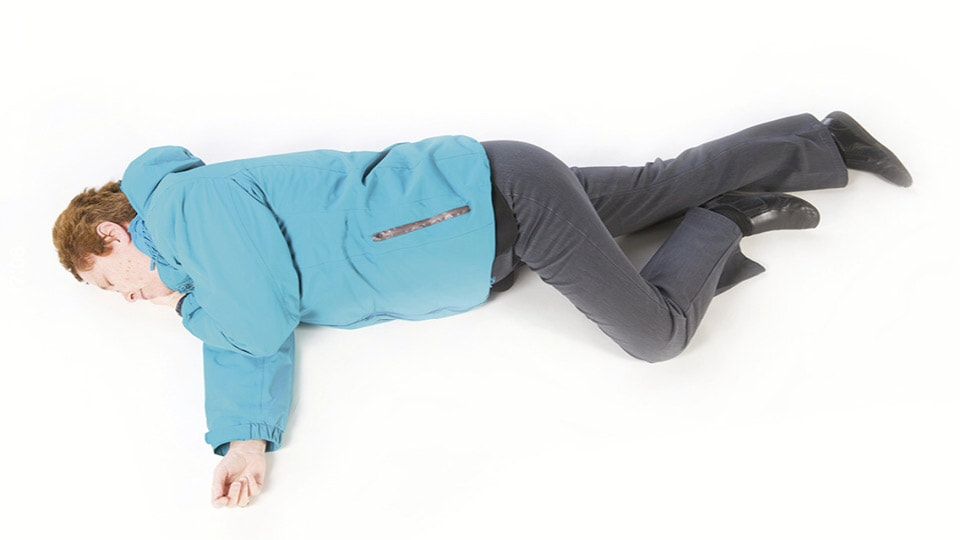
B - Breathing Check that the casualty is breathing normally. Look for chest movements, look and listen for breathing, and feel for breath on your cheek.
If there are no signs of breathing, start CPR. Interlock your fingers, place them in the centre of the casualty’s chest and press down hard and fast – around 5 to 6 centimetres and about twice a second. You may only need one hand for a child and shouldn’t press down as far. For infants, use two fingers in the middle of the chest and press down about a third of the chest depth. Don’t stop until the casualty starts breathing again or a medical professional takes over.
C - Circulation If the casualty is responsive and breathing, check for signs of bleeding. Protect yourself from exposure to blood and check for anything that may be in the wound, such as glass. Don’t remove anything that’s stuck in the wound. Taking care not to press on the object, build up padding on either side of the object. If nothing is embedded, apply firm pressure over the wound to stem the flow of blood. As soon as practical, fasten a pad to the wound with a bandage or length of cloth. Use the cleanest material available.
Burns
Put out any flames, taking care for your own safety. Cool the burn for at least 20 minutes with plenty of clean, cool water. Cover the burn with cling film if available. Don’t try to remove anything that’s sticking to the burn.
Be prepared
Always carry a first aid kit – you might never need it, but it could save a life. Learn first aid – you can get first aid training from a qualified organisation such as St John Ambulance, St Andrew’s First Aid, British Red Cross, or any suitable, qualified body
Annex 8 - Safety code for new drivers
The following information was compiled with the help of St John Ambulance, the British Heart Foundation and the British Red Cross. It’s intended as a general guide for those without first-aid training but shouldn’t be considered a substitute for proper training. Any first aid given at the scene of an incident should be looked on only as a temporary measure until the emergency services arrive.
1. Deal with danger
Further collisions and fire are the main dangers following a crash. Approach any vehicle involved with care, watching out for spilt oil or broken glass. Switch off all engines and, if possible, warn other traffic. If you have a vehicle, switch on your hazard warning lights. Stop anyone from smoking, and put on the gloves from your first-aid kit if you have one.
2. Get help
If you can do so safely, try to get the help of bystanders. Get someone to call the appropriate emergency services on 999 or 112 as soon as possible. They’ll need to know the exact location of the incident (including the direction of traffic, for example, northbound) and the number of vehicles involved. Try to give information about the condition of any casualties, for example, if anyone is having difficulty breathing, is bleeding heavily, is trapped in a vehicle or doesn’t respond when spoken to.
3. Help those involved
DO NOT move casualties from their vehicles unless there’s the threat of further danger. DO NOT remove a motorcyclist’s helmet unless it’s essential. DO try to keep casualties warm, dry and as comfortable as you can. DO give reassurance confidently and try not to leave them alone or let them wander into the path of other traffic. DO NOT give them anything to eat or drink.
4. Provide emergency care
Remember the letters D R A B C:
D - Danger Check that you are not in danger.
R - Response Try to get a response by gently shaking the casualty’s shoulders and asking loudly ‘Are you all right?’ If they respond, check for injuries.
A - Airway If there’s no response, open the casualty’s airway by placing your fingers under their chin and lifting it forward.
B - Breathing Check that the casualty is breathing normally. Look for chest movements, look and listen for breathing, and feel for breath on your cheek.
If there are no signs of breathing, start CPR. Interlock your fingers, place them in the centre of the casualty’s chest and press down hard and fast – around 5 to 6 centimetres and about twice a second. You may only need one hand for a child and shouldn’t press down as far. For infants, use two fingers in the middle of the chest and press down about a third of the chest depth. Don’t stop until the casualty starts breathing again or a medical professional takes over.
C - Circulation If the casualty is responsive and breathing, check for signs of bleeding. Protect yourself from exposure to blood and check for anything that may be in the wound, such as glass. Don’t remove anything that’s stuck in the wound. Taking care not to press on the object, build up padding on either side of the object. If nothing is embedded, apply firm pressure over the wound to stem the flow of blood. As soon as practical, fasten a pad to the wound with a bandage or length of cloth. Use the cleanest material available.
Burns
Put out any flames, taking care for your own safety. Cool the burn for at least 20 minutes with plenty of clean, cool water. Cover the burn with cling film if available. Don’t try to remove anything that’s sticking to the burn.
Be prepared
Always carry a first aid kit – you might never need it, but it could save a life. Learn first aid – you can get first aid training from a qualified organisation such as St John Ambulance, St Andrew’s First Aid, British Red Cross, or any suitable, qualified body
Introduction
Who The Highway Code is for, how it’s worded, the consequences of not following the rules, self-driving vehicles, and the hierarchy of road users (Rules H1 to H3).
This Highway Code applies to England, Scotland and Wales. The Highway Code is essential reading for everyone.
The aim of The Highway Code is to promote safety on the road, whilst also supporting a healthy, sustainable and efficient transport system.
Wording of The Highway Code
Knowing and applying the rules. Many of the rules in The Highway Code are legal requirements, and if you disobey these rules you are committing a criminal offence. You may be fined, given penalty points on your licence or be disqualified from driving. In the most serious cases you may be sent to prison. Such rules are identified by the use of the words ‘MUST/MUST NOT’. In addition, the rule includes an abbreviated reference to the legislation which creates the offence.
Although failure to comply with the other rules of The Highway Code will not, in itself, cause a person to be prosecuted, The Highway Code may be used in evidence in any court proceedings under the Traffic Acts (see The road user and the law) to establish liability. This includes rules which use advisory wording such as ‘should/should not’ or ‘do/do not’.
Knowing and applying the rules
Knowing and applying the rules contained in The Highway Code could significantly reduce road casualties. Cutting the number of deaths and injuries that occur on our roads every day is a responsibility we all share. The Highway Code can help us discharge that responsibility. Further information on driving/riding techniques can be found in ‘The Official DVSA Guide to Driving – the essential skills’ and ‘The Official DVSA Guide to Riding – the essential skills’.
gov.uk
Self-driving vehicles
By ‘self-driving vehicles’, we mean those listed as automated vehicles by the Secretary of State for Transport under the Automated and Electric Vehicles Act 2018.
To check if your vehicle is self-driving, visit Self-driving vehicles listed for use in Great Britain.
These vehicles are capable of safely driving themselves when the self-driving function is correctly turned on and the driver follows the manufacturer’s instructions. While the vehicle is driving itself, you do not need to monitor it.
Self-driving vehicles differ from vehicles that are fitted only with assisted driving features (like cruise control and lane-keeping assistance). Assisted driving features can do some of the driving, but the driver still needs to be responsible for driving at all times. If you are driving a vehicle using only its assisted driving features, Rule 150 applies.
A self-driving vehicle’s ability to drive itself may be limited to certain situations or parts of a journey. Things like the type of road, time of day, weather, location and speed may affect this. You should follow the manufacturer’s instructions about when and how to use the self-driving function safely.
While a self-driving vehicle is driving itself in a valid situation, you are not responsible for how it drives. You may turn your attention away from the road and you may also view content through the vehicle’s built-in infotainment apparatus, if available.
But you MUST still follow all relevant laws
- You MUST be fit to drive (for example, you must be within the drink-drive legal limits and not be under the influence of drugs). See Rules 90 to 96.
- The vehicle MUST be road legal (for example, it must have an MOT certificate, if applicable, and it must be taxed and insured). The vehicle must be roadworthy (see Rules 89 and 97; and Annexes 3 and 6). You will also still be responsible for your passengers and anything else you are carrying (see Rules 98 to 102).
- You MUST NOT do anything illegal – like using a handheld mobile phone, or similar hand-held device. There are exceptions to this, which are set out in Rule 149.
If a self-driving vehicle needs to hand control back to the driver, it will give you enough warning to do this safely. You MUST always be able and ready to take control, and do it when the vehicle prompts you. For example, you should stay in the driving seat and stay awake. When you have taken back control or turned off the self-driving function, you are responsible for all aspects of driving.
Hierarchy of Road Users
Rule H1
It is important that ALL road users are aware of The Highway Code, are considerate to other road users and understand their responsibility for the safety of others.
Everyone suffers when road collisions occur, whether they are physically injured or not. But those in charge of vehicles that can cause the greatest harm in the event of a collision bear the greatest responsibility to take care and reduce the danger they pose to others. This principle applies most strongly to drivers of large goods and passenger vehicles, vans/minibuses, cars/taxis and motorcycles.
Cyclists, horse riders and drivers of horse drawn vehicles likewise have a responsibility to reduce danger to pedestrians.
None of this detracts from the responsibility of ALL road users, including pedestrians, cyclists and horse riders, to have regard for their own and other road users’ safety.
Always remember that the people you encounter may have impaired sight, hearing or mobility and that this may not be obvious.
Rule H2 – Rule for drivers, motorcyclists, horse drawn vehicles, horse riders and cyclists
At a junction you should give way to pedestrians crossing or waiting to cross a road into which or from which you are turning.
You MUST give way to pedestrians on a zebra crossing, and to pedestrians and cyclists on a parallel crossing (see Rule 195).
Pedestrians have priority when on a zebra crossing, on a parallel crossing or at light controlled crossings when they have a green signal.
You should give way to pedestrians waiting to cross a zebra crossing, and to pedestrians and cyclists waiting to cross a parallel crossing.
Horse riders should also give way to pedestrians on a zebra crossing, and to pedestrians and cyclists on a parallel crossing.
Cyclists should give way to pedestrians on shared use cycle tracks and to horse riders on bridleways.
Only pedestrians may use the pavement. Pedestrians include wheelchair and mobility scooter users.
Pedestrians may use any part of the road and use cycle tracks as well as the pavement, unless there are signs prohibiting pedestrians.
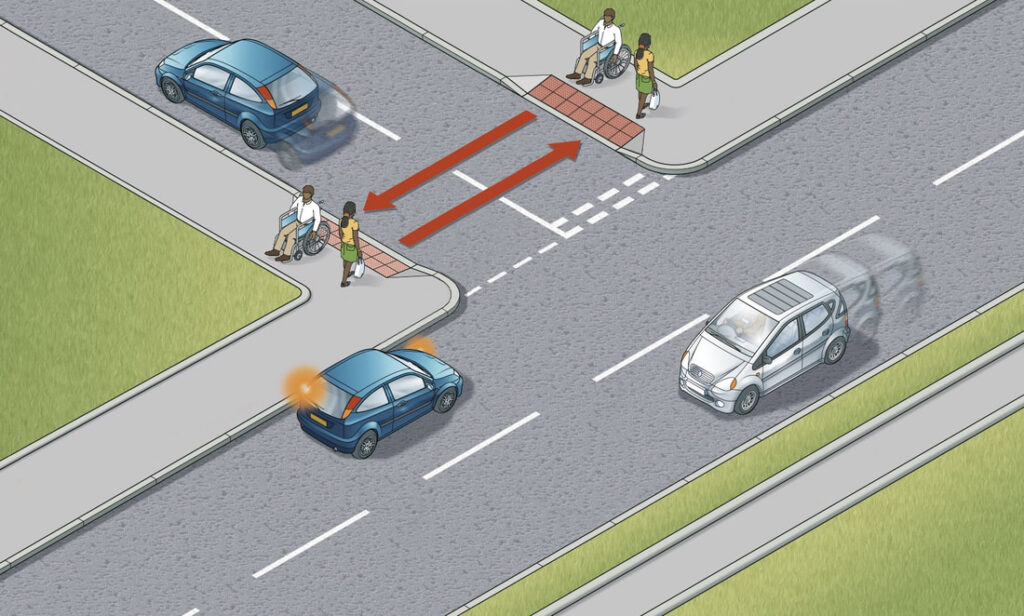
Rule H2: Wait for the pedestrian to cross the junction before turning. This applies if you are turning right or left into the junction.
Rule H3 – Rule for drivers and motorcyclists
You should not cut across cyclists, horse riders or horse drawn vehicles going ahead when you are turning into or out of a junction or changing direction or lane, just as you would not turn across the path of another motor vehicle. This applies whether they are using a cycle lane, a cycle track, or riding ahead on the road and you should give way to them.
Do not turn at a junction if to do so would cause the cyclist, horse rider or horse drawn vehicle going straight ahead to stop or swerve.
You should stop and wait for a safe gap in the flow of cyclists if necessary. This includes when cyclists are:
- approaching, passing or moving off from a junction
- moving past or waiting alongside stationary or slow-moving traffic
- travelling around a roundabout
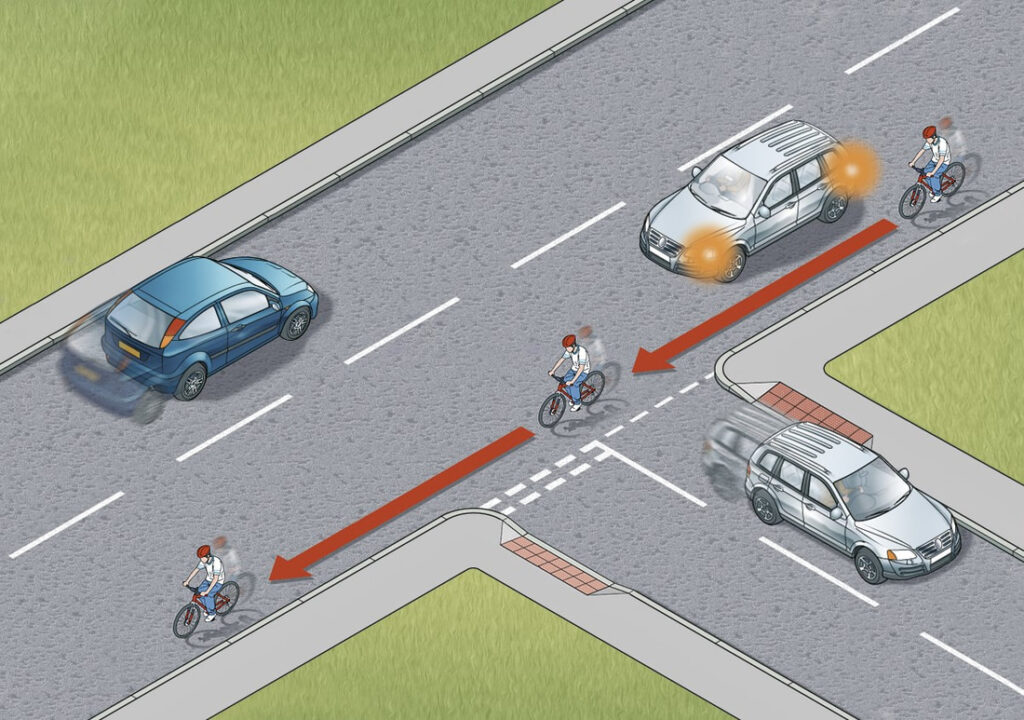
Rule H3: Wait for the cyclist to pass the junction before turning. This also applies if there is a cycle lane or cycle track and if you are turning right or left into the junction.
Subscribe for Highway Code News